

Free Delivery. Exclusive Deals. All Prime.
Prime members save on shipping and get first access to deals, plus Prime Video included. 30 days free.
The first cold morning is a rude time to learn that the family car only clicks politely from the driveway. Professional automotive battery testers help you check battery health, cranking strength and charging output before winter turns a weak battery into a schedule problem. After comparing 6 models, the Topdon Battery Tester is our top pick because it covers 12V testing, includes hand crank support and uses a 3.5-inch screen. The Foxwell Battery Tester is the alternative pick for 24V coverage with hand crank support.

Pros
- Tests 12V and 24V lead-acid batteries
- Supports CCA 100 to 2000A
- 3.5 inch color screen with intuitive interface
- Built-in printer for immediate reports
- Data playback saves the last test result
Cons
- Mini-USB software updates are Windows only
- Limited to lead-acid battery types listed
- Weighs about 2.84 pounds
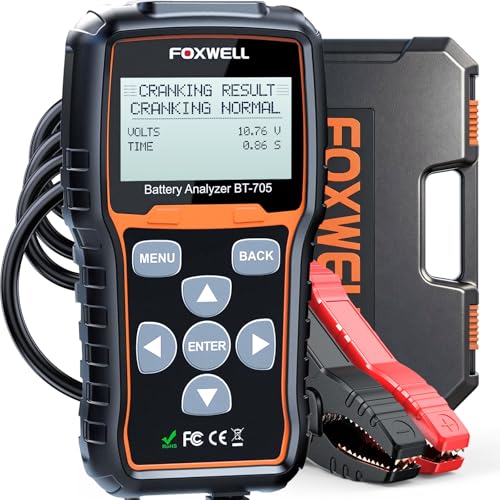
Pros
- Tests 12V and 24V battery systems across 100-2000 CCA range
- 5.9 ft cable allows one-person testing from driver's seat
- Clear results displayed as GOOD, RECHARGE, or REPLACE
- Compatible with Flooded, AGM, GEL, and EFB lead-acid batteries
- Includes hard carrying case for protection and organization
Cons
- Requires step-by-step guidance on screen for each test
- Limited to lead-acid battery types only
- Device dimensions may be bulky for compact storage spaces

Pros
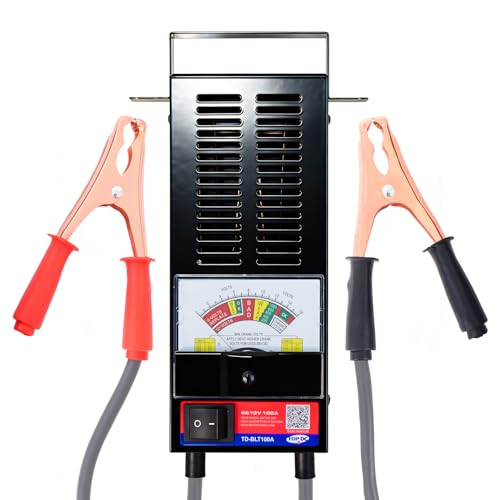
- Tests 3 functions with one device: battery health, charging system, and starter motor draw
- Handles both 6V and 12V batteries up to 1,000 CA with heavy load capacity
- Compatible with motorcycles, ATVs, cars, trucks, boats, RVs, and lawn tractors
- Analog meter provides quick results with simple rocker switch operation
- Built by Schumacher Electric, a manufacturer since 1947
Cons
- Weighs 2 pounds and measures 37.6 x 17.3 x 9.4 inches, requiring bench or storage space
- Analog meter may be less precise than digital displays for detailed diagnostics
- Does not test batteries larger than 1,000 CA

Pros
- Tests 12V and 24V battery systems
- Supports lead-acid and lithium-ion batteries
- Checks SOC, SOH, voltage and internal resistance
- 2.4-inch color TFT screen with day and night modes
- 31.5-inch cables help reach battery connections
Cons
- Gets power from the battery being tested
- Only supports 12V and 24V systems listed
- No customer review details provided
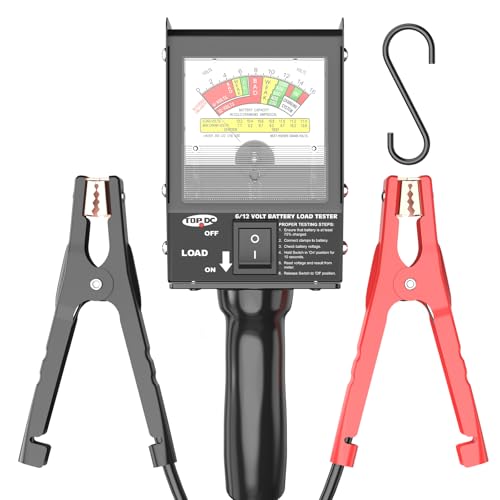
Pros
- 130 amp load tester for 6V and 12V batteries
- Large LCD shows voltage from 0 to 16V
- Anti-slip clamps fit top-post and side-post terminals
- Works with flooded, AGM, and gel lead-acid batteries
- Hanging hook and side slot support storage and carry
Cons
- For 6V and 12V lead-acid batteries only
- No warranty terms listed in the product data
- 11 x 5 x 4 inch size may take toolbox space

Pros
- Tests 12V lead acid batteries from 100-2000 CCA
- 3 inch color LCD screen displays results in 9 languages
- Evaluates battery health, alternator output, and charging system
- Real-time wave display shows detailed performance curves
- Compact design at 5.9 x 0.9 x 3.3 inches
Cons
- Only compatible with 12V lead acid batteries
- Requires learning curve to interpret wave display data
- No data provided on durability or long-term reliability
What We Looked For in Professional Battery Testers
Cold weather exposes weak batteries, but a useful tester should do more than show a simple voltage number. The strongest picks give clear information on battery condition, starting performance and charging output without forcing the user to decode every reading.
- What it measures: A professional battery tester should cover voltage and battery condition, and the better models add cranking and charging checks. The Topdon Battery Tester supports 12V battery testing and checks rated CCA, cranking systems and charging systems. Its 100 to 2000A CCA range matters because the same tool can be used across small vehicles and heavier applications.
- Display and readability: A readable screen is not a luxury when you are standing over an engine bay in winter light. Among our picks, screen sizes range from a 2.4-inch color TFT display to a 3.5-inch color screen. Two picks use color displays of at least 3 inches, which gives more room for summarized results and menu prompts.
- Compatible battery types: Battery support varies widely, so we favored models that cover more than a basic flooded 12V battery. The Ancel Battery Tester supports 12V and 24V systems, and it works with lead-acid and lithium-ion batteries. It also lists AGM, GEL, regular flooded and EFB support, which is useful when one household has a car, truck, RV or motorcycle.
- Build quality and leads: Lead length can decide whether one person can read the display from the driver’s seat during a cranking check. One pick has a 5.9-foot test cable, while another lists 31.5-inch cables for reaching harder battery connections. Protective housings, reinforced clamps and included storage are also useful because battery testers tend to live in garages, trunks and shop drawers.
- Safety features: Battery testing involves live terminals, so reverse connection protection and short-circuit protection are worth prioritizing. The Motopower Battery Tester is built for 12V batteries and covers 100 to 2000 CCA lead-acid batteries. It also reports internal resistance and charging status, which gives more context than voltage alone when deciding whether a battery is only discharged or likely near replacement.
We excluded jump starters and battery chargers because those solve different problems than diagnosis, and they are better handled separately. We also excluded shop-grade workshop compressors for tools because compressed air is a different job than checking a vehicle battery before winter.
Other Battery Testers Worth Considering
These are other battery testers we looked at but did not put on our main list.
If you would rather consider a simpler 6V unit, Vdiagtool Battery Tester is an alternative with hand crank support and a different size and feature mix. Compared with our top pick, it is less clearly positioned for broad 12V vehicle coverage.
For shoppers focused on a 12V setup, Uhanbut Battery Tester is another alternative with a different feature mix. It may suit a narrower garage, but our main picks give clearer coverage for cranking or charging checks across more vehicle types.
Acclope Battery Tester also centers on 6V use with hand crank support, which puts it closer to older or smaller battery work. That narrower voltage focus is the main reason it sits outside the main list, where several picks cover 12V and 24V systems.
And if 12V testing with hand crank support is the whole reason you are shopping, Konnwei Battery Tester is worth a look as an alternative. Our main list still has the edge for readers who want more detail on display size, battery chemistry support and measured ranges.
FAQs
What should a professional automotive battery tester measure before winter?
Look for voltage, CCA, battery health, cranking performance and charging output. Among our picks, CCA coverage reaches 100 to 2000A on several models, which is broad enough for many passenger vehicles and heavier applications.
Is 12V support enough for most drivers?
For many passenger cars, 12V support is the key requirement. If you also maintain trucks, RVs or commercial vehicles, 24V support can matter because several picks are designed for both 12V and 24V systems.
Does display size matter on a battery tester?
Yes, especially when you want clear pass, recharge or replace guidance without squinting. Our picks range from a 2.4-inch color display to a 3.5-inch color screen, while one model uses a highly visible analog meter instead.
What winter safety habits should go with battery checks?
A battery tester helps avoid a no-start situation, but winter vehicle safety also includes exhaust awareness. According to the Centers for Disease Control and Prevention, a snow-blocked tailpipe can cause carbon monoxide, an odorless and colorless gas, to build up quickly inside a vehicle.
Sources
- Clear Snow from Tailpipes, Centers for Disease Control and Prevention. CDC warning about snow-blocked vehicle tailpipes.
- Safety Guidelines: During & After a Winter Storm, Centers for Disease Control and Prevention. Winter heating safety for space heaters, kerosene heaters and carbon monoxide.




Write Your Review
No reviews yet. Be the first to share your experience!