

Free Delivery. Exclusive Deals. All Prime.
Prime members save on shipping and get first access to deals, plus Prime Video included. 30 days free.
The garage flashlight dies, the remote eats its last AA, and the car hesitates on the first cold morning, naturally all before coffee. Battery testers solve that guessing game by showing whether power is healthy, low or ready for replacement. After comparing 6 models, the Ancel Battery Tester stands out for 12V coverage, a 100 to 2000 CCA range and hand crank use. The Vtechology Battery Tester is the simpler alternative for 1.5V household cells.

Pros
- Tests 12V batteries from 100-2000 CCA with support for multiple battery types
- Reads State of Health, State of Charge, voltage, current, and cranking/charging system
- Built-in 4-in-1 protection against reverse polarity, short circuits, overcurrent, overvoltage
- Black-and-white screen with adjustable contrast and white backlight for all-light visibility
- Works with cars, trucks, boats, RVs, ATVs, and other 12V vehicles over 30Ah
Cons
- Not compatible with 6V, 8V, 24V batteries, or motorcycles below 30Ah
- Requires entering exact battery type and CCA rating for accurate results
- Cannot test lithium batteries

Pros
- Tests 7 battery types: AA, AAA, C, D, 9V, 1.5V, and button batteries
- Requires no separate battery to operate
- Compact and lightweight at 4.13 x 1.57 x 0.78 inches
- Color-coded analog display shows good, low, or replace status
Cons
- Estimates voltage only; does not measure battery capacity precisely
- Continuous testing drains the battery being checked
- Limited to testing household batteries, not vehicle-specific power

Pros
- Tests 12V lead-acid batteries across 100-2000 CCA range
- Works with multiple battery types: AGM, EFB, GEL, and flooded
- Compatible with cars, motorcycles, trucks, RVs, ATVs, boats, and more
- Provides SOH, SOC, voltage, current, and rating data
- Compact size fits in glove box or center console
Cons
- Requires proper clamp attachment to power on; cannot be pre-charged
- Three LED colors may require interpretation experience for some users
- No information provided on battery life or device durability

Pros
- Tests 12+ battery types including AA, AAA, C, D, 9V, and button cells
- LCD screen displays battery health status in three conditions: poor, weak, good
- Compact and lightweight at 0.2535 pounds with anti-slip grip
- Quick results help avoid unnecessary recharges and extend battery life
- Includes 1 AAA battery and 18-month warranty
Cons
- Cannot test or be powered by rechargeable batteries
- Small 5.2 x 3.46 x 0.94 inch size may be difficult for some users to handle
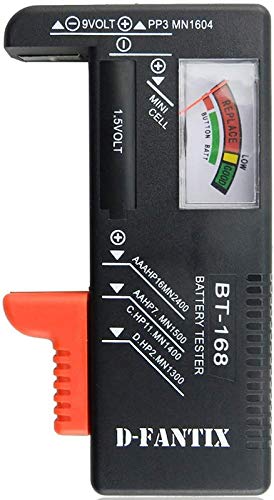
Pros
- Tests 7 battery types: AA, AAA, C, D, 1.5V, 9V, and button batteries
- Requires no batteries to operate - powered by the battery being tested
- Color-coded analog display clearly shows good, low, or replace status
- Compact and lightweight design at 0.11 pounds for easy portability
- Helps avoid waste by identifying good batteries before disposal
Cons
- Analog display provides approximate readings, not precise capacity measurements
- Small size may be difficult for those with limited dexterity to use
- Only tests battery voltage, not actual remaining capacity accurately

Pros
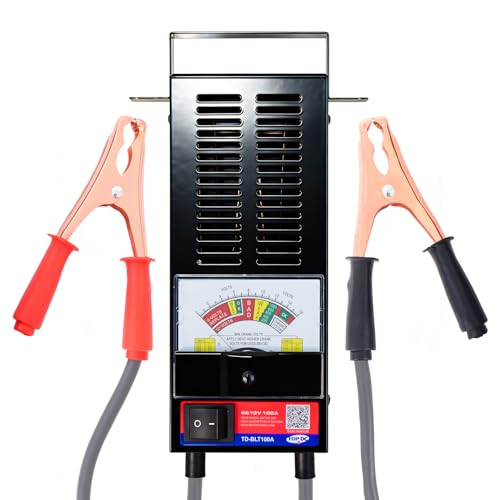
- Tests 3 functions with one device: battery health, charging system, and starter motor draw
- Handles both 6V and 12V batteries up to 1,000 CA with heavy load capacity
- Compatible with motorcycles, ATVs, cars, trucks, boats, RVs, and lawn tractors
- Analog meter provides quick results with simple rocker switch operation
- Built by Schumacher Electric, a manufacturer since 1947
Cons
- Weighs 2 pounds and measures 37.6 x 17.3 x 9.4 inches, requiring bench or storage space
- Analog meter may be less precise than digital displays for detailed diagnostics
- Does not test batteries larger than 1,000 CA
What Matters in Battery Testers for Winter Battery Checks
Cold weather exposes weak batteries quickly, so a useful checker needs to do more than flash a vague warning. For drivers, the most helpful models explain whether the battery itself, the starter or the charging system is the likely problem.
- What it measures: For a car battery, voltage alone is only part of the story. The Ancel Battery Tester is built for 12V batteries and covers a 100 to 2000 CCA range, which makes it more informative for winter starting problems than a simple household-cell gauge. It also reports State of Health, State of Charge, voltage and CCA, plus cranking and charging system checks.
- Display and readability: Among our picks, display styles split into analog needles, LED indicators, LCD bars and a black-and-white screen. Two of the household models use color zones for good, low and replace or recharge, while one pick uses an LCD to show poor, weak or good. A clear display matters when you are standing in a driveway and trying to decide whether to charge, replace or keep driving.
- Compatible battery types: The Topdon Battery Tester is a 12V option for lead-acid batteries, including regular flooded, AGM, EFB and GEL types. Its stated 100 to 2000 CCA coverage suits many cars, trucks, RVs, boats and lawn equipment. For household use, other picks cover AA, AAA, C, D, 9V and button cells, so the right choice depends on whether winter car starting or drawer-battery sorting is the job.
- Build quality and leads: Automotive models depend on clamps, because a poor connection can make a reading less useful. Two of our vehicle-focused picks specify copper clamps, and one adds reinforced ABS housing for garage durability. The smaller household units are built around compact bodies, with one pick described as pocket-friendly and another as lightweight.
- Safety features: The Schumacher Electric Battery Tester covers 6V and 12V batteries, with a 50-amp load test for 6V and a 100-amp load test for 12V. That makes it relevant for motorcycles, lawn tractors, cars, light trucks and RV batteries. Across the group, safety-minded features include reverse-polarity protection, short-circuit protection, overcurrent protection and overvoltage protection.
We excluded jump starters and battery chargers because they solve a different problem after the battery is already weak or dead. We also excluded shop-grade workshop compressors for tools, which are a different job than tire inflation and not a battery-health check.
Other Battery Testers Worth Considering
These are other battery testers we looked at but did not put on our main list.
If you want another vehicle-focused checker, Motopower Battery Tester is a 12V alternative with hand crank use and a different size and feature mix. Compared with our top pick, the tradeoff is that the main list prioritizes a stated 100 to 2000 CCA range and multiple system checks for winter starting decisions.
For buyers who put warranty coverage high on the list, Kkeanic Battery Tester offers a 1-year warranty and a different size and feature mix. That may appeal if support terms matter more than the main list’s split between 12V car diagnostics and 1.5V household-cell checking.
Gardner Bender Battery Tester keeps the focus on 12V use, which can be enough for basic vehicle battery checks. Our main 12V picks go further by listing cranking, charging or load-related functions, so they give more context when a cold-start problem could involve the battery or the vehicle’s electrical system.
And if 6V coverage is the reason you are shopping, OBDResource Battery Tester is another alternative with that lower-voltage capability. Our main list includes a 6V and 12V load-test option, which is useful if you want one tool for both smaller batteries and standard vehicle batteries.
FAQs
What should a battery tester measure before winter?
For a car battery, look for more than voltage if you want a clearer winter-readiness check. Our vehicle-focused picks include 12V testing, and some add CCA, State of Health, State of Charge, cranking checks or charging checks.
Is a household battery tester enough for a car battery?
No, a household unit for AA, AAA, C, D, 9V or button cells is not the same tool as a car battery tester. The car-focused picks are built around 12V batteries, while one load-test option also covers 6V batteries.
Do battery testers need their own batteries?
Several simple household checkers are powered by the battery being checked, so they do not need a separate internal battery. One LCD household pick includes 1 AAA battery, so it is worth checking the power requirement before choosing.
What winter safety steps matter besides checking the battery?
According to the Centers for Disease Control and Prevention, a snow-blocked tailpipe can cause carbon monoxide to build up quickly inside a vehicle. Before driving in snowy conditions, check that the tailpipe is clear of snow, and use a battery-operated carbon monoxide detector at home during winter heating season.
Sources
- Clear Snow from Tailpipes, Centers for Disease Control and Prevention. CDC warning about snow-blocked vehicle tailpipes.
- Safety Guidelines: During & After a Winter Storm, Centers for Disease Control and Prevention. Winter heating safety for space heaters, kerosene heaters and carbon monoxide.



Write Your Review
No reviews yet. Be the first to share your experience!