

Free Delivery. Exclusive Deals. All Prime.
Prime members save on shipping and get first access to deals, plus Prime Video included. 30 days free.
The morning the dash clicks, the headlights dim, and your coffee is still too hot to drink is a bad time to guess. Battery tester automotives help show voltage, starting strength and charging behavior before winter makes weak batteries obvious. After comparing 6 models, the Topdon Battery Tester is the top pick for 12V coverage, hand crank checks and a 1-year warranty. The Schumacher Electric Battery Tester is the alternative pick for drivers who also need 6V testing.

Pros
- Tests 12V and 24V batteries with 99.9% accuracy across 100-2000 CCA range
- 3-in-1 diagnostics includes cranking, charging, and overall battery health tests
- Operates reliably in extreme temperatures from -4°F to 140°F
- 2.4-inch color LCD display remains readable in direct sunlight
- Compatible with cars, SUVs, trucks, RVs, boats, motorcycles, and equipment
Cons
- Only works with 12V and 24V batteries, not suitable for other voltages
- Requires direct connection to battery terminals for testing
- 1-year warranty is limited compared to some competitor products

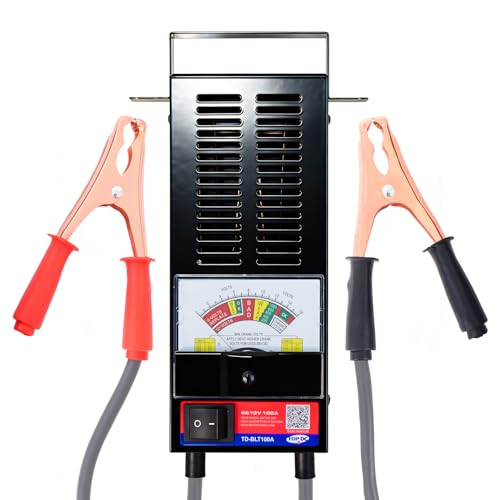
Pros
- Tests 3 functions with one device: battery health, charging system, and starter motor draw
- Handles both 6V and 12V batteries up to 1,000 CA with heavy load capacity
- Compatible with motorcycles, ATVs, cars, trucks, boats, RVs, and lawn tractors
- Analog meter provides quick results with simple rocker switch operation
- Built by Schumacher Electric, a manufacturer since 1947
Cons
- Weighs 2 pounds and measures 37.6 x 17.3 x 9.4 inches, requiring bench or storage space
- Analog meter may be less precise than digital displays for detailed diagnostics
- Does not test batteries larger than 1,000 CA

Pros
- Tests 12V batteries from 100-2000 CCA across all types
- 99.7% testing accuracy with results in milliseconds
- Tests battery, alternator, starter, and charging system
- Works on batteries both in-vehicle and out-of-vehicle
- Galvanized alloy clips provide durability and safety
Cons
- Limited to 12V systems only, not for other voltages
- Requires direct battery connection for each test
- No warranty information provided in product data
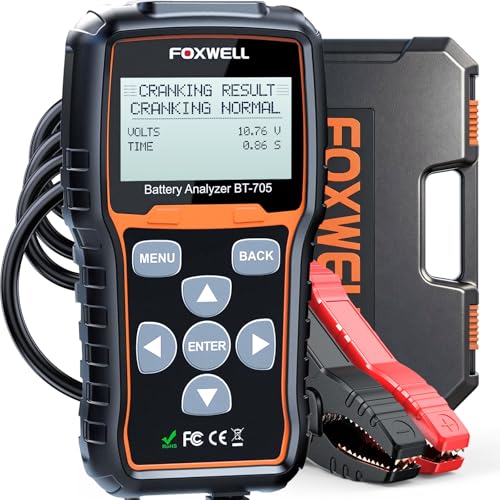
Pros
- Tests 12V and 24V battery systems across 100-2000 CCA range
- 5.9 ft cable allows one-person testing from driver's seat
- Clear results displayed as GOOD, RECHARGE, or REPLACE
- Compatible with Flooded, AGM, GEL, and EFB lead-acid batteries
- Includes hard carrying case for protection and organization
Cons
- Requires step-by-step guidance on screen for each test
- Limited to lead-acid battery types only
- Device dimensions may be bulky for compact storage spaces
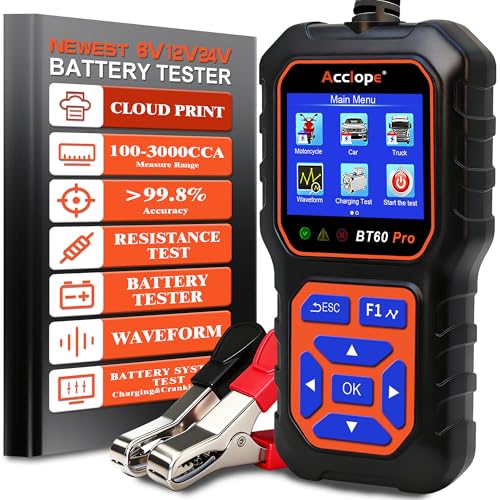
Pros
- Tests 6V, 12V, and 24V batteries with CCA range of 100-3000
- Supports multiple battery types: lead-acid, AGM, GEL, EFB, and lithium
- QR code cloud printing for easy result sharing and record-keeping
- Built-in LED light and wide-mouth clamps for safe testing in low light
- 3.2-inch HD screen with intuitive menu in 12 languages
Cons
- LiFePO4 lithium battery CCA results not guaranteed, voltage/health only
- Not compatible with 48V systems or OBD2 diagnostic functions
- Cannot perform load testing; conductance-based diagnostics only
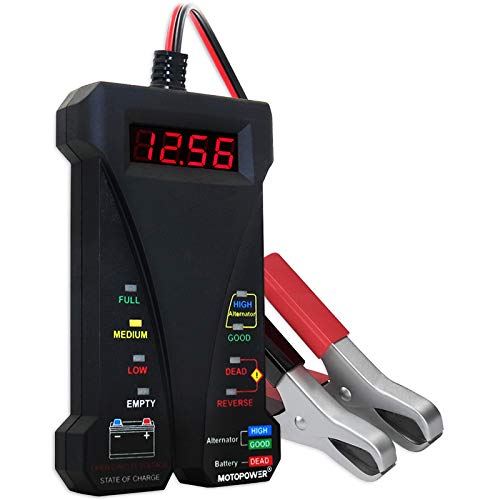
Pros
- Plug-and-test design requires no complex setup procedures
- Dual indication with 4-digit LCD display and 8 LED indicators
- Reverse connection and over-voltage protection included
- 50cm extension cable with 30A alligator clips for flexible use
- Compact and lightweight at 150 grams for easy portability
Cons
- Testing range of 4-20V DC limits use to 12V systems only
- No information provided about accuracy of LED indicators
- Requires manual interpretation of 8 different LED status indicators
What Matters in Automotive Battery Testers Before Winter
Cold weather turns a marginal battery into a practical problem, so a tester needs to do more than show a vague good or bad result. The most useful battery testers combine measurable battery health information with readable output and clamps that make a clean connection.
- What it measures: A useful winter battery check should cover voltage and CCA, because a battery can show voltage but still struggle under starting load. Among our picks, CCA coverage runs from 100 to 3000 on models that report it, while load testing includes 50 amps on 6V batteries and 100 amps on 12V batteries on one analog option. The Topdon Battery Tester focuses on 12V systems, includes hand crank checks and adds a 1-year warranty, which fits drivers who want battery, cranking and charging information in one tool.
- Display and readability: A tester that is hard to read in a driveway is less useful when the temperature drops. Our picks include screens from 2.4 inches to 3.2 inches, plus one analog meter and one compact LCD style that reads voltage to 0.01 volts. The Konnwei Battery Tester is a 12V option with hand crank checks, and its readout is meant to report voltage, internal resistance, CCA, battery health and charge status without requiring a separate meter.
- Compatible battery types: Battery type matters because a tester built only for one chemistry can give limited information on another. Across the main list, compatibility includes regular flooded, AGM, GEL and EFB lead acid batteries, while one pick also supports lithium voltage and health checks. Voltage support ranges from 6V to 24V, and that spread matters if your garage includes a motorcycle, car, truck, boat or RV.
- Build quality and leads: Leads and clamps affect whether the tester can stay connected while you start the vehicle. One pick has a 5.9 foot test cable, which is long enough to reach from the battery area to the driver seat for one person cranking checks. The Foxwell Battery Tester supports 24V systems and hand crank checks, and that longer cable gives it a practical edge for trucks and other larger vehicles.
- Safety features: Battery testing can involve awkward angles, corroded terminals and low light, so protection features are worth noting. In the group, safety details include reverse connection protection, over voltage protection, wide mouth clamps and a built in LED light on one model. According to the Centers for Disease Control and Prevention, drivers should also check that a vehicle tailpipe is clear of snow before driving, because a blocked tailpipe can let carbon monoxide build up quickly inside the vehicle.
We excluded jump starters and battery chargers because those solve a different problem after the battery is weak or dead. We also left out shop grade workshop compressors for tools, since that is a different job than tire inflation and unrelated to checking battery health.
Other Battery Testers Worth Considering
These are other battery testers we looked at but did not put on our main list.
If you want a simpler 6V option with a hand crank layout, Topdc Battery Tester stays close to the alternative pick in voltage coverage. Its rubber build is the main distinction, but it gives up the broader main list context where our top pick covers 12V diagnostics with a 1-year warranty.
For shoppers comparing compact 12V tools, TopDiag Battery Tester offers a hand crank design with a different size and feature mix. The reason it stayed off the main list is that several main picks pair 12V battery checks with clearer stated cranking or charging system functions.
Aneng Battery Tester is another 12V alternative for drivers who mainly want a basic battery check. It may suit a glove box role, but the main picks give more explicit measured outputs, with some covering CCA ranges that start at 100 and reach as high as 3000.
And if rubber build is a priority, Battery Tender Battery Tester combines 12V support with a hand crank layout and a rubber build. That design difference is useful, but our top pick adds the clearer warranty number, while other main picks add broader 24V or 6V coverage.
FAQs
What should drivers check before winter with a battery tester?
Start with voltage, then look for CCA or a cranking result if the tester provides it. Among our picks, CCA coverage on digital models ranges from 100 to 3000, which helps separate a charged battery from one that may struggle to start.
Is a 12V battery tester enough for most cars?
For most passenger vehicles, 12V coverage is the key requirement. If your garage includes motorcycles, small equipment or trucks, a tester with 6V or 24V support can cover more batteries with the same tool.
How important is the display on an automotive battery tester?
Display clarity matters because many checks happen outdoors or under the hood. The main list includes digital displays from 2.4 inches to 3.2 inches, plus an analog meter, so readability depends on whether you prefer guided text, numerical readouts or a needle style gauge.
What winter safety issue should drivers remember when checking a car?
According to the Centers for Disease Control and Prevention, a snow blocked tailpipe can let carbon monoxide build up quickly inside a vehicle. Before driving after snow, check that the tailpipe is clear, and keep a battery operated carbon monoxide detector in mind for broader winter safety planning.
Sources
- Clear Snow from Tailpipes, Centers for Disease Control and Prevention. CDC warning about snow-blocked vehicle tailpipes.
- Safety Guidelines: During & After a Winter Storm, Centers for Disease Control and Prevention. Winter heating safety for space heaters, kerosene heaters and carbon monoxide.




Write Your Review
No reviews yet. Be the first to share your experience!