

Free Delivery. Exclusive Deals. All Prime.
Prime members save on shipping and get first access to deals, plus Prime Video included. 30 days free.
The driveway is icy, the coffee is cooling, and the engine gives one sad click instead of starting. Car battery testers help you check battery health before winter, including whether the battery or charging system is the likely problem. After comparing 6 models, the Topdon Battery Tester stands out for 12V battery testing, 100 to 2000 CCA coverage and a hand crank related check. The Motopower Battery Tester is the alternative pick for drivers who want another 12V hand crank option.

Pros
- Tests 12V lead-acid batteries across 100-2000 CCA range
- Works with multiple battery types: AGM, EFB, GEL, and flooded
- Compatible with cars, motorcycles, trucks, RVs, ATVs, boats, and more
- Provides SOH, SOC, voltage, current, and rating data
- Compact size fits in glove box or center console
Cons
- Requires proper clamp attachment to power on; cannot be pre-charged
- Three LED colors may require interpretation experience for some users
- No information provided on battery life or device durability

MOTOPOWER MP0515A 12V Car Battery Tester Automotive 100-2000 CCA Battery Load Tester Auto Cranking and Charging System Tester
Pros
- Tests 12V lead acid batteries from 100-2000 CCA
- 3 inch color LCD screen displays results in 9 languages
- Evaluates battery health, alternator output, and charging system
- Real-time wave display shows detailed performance curves
- Compact design at 5.9 x 0.9 x 3.3 inches
Cons
- Only compatible with 12V lead acid batteries
- Requires learning curve to interpret wave display data
- No data provided on durability or long-term reliability

Pros
- Works with 12V batteries in cars, trucks, motorcycles, and other vehicles
- LED display shows real-time voltage, battery health, and charging status
- Reverse connection protection with buzzer alarm prevents wiring errors
- Over-voltage protection triggers automatically if voltage exceeds safety limits
- Compact size at 4.72 x 2.75 x 0.79 inches fits easily in any vehicle
Cons
- Only compatible with 12V battery systems, not suitable for 24V vehicles
- No information provided about measurement accuracy or calibration requirements
- LED display readability depends on ambient lighting conditions

Pros
- Tests 12V batteries from 100-2000 CCA across all types
- 99.7% testing accuracy with results in milliseconds
- Tests battery, alternator, starter, and charging system
- Works on batteries both in-vehicle and out-of-vehicle
- Galvanized alloy clips provide durability and safety
Cons
- Limited to 12V systems only, not for other voltages
- Requires direct battery connection for each test
- No warranty information provided in product data

Pros
- Tests 6V, 12V, and 24V batteries with 100-2000 CCA range
- Displays SOH and SOC data plus internal resistance in under 2 seconds
- 99.6% accuracy based on CCA standard testing
- Plug-and-play design works on batteries in or out of vehicle
- Polarity reverse connection protection prevents circuit damage
Cons
- Screen flickers if clip is not properly clamped to battery
- Compact 1.8-inch display may be difficult to read in low light
- Limited to battery testing only, does not test charging system

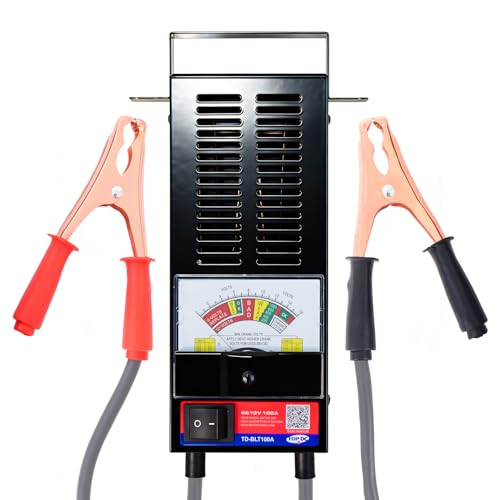
Pros
- Tests both 6V and 12V batteries up to 1000 CCA capacity
- Load test capability: 100A for 12V batteries, 50A for 6V batteries
- Diagnoses battery condition, starter motor draw, and charging system
- Insulated carry handle and color-coded clips for safe operation
- Ventilated case design prevents overheating during heavy-duty use
Cons
- Voltage accuracy of only +/- 0.2V may not catch minor issues
- Requires direct battery terminal connection, limiting remote diagnostics
- No data on portability weight or storage dimensions provided
What We Looked For in Battery Testers for Winter Battery Checks
A winter battery check is not just about seeing any voltage number on a screen. A useful tester should tell you enough about charge, starting ability and charging behavior to decide whether to drive, recharge or replace the battery before the first hard freeze.
- What it measures: The most useful picks report more than basic voltage, because a 12V battery can still be weak under starting load. Among our picks, CCA coverage reaches from 100 to 2000 on several digital models, which matters because cold cranking amps describe starting ability in cold conditions. The Topdon Battery Tester covers 12V lead acid batteries and is described with a hand crank related check, so it fits drivers who want battery, cranking and charging information in one small tool.
- Display and readability: Winter checks often happen in a dim garage or outside before work, so the display has to be readable without guessing. One pick uses a 3 inch color LCD with 240 by 320 pixels, while another uses a 1.8 inch HD screen. A few models also use LED indicators, which can be quicker to read when you only need a simple high, low or full status.
- Compatible battery types: The best spread here covers the batteries drivers are likely to see in cars, trucks, motorcycles, boats and lawn equipment. Several picks handle 12V batteries from 100 to 2000 CCA, and one main-list model also covers 6V and 24V batteries. The Konnwei Battery Tester is a 12V hand crank related option that covers flooded, AGM flat plate, AGM spiral and gel batteries, which is useful if your household has more than one vehicle type.
- Build quality and leads: Good contact at the terminals matters because a loose clamp can make a weak battery look worse than it is. One pick uses galvanized alloy clips, another uses copper clamps, and another uses red and black rubber grips to mark polarity. The Yaegoo Battery Tester is a 12V unit with rubber build details at the clips and a ventilated case, which makes sense for a traditional load tester style.
- Safety features: Reverse connection protection is worth prioritizing, especially when cold hands and a dirty battery case make the terminals harder to see. Several picks include reverse polarity protection, and one also adds over voltage protection with a buzzer alarm. Winter safety is broader than the battery, too: according to the Centers for Disease Control and Prevention, a snow blocked tailpipe can let odorless, colorless carbon monoxide build up quickly inside a vehicle.
We excluded jump starters and battery chargers because those solve different problems after a battery is already low or dead. We also left out shop grade workshop compressors for tools, because that is a different job than checking electrical health before winter driving.
Other Battery Testers Worth Considering
These are other battery testers we looked at but did not put on our main list.
If you want a simpler 12V alternative, Aneng Battery Tester keeps the focus on basic battery checking rather than the broader diagnostic menus found on some main picks. Its different size and feature mix may appeal if you only want a compact tester, but our top pick gives broader 100 to 2000 CCA context for deciding whether a battery is aging or just undercharged.
For shoppers who care most about grip and outer protection, Topdc Battery Tester brings a 6V setup with a hand crank related design and rubber build. That rubber emphasis is useful in a garage, but it is less directly aligned with the 12V vehicle focus that most of our main picks prioritize.
Acclope Battery Tester is another 6V hand crank related alternative, so it may make more sense for older equipment than for the typical modern car battery. Compared with our alternative pick, which is centered on 12V checks, this different size and feature mix is narrower for everyday passenger vehicles.
Need more reach around the engine bay? Foxwell Battery Tester lists 6.5 feet of cable along with 12V coverage and a hand crank related function. That added reach can be convenient, but the main list favors models that put more emphasis on CCA ranges, battery health readouts and charging system checks.
FAQs
What should a battery tester measure before winter?
At minimum, look for voltage, because it gives a quick picture of charge level. For a better winter check, CCA support from 100 to 2000 and a cranking or charging system test are more useful because they relate to whether the engine will start in cold weather.
Is a 12V battery tester enough for most drivers?
For most passenger cars, SUVs, motorcycles and light trucks, a 12V tester is the right starting point. Some picks also cover 6V or 24V batteries, which is helpful if you maintain older vehicles, boats or equipment in addition to a daily driver.
Do display types matter on car battery testers?
Yes, because a winter battery check may happen in low light or bad weather. The main picks include displays ranging from simple LED indicators to a 3 inch color LCD, so choose based on whether you prefer quick status lights or more detailed numbers.
What winter safety step should drivers remember after checking the battery?
Before driving in snow, check that the tailpipe is clear. The Centers for Disease Control and Prevention warns that a blocked tailpipe can cause carbon monoxide to build up quickly inside the vehicle.
Sources
- Clear Snow from Tailpipes, Centers for Disease Control and Prevention. CDC warning about snow-blocked vehicle tailpipes.
- Safety Guidelines: During & After a Winter Storm, Centers for Disease Control and Prevention. Winter heating safety for space heaters, kerosene heaters and carbon monoxide.




Write Your Review
No reviews yet. Be the first to share your experience!