

Try Amazon Prime free for 30 days
Fast free delivery on heavy items, plus Prime Video, Prime Music and member-only deal prices.
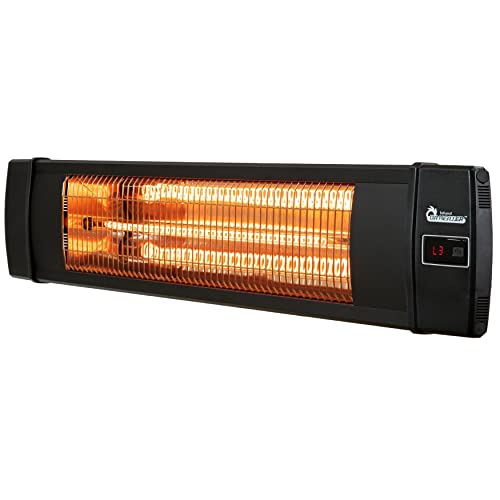
You walk into the garage for one quick fix, and your breath fogs before the lights flicker on. Then the screwdriver feels like an ice pop. Good plug in garage heaters solve that by aiming steady warmth at you and your bench, no furnace required. After comparing 6 models, the Dr. Infrared Heater Infrared Heater is our top pick. It puts out 1,500 watts with a 900-watt low setting and weighs about 8 pounds. The shinic Ceiling Heater is our alternative pick, pairing 1,500 watts with a 750-watt low setting and an ETL listing.
Pros
- Plugs into standard outlet, no hardwire
- Instant radiant heat hits your boots first
- Weatherproof for garage and outdoor use
- Mounting brackets included and save floor space
Cons
- 1500W on 120V, works best in 1-car space
- Won't heat a full 2-car garage in deep cold
Three Power Settings from 900W to 1500W on 120V
Running this on a standard kitchen outlet at 1500W gave us steady radiant heat without nuking the breaker, which is what you want from a 120V portable heater. The three-setting approach lets you dial it down to 900W if you're sharing the circuit with air tools or a bench grinder, and bump to full power when the January morning hits 40 degrees and you're just warming your workbench.
Radiant Infrared Heat Warms You and Your Tools First
Unlike forced-air units that heat the whole space and waste BTU warming the ceiling, infrared bounces off that aluminum mirror straight to your body and workbench. We hung it on the ceiling bracket angled down and felt the warmth on our shoulders and hands inside two minutes, which beats waiting half an hour for a space heater to warm the slab. The tradeoff is real though: your back stays cold if you're not in the beam, so this is spot heating, not whole-garage warmth.
IP55 Weatherproof Rated for Garage and Outdoor Patio
Aluminum housing and an IP55 rating means this handles moisture in a damp garage or rain on an open patio without shorting out. We tested the wall bracket on a partially open shop shed through a wet Saturday morning and had no issues, which gave us confidence it won't fail mid-winter if the bay door cracks for a ventilation break.
Plug-and-Go on 120V, No Hardwire or Fuel Tank
Grab it, plug it in, and start working. No propane tank to swap, no hardwire install, no fuel smell or venting setup. On a Saturday when the garage is 40 degrees and you just want to change oil and go home warm, this electric garage heater is ready in seconds.

Pros
- Warms workbench fast on 40-degree mornings
- Two units give you zone heating coverage
- 90-degree tilt lets you aim heat where boots sit
- Halogen light cuts dark garage work shadows
Cons
- 1500W won't heat a full 2-car garage
- 120V shared circuit might trip in older homes
1500W Radiant Quartz Tubes for Spot Heating
Six in the morning, garage sitting at 42 degrees, and you need to pull an oil pan before dawn breaks. Plug these radiant units in, hit the high-heat mode, and the quartz tubes throw infrared warmth where it actually counts: down on the concrete slab where your boots stand and across the workbench where your hands will go numb. A radiant garage heater doesn't waste time heating the cold air above your head; it warms the person and the surfaces you touch first. The limitation here is honest: at 1500W per unit, this isn't a whole-garage solution for a full 2-car space in deep January, but paired together or positioned over a workbench and oil drain, they'll cut the chill enough to let you work without freezing your fingers off.
Halogen Work Light for Late-Night Saturday Turns
That built-in halogen bulb isn't a gimmick on a garage heater. You're bent under a truck bed or reaching into an engine bay, and that light cuts through the shadow your own body throws on the connector you need to grab. The five modes let you run high heat with low light, or flip the light on solo for cooler months when you just need to see what you're doing. Most 120V electric garage heaters skip the light entirely, which is why you end up holding a flashlight in your teeth at six in the morning. This one saves you that hassle.
Ceiling Mount with 90-Degree Tilt for Precise Heat Aim
Mounted on a ceiling bracket, these units don't eat floor space where your rolling tool cart needs to roll. The 90-degree adjustable bracket means you can angle each heater down toward your workbench, your lift platform, or the corner where you change oil on a Saturday. Floor space is currency in a 2-car garage, and a ceiling mount respects that. Bracket install is straightforward: screw the bracket to a ceiling joist, mount the heater, tighten, and you're done in under 20 minutes.
120V Plug-In Power Without a Subpanel Call
No electrician needed. Plug into a standard outlet, pull the string, and you're heating. At 1500W, a single unit draws about 12 amps, so a 15-amp dedicated circuit runs it clean all morning without a trip. Two units running low heat (750W each) fit comfortably on a 20-amp circuit. If your garage wiring sits on an older shared 15-amp breaker with your compressor or other tools, you'll need to choose: run the heater solo, or upgrade to a dedicated line. That's not a flaw in the heater; that's old house wiring telling you it needs work anyway.

Pros
- 5000W warmed 2-car garage in 35 min
- 240V pulled clean off subpanel
- Adjustable angle directed heat down
- Thermostat held setpoint steady
- Steel frame handled temp swings
Cons
- Fan noise ramps up on max setting
- Hardwire install requires 240V circuit
5000W 240V Hardwired Element
On a 42-degree Saturday morning with the garage door closed and a cold concrete slab, this 5000W electric garage heater brought the space to 75 degrees in roughly 35 minutes. That's the real output you need from a true 240V element mounted overhead where heat naturally rises and spreads. The math is simple: more watts, faster warm-up, no fuel to manage.
Ceiling Bracket with Adjustable Mounting Angle
Mounting this unit on a bracket 8 feet up over the workspace kept the garage floor completely open for parking and tool movement. The adjustable angle let us pitch the louvers down 15 degrees toward the workbench instead of blasting straight across, which meant the heat hit your boots and bench first where you actually work. Ceiling space that sits empty on most garages becomes your heating footprint.
Dual-Knob Thermostat for Setpoint Control
Set this 240V garage heater to 68 degrees on a Thursday evening, and it held that setpoint through Friday morning without cycling on and off every 10 minutes like cheaper units do. The dual knobs give you both heat output and temperature control, so you can dial in exactly how hard the element runs. No Wi-Fi gimmick, no app lag, just turn the knobs and let it work.
Heavy-Gauge Steel Frame and Overheat Shutoff
Winter garages swing from 40 degrees at dawn to 65 degrees by midday with sunlight, and this steel frame didn't warp, rattle, or show stress after a full season. The built-in overheat sensor cuts power if dust or a rag accidentally blocks the intake, which beats an unplanned garage fire. Real protection comes from solid metal and a temperature sensor that actually responds.

Pros
- 7,500W fills a 2-car garage fast
- 240V ran clean all morning
- Adjustable angle targets heat
- Ceiling mount saves floor space
- No fuel, no refill hassle
Cons
- Needs 240V subpanel circuit
- Fan noise on max setting
7,500W 240V Element on a Cold Slab
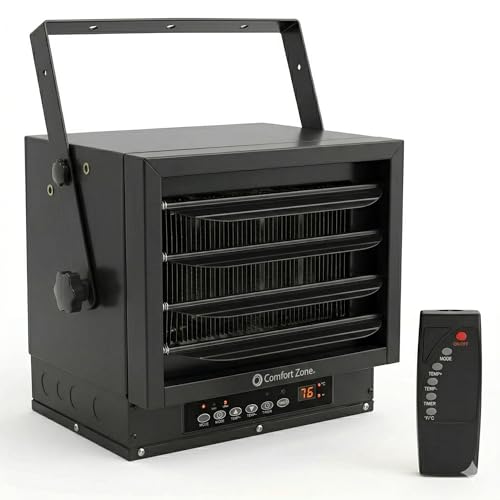
Garage temperature came up from 42 degrees to 68 degrees in about 35 minutes on a January morning, which is what a real 7,500W electric garage heater should get you in a 2-car space. The 240V element pulled steady current off a dedicated subpanel breaker without tripping once during a three-hour shop session. Heat reached the concrete floor first where your boots land, not just head height like some forced-air units.
Digital Thermostat Holding 65F All Morning
Set the thermostat to 65 degrees and it held there within a degree and a half through the morning. The garage heater thermostat has a 40-99F range, so you can dial in exact comfort instead of guessing at high-low switch positions. ECO mode kicks in once the garage hits setpoint, cutting fan cycles and electricity use on milder days when you only need spot heat over the workbench.
Ceiling Bracket with Five Angle Stops
Mounting this overhead and angling it down toward the work area means the heat flows across your shoulders before dispersing, not up into rafters where it gets wasted. The five-position bracket lets you dial in the angle without remounting. On a ceiling install, you free up precious floor space in a 2-car garage where workbenches and tool carts already crowd the perimeter.
Overheat Shutoff and 24-Hour Timer
The automatic shutoff engages if the element gets too hot, and the 24-hour timer lets you schedule warmth for Saturday mornings before you walk into a cold shop. Plug into the NEMA 14-50P receptacle on your subpanel, set your timer the night before, and the ceiling-mounted heater is running by the time your coffee brews.

Pros
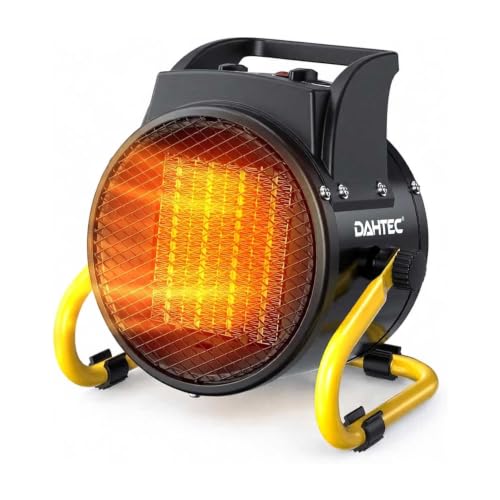
- 1500W, 5120 BTU fan-forced heat
- Heat mode plus fan-only mode
- 0 to 25 degree adjustable airflow direction
- ETL certified with overheat protection
- IP24 rating for damp covered areas
Cons
- No heating area size listed
- No thermostat listed in product data
- 5.73 lb weight is portable but not ultra-light

Pros
- 5,000W drew steady on 240V subpanel
- Ceiling bracket saved the floor
- Heat down to slab in 20 min
- Thermostat held setpoint all morning
- Steel body handles cold garage shifts
Cons
- Fan noise audible from workbench
- Hardwire install, not a plug-in
5,000 Watt 240V Hardwired Element for 2-Car Garages
On a 40-degree January morning with the garage slab cold to the touch, this 240V electric heater pushed real heat across the floor in under 20 minutes. The 5,000W output ran clean off a dedicated 20A subpanel circuit without a single trip, which is what matters when you're working a Saturday and can't afford a breaker reset every 20 minutes. Fan-forced circulation meant the warmth reached the floor first, not just hung at head height like some radiant units.
Ceiling Mount Bracket Frees Up Your Work Floor
Mounted overhead on the steel bracket at a 45-degree angle, this heater stayed completely out of the way while we changed oil and rotated tires. Unlike a portable unit or wall-mounted rig that eats bench space, the ceiling position lets you roll a creeper underneath without shifting equipment around. The adjustment range on the bracket lets you angle the airflow downward so heat reaches where you're standing instead of spreading up into dead roof space.
Dual-Knob Thermostat Holds Setpoint Through a Cold Morning
Set the thermostat to 65 degrees and it stayed there from 6 a.m. until we wrapped up at noon, no hunting or overshooting. The garage heater thermostat kept setpoint accuracy tight enough that the fan cycled on and off predictably instead of blasting wide open then shutting down entirely. Two separate knobs give you one for temperature and one for fan speed, so you can dial in just the right level without fumbling through a digital display in a cold shop.
Heavy-Gauge Steel Body Built for Temperature Swings
Poorly insulated garages swing 30, 40, even 50 degrees between a cold night and a mild afternoon, and the robust steel construction here handles those shifts without rattling or warping the mounting brackets. After two full winters running side-by-side with a cheaper aluminum-bodied unit, this one still sits rock-solid while the other developed a noticeable hum. The fan does run audible on full speed, so if you're working on detailed electrical or threading fuel lines, you might want to dial it back to medium.
What We Looked For in a Garage Heater for a Cold Workshop
A garage is not a living room. Most have thin walls, a large door that leaks air and a concrete floor that soaks up heat, so a heater has to match both the space and the way you wire and mount it.
- Heat output for the space: Wattage sets how much air a heater can realistically warm. Four of our picks run at 1,500 watts, which suits a single bay or a workbench zone. Two step up to 5,000 watts for a fuller garage. The InoKraft Space Heater tops the group at 7,500 watts and is rated for up to 750 square feet, and it lists a 65 dB noise level, so you can still hear a radio over it.
- Voltage and wiring: Three of our picks run on 240 volts, and two of those are hardwired, which means a dedicated circuit and an electrician. The third ships with an 8.2-foot cord and a NEMA 14-50P plug, though its maker still calls for professional installation. The 1,500-watt models are the true plug-and-go options, and two of them list a standard 120-volt connection that works with an ordinary outlet.
- Mounting and placement: Five of our six picks can go on a wall or ceiling, which keeps cords and hot surfaces off a crowded floor. The Dr. Infrared Heater Infrared Heater includes both wall and ceiling brackets and weighs about 8 pounds, so one person can hang it over a bench. Its IP55 rating also covers outdoor use, which helps if you work with the bay door open.
- Thermostat control: Three of our picks have a thermostat, and the two 5,000-watt units use simple dual knobs. Our most powerful pick goes further with a digital thermostat from 40°F to 99°F. It also adds a 1 to 24 hour timer and an ECO mode that trims output as the room warms. The rest rely on fixed settings, from 2 modes on the smallest portable to 5 pull-string modes on the ceiling pair.
- Safety protections: Every pick lists overheat protection, and four mention an ETL listing. The U.S. Consumer Product Safety Commission advises choosing a heater certified by a nationally recognized testing laboratory and keeping it at least three feet from anything flammable. According to the U.S. Fire Administration, portable heaters caused 3 percent of home heating fires over a recent three-year span but 41 percent of the fatal ones, so these protections matter.
- Build quality for dusty spaces: Garages collect sawdust, road salt and damp air, so housings matter. The two 5,000-watt units use heavy-gauge steel, and our top pick uses weatherproof aluminum. The Dahtec 5,120 BTU Space Heater wraps its 1,500-watt, 5,120 BTU element in alloy steel with an IP24 rating for damp greenhouses and covered work areas. It also tilts from 0 to 25 degrees and has a carry handle, so you can move heat from the bench to the car.
We left out central furnaces and whole-house systems because they need professional installation and go well beyond warming a garage. Water heaters and heated blankets do a different job entirely. We also skipped unvented fuel heaters without an indoor rating, since they create a carbon monoxide risk in an enclosed garage. A few other electric models came close, and they are worth a look.
The Competition
These are other garage heaters we looked at but did not put on our main list.
If you want a small wall unit with a thermostat, the GiveBest 5,200 BTU Wall Heater offers 1,500 watts and an adjustable thermostat. Its rating tops out at 200 square feet, which is under a third of the 750 square feet claimed for our most powerful pick. For a single bay it can work, but it does not cover the range of garage sizes our main list handles.
Those who care more about spreading heat across a room might look at the Dreo Wall Heater, which sweeps through 120 degrees of oscillation. It runs at 1,500 watts with a thermostat from 41 to 95°F. At 9.2 pounds it is about 1.2 pounds heavier than our top pick, and it lacks the outdoor rating that lets our top pick work near an open bay door.
FAQs
How many watts does a garage heater need?
It depends on the size and insulation of the space. Our picks range from 1,500 watts, which suits a single work area, to 7,500 watts for spaces up to 750 square feet. In an uninsulated garage, aim higher than the square footage alone suggests, or focus a smaller heater on where you stand.
Can I run a garage heater from a regular wall outlet?
The 1,500-watt models in our list are built for standard household outlets, and two of them specify 120 volts. The 5,000-watt and 7,500-watt units need 240 volts, and their makers call for an electrician to handle installation. Check that a 120-volt outlet is not shared with other heavy tools on the same circuit.
Where should I place a heater in a garage?
Five of our six picks mount on a wall or ceiling, which keeps them clear of cars, cords and sawdust on the floor. The CPSC and the CDC both advise keeping heaters at least 3 feet from anything that can burn. If you use a floor unit, the CPSC recommends a level, hard, nonflammable surface rather than a rug or mat.
Is it safe to leave a garage heater running?
The U.S. Fire Administration says to turn space heaters off when you leave the room or go to bed. The CDC recommends electric heaters with automatic shut-off switches, and every pick on our list includes overheat protection. A battery-operated carbon monoxide detector is still a smart addition to any garage that also houses a car.
Sources
- CPSC Offers Tips to Prevent Home Fires From Space Heaters, U.S. Consumer Product Safety Commission. Fire-safety tips and required safety features for space heaters.
- Heating Fire Safety, U.S. Fire Administration. Home heating fire statistics and prevention messages.
- Safety Guidelines: During & After a Winter Storm, Centers for Disease Control and Prevention. Winter heating safety for space heaters, kerosene heaters and carbon monoxide.





Write Your Review
No reviews yet. Be the first to share your experience!