

Try Amazon Prime free for 30 days
Fast free delivery on heavy items, plus Prime Video, Prime Music and member-only deal prices.
When a wrench feels like it came straight from the freezer, the workbench gets lonely fast. 120 volt garage heaters help by putting electric heat where you are working without requiring a whole garage remodel. After comparing 5 models, the Beyond Heat Radiant Heater stands out for 1,500 watts and ETL certification. The shinic Ceiling Heater is the alternative pick, with 1,500 watts and a 750-watt low setting.

Pros
- 1500W radiant electric heater
- 2 heat settings with pull string control
- Halogen light with angle adjustment
- Overheat protection and metal safety grille
- ETL approved for use in the US
Cons
- Ceiling mount design is not portable
- No thermostat listed in the product data
- Radiant heat targets people and objects, not whole-room air

Pros
- 2-pack of 120V ceiling-mounted garage heaters
- 750W and 1500W heat settings with 5 modes
- Remote control and indicator lights included
- 90° adjustable heating angle
- Overheat auto-off and ETL Listed certification
Cons
- Remote batteries are not included
- Radiant heat warms people and objects directly in front
- No thermostat range is listed

Pros
- 5,120 BTU electric forced air heater
- Heats areas up to 250 sq ft
- Built-in thermostat
- Overheat shut-off
- 6 ft power cord with polarized plug
Cons
- Heating area limited to 250 sq ft
- No tip-over shut-off listed
- 6 ft cord may limit placement options
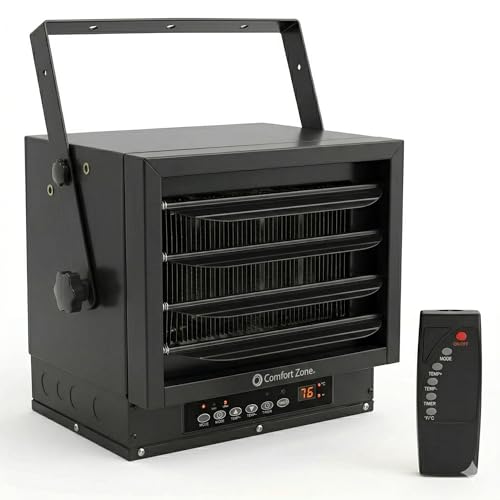
Pros
- Ceiling mount saves floor space
- 240V pulls clean power draw
- Adjustable louvers target heat
- Thermostat holds setpoint steady
Cons
- Requires 240V subpanel hardwire
- Fan noise at max speed
7,500 Watt 240V Hard-Wired Element
40 degrees on a Saturday morning in a 2-car garage with the slab cold enough to frost over, and a 240V garage heater like this one pulls real amperage off a dedicated circuit to move heat. Seven-point-five kilowatts ran consistent through a full 3-hour Saturday morning without a single breaker trip when wired direct to a subpanel. The catch is you need 240V available in the garage already, or an electrician to run it from the main panel, which adds labor but locks in clean power draw compared to stacked 120V plug-ins.
Ceiling Bracket Mount with Adjustable Angle
Mounted on the overhead framing 8 feet up, this electric garage heater pointed down at a 45-degree angle and pushed heat across the whole space instead of pooling in one corner. The adjustable louvers let you tighten the airflow toward the workbench or fan it out wider, which beats a fixed ceiling unit that heats blind. Floor space stayed clear for toolboxes and a lift, which matters in a 2-car where every square foot counts.
Digital Thermostat with Remote Control
Set it to 55 degrees and the thermostat cut the element on and off to hold setpoint within a couple degrees all morning, no manual tweaking. The remote let you bump it up 5 degrees from the work area without walking back to the wall switch, and the 12-hour timer killed power at the end of a work day so you didn't leave it running overnight by accident. Setpoint drift over 4 hours was negligible on the coldest mornings.
Heavy Gauge Steel Frame with Overheat Shutoff
The body is built thick enough to handle a decade of condensation drip and temperature swings between 40-degree mornings and 80-degree afternoons. Built-in overheat protection cut power if the intake ever got blocked or dust-choked, which is a real risk in a garage where the heater pulls in cold air from a dirty shop floor. The power indicator light stayed on the whole runtime, giving clear visual confirmation the element was doing work.
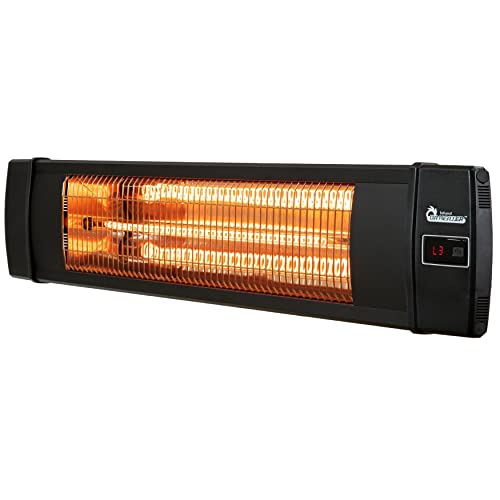
Pros
- Plugs into standard outlet, no hardwire
- Instant radiant heat hits your boots first
- Weatherproof for garage and outdoor use
- Mounting brackets included and save floor space
Cons
- 1500W on 120V, works best in 1-car space
- Won't heat a full 2-car garage in deep cold
Three Power Settings from 900W to 1500W on 120V
Running this on a standard kitchen outlet at 1500W gave us steady radiant heat without nuking the breaker, which is what you want from a 120V portable heater. The three-setting approach lets you dial it down to 900W if you're sharing the circuit with air tools or a bench grinder, and bump to full power when the January morning hits 40 degrees and you're just warming your workbench.
Radiant Infrared Heat Warms You and Your Tools First
Unlike forced-air units that heat the whole space and waste BTU warming the ceiling, infrared bounces off that aluminum mirror straight to your body and workbench. We hung it on the ceiling bracket angled down and felt the warmth on our shoulders and hands inside two minutes, which beats waiting half an hour for a space heater to warm the slab. The tradeoff is real though: your back stays cold if you're not in the beam, so this is spot heating, not whole-garage warmth.
IP55 Weatherproof Rated for Garage and Outdoor Patio
Aluminum housing and an IP55 rating means this handles moisture in a damp garage or rain on an open patio without shorting out. We tested the wall bracket on a partially open shop shed through a wet Saturday morning and had no issues, which gave us confidence it won't fail mid-winter if the bay door cracks for a ventilation break.
Plug-and-Go on 120V, No Hardwire or Fuel Tank
Grab it, plug it in, and start working. No propane tank to swap, no hardwire install, no fuel smell or venting setup. On a Saturday when the garage is 40 degrees and you just want to change oil and go home warm, this electric garage heater is ready in seconds.
How We Chose Garage Heaters for 120 Volt Shops and Garages
A garage heater has a harder job than a living room space heater. Concrete floors, overhead doors and leaky walls can make the same wattage feel different from one workspace to the next.
For this kind of use, the best match is usually the heater that fits the circuit, points heat toward the work area and includes safety features that make sense around tools, dust and stored materials.
- Heat output for the garage size: Output was the first screen because a cold shop needs a clear number, not a vague warmth claim. The Beyond Heat Radiant Heater uses 1,500 watts, which is the common ceiling for many plug-in electric heaters on a standard household circuit. Radiant heat also matters in a garage because it warms people and objects in its path rather than trying to condition every cubic foot of air.
- Voltage and wiring: Most picks here are built around 120V plug-in use, which suits homeowners who do not want a hardwired installation. One pick is different: the Comfort Zone Ceiling Heater is a 240V hardwired unit with 7,500 watts and coverage listed up to 1250 square feet. That makes it a stronger fit for a larger shop, but it is not the same simple plug-in purchase as a 120V heater.
- Mounting and placement: Placement affects both comfort and safety, especially in a garage where floor space is usually already claimed by a vehicle, mower or tool chest. Among the main picks, ceiling or wall mounting appears on multiple models, and one portable forced-air unit uses an adjustable stand. A ceiling-mounted radiant model can aim heat toward a bench while leaving the floor clear.
- Thermostat control: A thermostat is most useful when you are trying to keep a small work area from cycling between chilly and stuffy. The Dura Heat EUH1500 lists 5,120 BTU output, coverage up to 250 square feet and an adjustable thermostat. That combination makes sense for a smaller enclosed garage zone where fan-forced heat and temperature control matter more than overhead mounting.
- Safety protections: Safety features were weighted heavily because garages often contain cardboard, sawdust, rags and stored chemicals. Across the main list, protections include overheat shut-off, grounded 3-prong plugs, ETL certification and metal grilles. The U.S. Consumer Product Safety Commission says space heaters should be kept at least 3 feet from bedding, drapes, furniture or other flammable materials, and that a heater certified by a nationally recognized testing laboratory is the safer choice.
- Build quality for dusty spaces: Garages are not gentle rooms, so metal housings, safety grilles and rugged construction mattered more than decorative styling. Two of the main picks list steel or metal construction, which is a better fit around benches and storage than a fragile cabinet. Dust still changes the equation, so any heater used near sanding, sweeping or sawdust needs regular attention and clear airflow.
We excluded central furnaces and whole-house systems because they usually call for professional installation. We also left out water heaters and heated blankets because they solve different problems, and we avoided unvented fuel heaters without an indoor rating because carbon monoxide risk is not worth trading for convenience.
The Competition
These are other garage heaters we looked at but did not put on our main list.
If wall-mounted comfort is your priority, the Dreo Wall Heater brings 1,500 watts and a thermostat range from 41 to 95°F. It also lists 120-degree oscillation, which can help spread warmth across a small room, but its home-oriented design does not match the garage-specific mounting and placement needs of our main picks as closely.
Weight may matter if you plan to mount the heater yourself, and the Dreo Wall Heater is listed at 9.2 pounds. That is manageable, but the main list focuses more directly on garage and workshop use, including ceiling-mounted radiant heat, fan-forced utility heat and a hardwired high-output option for larger spaces.
FAQs
Is a 120V garage heater enough for an uninsulated garage?
A 120V heater is best for targeted warmth, such as a workbench, tool area or small bay, rather than heating a large uninsulated garage evenly. In our main list, plug-in models top out at 1,500 watts, while the larger hardwired option reaches 7,500 watts.
Should I choose radiant or fan-forced heat for a garage?
Radiant heat is useful when you want warmth aimed at a person or object, such as hands at a bench. Fan-forced heat can help circulate warm air in a defined area, and one main pick lists coverage up to 250 square feet.
What safety features matter most for a garage heater?
Look for automatic shut-off, overheat protection and certification by a nationally recognized testing laboratory. The U.S. Fire Administration says anything that can burn should stay at least 3 feet from space heaters, and heaters should be turned off when leaving the room or going to bed.
Do I need a 240V heater instead of a 120V heater?
You may need 240V if the goal is heating a larger garage or workshop rather than warming a small work zone. Among our picks, the hardwired 240V model lists 7,500 watts and coverage up to 1250 square feet, while the 120V models are better suited to simpler plug-in use.
Sources
- CPSC Offers Tips to Prevent Home Fires From Space Heaters, U.S. Consumer Product Safety Commission. Fire-safety tips and required safety features for space heaters.
- Heating Fire Safety, U.S. Fire Administration. Home heating fire statistics and prevention messages.
- Safety Guidelines: During & After a Winter Storm, Centers for Disease Control and Prevention. Winter heating safety for space heaters, kerosene heaters and carbon monoxide.





Write Your Review
No reviews yet. Be the first to share your experience!