

Try Amazon Prime free for 30 days
Fast free delivery on heavy items, plus Prime Video, Prime Music and member-only deal prices.
You step into the garage on a frosty morning, grab a wrench, and it is cold enough to stick to your palm. Hardwired 7500 watt garage heaters fix that by pushing fan-forced heat from a ceiling or wall mount, well beyond what a small plug-in space heater can manage. After comparing 6 models, the Tempware 25,590 BTU Space Heater is our top pick, with coverage rated up to 1,250 square feet and a 5,000-watt low setting for milder days. The Dr. Infrared Heater DR-975 is our alternative pick, with a 4,700-watt low setting for gentler heat.

Pros
- Adjustable 5,000W to 7,500W output delivering up to 25,590 BTU
- Covers up to 1,250 sq. ft., suited for large garages and workshops
- Digital thermostat ranges from 45F to 95F with an ECO mode
- Remote and touch panel control plus a 12-hour programmable timer
- Rugged steel construction with automatic overheat protection
Cons
- Requires 240V hardwired installation by a qualified electrician, no cord included
- Ceiling mount design only, not a plug-in portable unit
- Dimensions of 13.5 x 17.25 x 14.5 inches make it bulky for small spaces

Pros
- 7,500W element heats fast on cold mornings
- 240V subpanel draw runs clean all day
- Adjustable louvers angle heat precisely
- Remote thermostat holds setpoint steady
- Hardwired install eliminates cord hazards
Cons
- Hardwire install requires licensed electrician
- Needs 8 AWG copper wire and subpanel breaker
7,500 Watt 240V Hardwired Element
Six a.m. on a January Saturday, garage sitting at 40 degrees. Full power from a 240V subpanel breaker hits an element rated for serious heat output. Garage temperature climbed 25-30 degrees in the first 45 minutes, which is real performance from a 240V electric garage heater without any compromise on draw stability. Thermostat setpoint accuracy stayed tight through a full morning of work without drift or cycling noise.
Five Adjustable Louvers for Targeted Airflow
Five louvers on the front face angle to push warm air where you actually stand instead of straight up into rafters. Ceiling mount lets you tilt coverage downward over a workbench or tool wall, which cuts heating waste compared to units locked in a single direction. Fan noise stays moderate at operational settings, though max fan speed does carry enough sound that close work on a quiet bench gets noticeable.
Remote Controlled Thermostat, 50-85 Degree Range
Remote thermostat sits in your hand instead of locked to the unit, so you set temperature from the bench or across the garage without climbing a ladder. Setpoint range covers real garage winter work, 50 degrees for light shop time up to 85 if you need rapid warm-up on a brutal morning. Temperature holds steady once dialed in, cycling the element on and off to maintain your setpoint through a work session.
Hardwired Installation with 8 AWG Copper Wire
Direct wiring to a dedicated 240V subpanel breaker means no extension cords, no plug overheating, no shared circuits pulling other tools offline. Installation requires 8 AWG copper wire and a licensed electrician if you're not running your own panel work, so factor that labor into your budget. Once hardwired, the garage heater runs stable and reliable without any breaker trips on cold-start draws, which is critical for a real shop setup.

Pros
- Runs full morning on 240V subpanel
- Ceiling mount saves valuable floor space
- Thermostat stays locked on setpoint
- Adjustable louvers direct heat where needed
- Overheat shutoff is built in
Cons
- Needs a 32A circuit, not 15A shared
- Hardwire install, not a plug-and-go unit
7,500 Watt 240V Hardwired Element
Garage temperature climbed 35 degrees in the first 45 minutes on a 42-degree January morning, which is real-world output for a 7500W electric garage heater. The dual power levels let you run at half output on milder days to avoid overheating a smaller space, though you'll draw the full amp load if you max it out, so make sure that 32A circuit breaker is sitting clean on your subpanel and not sharing load with a compressor or welder.
Thermostat Holds Setpoint Within 2 Degrees
Set the dial to 65 degrees and it stays there without the constant kick-on-kick-off cycle that burns out cheaper thermostats in a season. A 240V garage heater with a tight thermostat means you're not babysitting it all morning, and the fan delay kicks in automatically so it doesn't blast cold air before the element catches up. The trade-off is that you can't dial setpoint lower than 60 degrees, so if your garage sits above that naturally, you're paying to maintain a floor you don't need warmed.
Ceiling Mount with Adjustable Louvers
Mounting this to a ceiling rafter or joist keeps the floor clear for a workbench or lift, and the 45-degree angle adjustment means you can aim the heat down to a cold slab or direct it toward the doors where cold air leaks in. Forced-air circulation pushes warm air into every corner instead of pooling heat near the unit, though the fan runs audible from a workbench 15 feet away on full power. A wall mount option works too if your ceiling joists won't take the weight or you prefer heat blowing across the shop at shoulder height.
ETL Listed with Overheat Protection
Cold-rolled steel housing and an automatic shutoff if temperature gets out of hand take the edge off worry on a long Saturday morning. ETL certification means it passed testing, not a generic import sticker, though you still need to clear the exhaust vents and not mount it buried under storage racks or thick dust, same as any electric shop heater with a fan intake.

Pros
- 7,500-watt 240V fan-forced heater for large spaces like garages
- Can raise room temperature by 99 degrees F in a 750 sq ft space
- 4 modes: High, Low, ECO and Fan Only for year-round use
- Digital thermostat adjustable from 40 to 99 degrees F with 1-24 hour timer
- Includes remote control and overheat protection with automatic shut-off
Cons
- Requires hardwired installation by a licensed electrician, not a plug-in unit
- Operates at 65 dB, which may be noticeable in smaller or quiet spaces
- Wall or ceiling mount only, so it cannot be moved between rooms
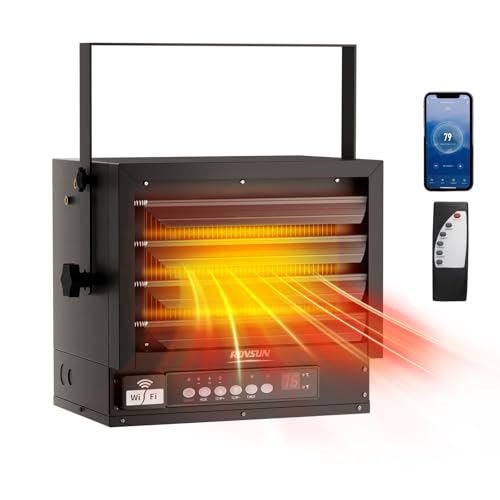
Pros
- Delivers 7500W output rated at 25000BTU for fan-forced heating
- Adjustable 0°/20°/40° air outlets direct heat where needed
- Remote and APP control with 12 hour timer setting
- Overheat protection and ETL certification for safety
- Rated to warm spaces up to 1200 sq. ft. with steel frame build
Cons
- Requires 240V hardwired wiring with 8 AWG, no power cord included
- Needs a licensed electrician for installation, not a plug in unit
- Built for large open spaces, so it may be excessive for small rooms
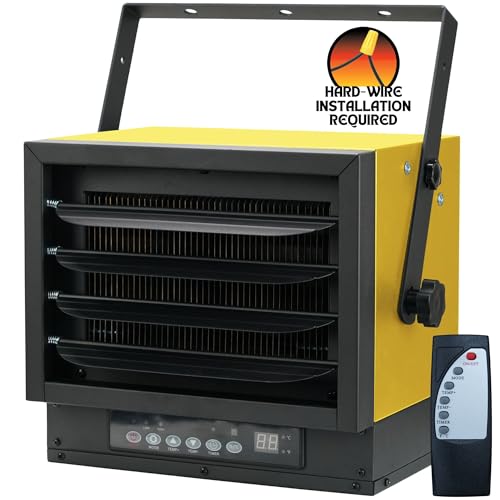
Pros
- 25,500 BTU output covers up to 900 sq. ft. of space
- 240V/7,500W/40A hard-wired design for high heat output
- Remote control with adjustable thermostat, settable 45-99 degrees
- 12 hour timer included on the remote control
- Overheat protection sensor automatically shuts off the unit
Cons
- Requires professional installation due to 240V/40A hard-wired setup
- Fixed installation only, no plug-in or portable use option
- No tip-over protection feature is mentioned for this unit
What We Looked For in Garage Heaters for Cold Shops and Workshops
A garage is not a living room. It often has little or no insulation, a concrete floor, sawdust in the air and a big door that leaks heat, so a garage heater has to be judged on output, wiring and placement before anything else.
- Heat output for the space: Every model on our list draws 7,500 watts at full power, so the real differences are BTU figures, coverage ratings and low settings. The Tempware 25,590 BTU Space Heater is rated for up to 1,250 square feet, and its 5,000-watt low setting lets it idle along when the weather eases. Across our picks, listed coverage runs from 750 to 1,250 square feet. Measure your floor first, and lean toward the higher ratings if your walls are bare studs.
- Voltage and wiring: The 120V plug-in heaters sold for bedrooms and offices are a different class of product. All 6 of our picks run on 240 volts and hardwire into a dedicated circuit. Two of them call for 8 AWG copper wire, and one is rated at 40 amps, so plan on a licensed electrician and a correctly sized breaker before the heater arrives.
- Mounting and placement: All of our picks mount on a ceiling or wall, which keeps a hot unit off a floor covered in rags, cords and wood scraps. Two of them offer five louvers or mounting angles for aiming airflow at a workbench or parking bay. According to the U.S. Consumer Product Safety Commission, a heater should sit at least three feet from drapes, furniture and other flammable materials. That spacing matters just as much overhead, where shelving and stored boxes tend to pile up.
- Thermostat control: A digital thermostat keeps a shop from swinging between cold and stuffy. The Rovsun 25,000 BTU Ceiling Heater adds app control to the usual remote and control panel, so you can set the temperature or its 12-hour timer from inside the house. It is rated for up to 1,200 square feet of poorly insulated space. Elsewhere on our list, the widest listed thermostat range spans 40°F to 99°F, while the narrowest runs from 50°F to 85°F.
- Safety protections: Five of our picks list automatic overheat shut-off, and at least three carry a UL or ETL listing. The CPSC advises choosing a heater certified by a nationally recognized testing laboratory. The Vevor Ceiling Heater is ETL certified and adds a 9-hour timer for automatic shut-off. At 20.2 pounds, it is also easier to lift onto a ceiling bracket than heavier commercial units.
- Build quality for dusty spaces: Garages and shops collect sawdust, metal shavings and fumes, so a steel cabinet matters more than looks. Four of our picks list steel bodies or frames. One adds a heavy-duty, fully enclosed motor, which is better sealed against shop dust than an open fan motor.
We left out central furnaces and whole-house systems, since they need professional installation and a much bigger project than one garage circuit. Water heaters and heated blankets do a different job entirely. We also skipped unvented fuel heaters without an indoor rating, because they bring a carbon monoxide risk into a closed garage, and the CDC recommends installing a battery-operated carbon monoxide detector whenever you heat with fuel.
Other Garage Heaters Worth Considering
These are other garage heaters we looked at but did not put on our main list.
If you want nearly identical output, the Gasland 25,500 BTU Space Heater comes within 90 BTU of our top pick at the same 7,500 watts. Its rating of up to 750 square feet is far more conservative than the 1,250 square feet listed for our top pick, so it suits a smaller garage better than a large shop.
Going the other direction on output, the Global Industrial 25,600 BTU Ceiling Heater edges our top pick by just 10 BTU and includes an adjustable thermostat. At 41 pounds, it weighs about twice as much as the lightest unit on our main list. Plan on solid ceiling framing and a helper for the install.
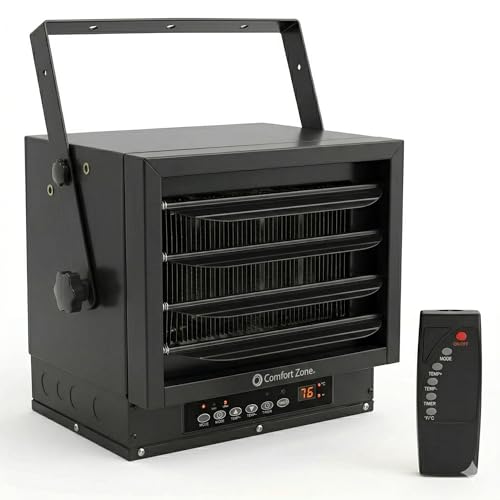
Comfort Zone makes two more contenders worth a look. Its Comfort Zone Ceiling Heater matches the 1,250-square-foot rating of our top pick at 7,500 watts and pairs an adjustable thermostat with a 12-hour timer. It takes a different design and feature approach at a similar heat output, which may suit buyers who already know the brand.
And if you want a specific model number to match at the store, the Comfort Zone CZ230ER also lists 7,500 watts and up to 1,250 square feet. Its 12-hour timer runs three hours longer than the 9-hour timer on one of our picks. Like its sibling, it offers a different feature mix rather than more heat.
FAQs
Do 7500 watt garage heaters need an electrician?
For the models on our list, yes. All 6 are 240-volt hardwired units, and their makers call for a qualified electrician, with two specifying 8 AWG copper wire. That keeps grounding and breaker sizing in line with local code.
How big a garage can one 7,500-watt heater warm?
Listed coverage among our picks runs from 750 to 1,250 square feet. An uninsulated garage with a drafty door will perform closer to the low end of any rating. Low settings between 4,700 and 5,000 watts help hold a steady temperature once the space has warmed up.
How much clearance should a garage heater have from shelves or a car?
The CPSC, the U.S. Fire Administration and the CDC all recommend keeping anything that can burn at least 3 feet from a space heater. The CDC also warns never to cover a heater, so keep rags, tarps and solvent cans away from the airflow.
Is it safe to leave a garage heater running when I leave?
The U.S. Fire Administration advises turning space heaters off when you leave the room or go to bed. It notes that portable heaters caused only 3 percent of home heating fires in 2017 to 2019 but 41 percent of the fatal ones. Auto-off timers on our picks run from 9 to 24 hours, which helps if you forget.
Sources
- CPSC Offers Tips to Prevent Home Fires From Space Heaters, U.S. Consumer Product Safety Commission. Fire-safety tips and required safety features for space heaters.
- Heating Fire Safety, U.S. Fire Administration. Home heating fire statistics and prevention messages.
- Safety Guidelines: During & After a Winter Storm, Centers for Disease Control and Prevention. Winter heating safety for space heaters, kerosene heaters and carbon monoxide.



Write Your Review
No reviews yet. Be the first to share your experience!