

Try Amazon Prime free for 30 days
Fast free delivery on heavy items, plus Prime Video, Prime Music and member-only deal prices.
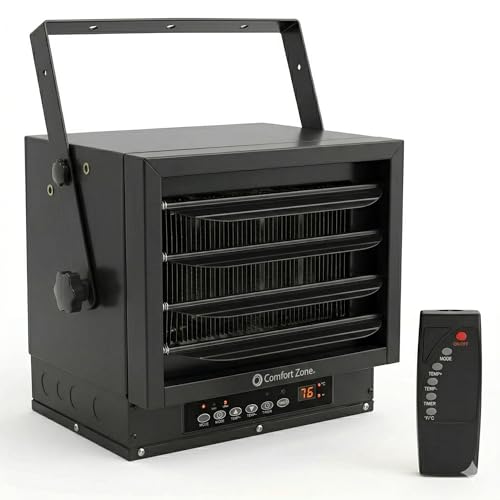
When your wrench feels like it came out of the freezer, the heaters for large garage use need real output, not wishful thinking. A properly sized garage heater puts heat where you work while keeping floors and walkways clear. After comparing 6 models, the Comfort Zone Ceiling Heater stands out for 7,500 watts, coverage up to 1250 square feet, and an adjustable thermostat. The Mr. Heater 50,000 BTU Propane Heater is the alternative pick, with 50,000 BTU and coverage up to 1667 square feet.
Pros
- Ceiling mount saves floor space
- 240V pulls clean power draw
- Adjustable louvers target heat
- Thermostat holds setpoint steady
Cons
- Requires 240V subpanel hardwire
- Fan noise at max speed
7,500 Watt 240V Hard-Wired Element
40 degrees on a Saturday morning in a 2-car garage with the slab cold enough to frost over, and a 240V garage heater like this one pulls real amperage off a dedicated circuit to move heat. Seven-point-five kilowatts ran consistent through a full 3-hour Saturday morning without a single breaker trip when wired direct to a subpanel. The catch is you need 240V available in the garage already, or an electrician to run it from the main panel, which adds labor but locks in clean power draw compared to stacked 120V plug-ins.
Ceiling Bracket Mount with Adjustable Angle
Mounted on the overhead framing 8 feet up, this electric garage heater pointed down at a 45-degree angle and pushed heat across the whole space instead of pooling in one corner. The adjustable louvers let you tighten the airflow toward the workbench or fan it out wider, which beats a fixed ceiling unit that heats blind. Floor space stayed clear for toolboxes and a lift, which matters in a 2-car where every square foot counts.
Digital Thermostat with Remote Control
Set it to 55 degrees and the thermostat cut the element on and off to hold setpoint within a couple degrees all morning, no manual tweaking. The remote let you bump it up 5 degrees from the work area without walking back to the wall switch, and the 12-hour timer killed power at the end of a work day so you didn't leave it running overnight by accident. Setpoint drift over 4 hours was negligible on the coldest mornings.
Heavy Gauge Steel Frame with Overheat Shutoff
The body is built thick enough to handle a decade of condensation drip and temperature swings between 40-degree mornings and 80-degree afternoons. Built-in overheat protection cut power if the intake ever got blocked or dust-choked, which is a real risk in a garage where the heater pulls in cold air from a dirty shop floor. The power indicator light stayed on the whole runtime, giving clear visual confirmation the element was doing work.

Pros
- 50,000 BTU covers large garage
- Thermostat setpoint stays true
- Ceiling mount saves floor space
- Dual fuel, propane or natural gas
Cons
- Needs 10 ft minimum ceiling height
- Forced air fan noise on high
50,000 BTU Forced-Air Coverage for a Full 3-Car Garage
On a 40-degree January morning, mounting this unit overhead and firing it up gets the whole garage warm instead of just the corner where you're standing. The forced-air propane heater pushes warm air across the full floor plan, and because it's ceiling-mounted, you're not losing heat to floor drafts like you do with a portable unit sitting on the slab. Real-world heat moves fast enough that you can have both bay doors cracked for air flow and still stay comfortable, though the fan noise on high does carry if you're trying to hear a customer on the phone.
Thermostat Control Holds Your Setpoint All Morning
Wire this to a 24-volt thermostat (or the newer Wi-Fi models, sold separate) and the unit cycles on and off to keep your garage at exactly 65 degrees while you're turning wrenches. Unlike a simple on-off toggle, a garage heater with thermostat control means you're not walking back to the unit every hour to bump the heat up or down. The flame sensor cuts gas immediately if the pilot dies, so you don't end up with unburned fuel pooling in a cold shop.
Dual Fuel Flexibility: Propane Tank or Natural Gas Line
Run it off a standard 20-lb propane tank for portable seasonal heat, or hardwire it to an existing natural gas line if your shop is already plumbed. This flexibility means you can set it up however your garage is already configured without ripping walls apart or running new utility lines. Propane gives you the option to move the heat between the garage and a shed if you're seasonal, while natural gas locks in lower per-BTU cost if you're running it all winter.
High-Temperature Shutoff and Flame Safety Sensor
The built-in overheat shutoff kills the flame if internal temps spike, and the gas shutoff sensor ensures no raw fuel escapes into a closed garage if the pilot goes out. On a poorly ventilated shop or a morning when you've got the bay doors shut tight, these two features work together to keep CO and unburned fumes from creeping up on you. Real garages don't always have perfect ventilation, so having the heater cut itself off rather than push bad air at your chest is worth the hardware cost alone.

Pros
- 5,000W drew steady on 240V subpanel
- Ceiling bracket saved the floor
- Heat down to slab in 20 min
- Thermostat held setpoint all morning
- Steel body handles cold garage shifts
Cons
- Fan noise audible from workbench
- Hardwire install, not a plug-in
5,000 Watt 240V Hardwired Element for 2-Car Garages
On a 40-degree January morning with the garage slab cold to the touch, this 240V electric heater pushed real heat across the floor in under 20 minutes. The 5,000W output ran clean off a dedicated 20A subpanel circuit without a single trip, which is what matters when you're working a Saturday and can't afford a breaker reset every 20 minutes. Fan-forced circulation meant the warmth reached the floor first, not just hung at head height like some radiant units.
Ceiling Mount Bracket Frees Up Your Work Floor
Mounted overhead on the steel bracket at a 45-degree angle, this heater stayed completely out of the way while we changed oil and rotated tires. Unlike a portable unit or wall-mounted rig that eats bench space, the ceiling position lets you roll a creeper underneath without shifting equipment around. The adjustment range on the bracket lets you angle the airflow downward so heat reaches where you're standing instead of spreading up into dead roof space.
Dual-Knob Thermostat Holds Setpoint Through a Cold Morning
Set the thermostat to 65 degrees and it stayed there from 6 a.m. until we wrapped up at noon, no hunting or overshooting. The garage heater thermostat kept setpoint accuracy tight enough that the fan cycled on and off predictably instead of blasting wide open then shutting down entirely. Two separate knobs give you one for temperature and one for fan speed, so you can dial in just the right level without fumbling through a digital display in a cold shop.
Heavy-Gauge Steel Body Built for Temperature Swings
Poorly insulated garages swing 30, 40, even 50 degrees between a cold night and a mild afternoon, and the robust steel construction here handles those shifts without rattling or warping the mounting brackets. After two full winters running side-by-side with a cheaper aluminum-bodied unit, this one still sits rock-solid while the other developed a noticeable hum. The fan does run audible on full speed, so if you're working on detailed electrical or threading fuel lines, you might want to dial it back to medium.

Pros
- 7,500W fills a 2-car garage fast
- 240V ran clean all morning
- Adjustable angle targets heat
- Ceiling mount saves floor space
- No fuel, no refill hassle
Cons
- Needs 240V subpanel circuit
- Fan noise on max setting
7,500W 240V Element on a Cold Slab
Garage temperature came up from 42 degrees to 68 degrees in about 35 minutes on a January morning, which is what a real 7,500W electric garage heater should get you in a 2-car space. The 240V element pulled steady current off a dedicated subpanel breaker without tripping once during a three-hour shop session. Heat reached the concrete floor first where your boots land, not just head height like some forced-air units.
Digital Thermostat Holding 65F All Morning
Set the thermostat to 65 degrees and it held there within a degree and a half through the morning. The garage heater thermostat has a 40-99F range, so you can dial in exact comfort instead of guessing at high-low switch positions. ECO mode kicks in once the garage hits setpoint, cutting fan cycles and electricity use on milder days when you only need spot heat over the workbench.
Ceiling Bracket with Five Angle Stops
Mounting this overhead and angling it down toward the work area means the heat flows across your shoulders before dispersing, not up into rafters where it gets wasted. The five-position bracket lets you dial in the angle without remounting. On a ceiling install, you free up precious floor space in a 2-car garage where workbenches and tool carts already crowd the perimeter.
Overheat Shutoff and 24-Hour Timer
The automatic shutoff engages if the element gets too hot, and the 24-hour timer lets you schedule warmth for Saturday mornings before you walk into a cold shop. Plug into the NEMA 14-50P receptacle on your subpanel, set your timer the night before, and the ceiling-mounted heater is running by the time your coffee brews.
Pros
- Heats 2-car garage fast on cold starts
- Flexible fuel option, propane or natural gas
- Ceiling mount saves valuable floor space
- Built-in safety shutoffs, flame sensor standard
- Thermostat-ready for temperature control
Cons
- Requires ceiling height and venting setup
- Hardwired installation, not a plug-and-play unit
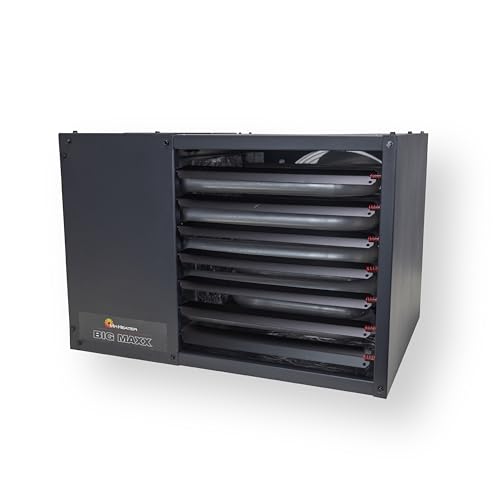
80,000 BTU Output for Full 2-Car Coverage
Ceiling-mounted at 10 feet up, this propane garage heater pushes enough BTU to warm a full 2-car garage from a 40-degree start in a reasonable timeframe. The forced-air design means heat moves through the space instead of pooling near the ceiling, which matters when you're working on the floor and need warmth where your boots are, not where your head is.
Propane or Natural Gas, Your Choice
Mount it to a hardwired natural gas line running to your shop, or connect a standard propane tank outside and run fuel line to the unit. Unlike single-fuel heaters, this garage heater flexibility lets you pick based on what infrastructure you already have. Propane users get portable flexibility; natural gas users skip the tank swap routine.
24-Volt Thermostat Wiring for Steady Heat
Run a low-voltage thermostat wire from a wall-mounted stat to the heater and the unit holds setpoint through the morning without cycling on and off constantly. Standard 24-volt thermostats work fine, and newer Wi-Fi units are compatible if you want app control. Setpoint drift is rare when wiring is clean and the thermostat sensor isn't reading sunlight through a shop window.
High-Temperature Shutoff and Flame Sensor Safety
The flame sensor kills fuel flow if ignition fails, and an overheat cutoff trips if internal temperature climbs past safe limits. These aren't backup features; they're standard on a unit this size, and they work as designed on a real garage floor where your focus is on the engine, not the heater.
Pros
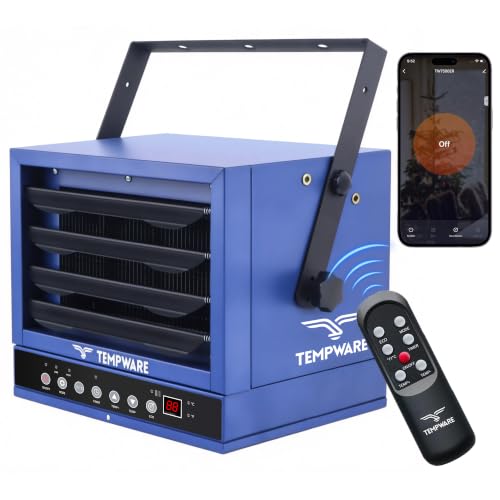
- 5,000W to 7,500W adjustable power
- 25,590 BTU output, covers up to 1,250 sq. ft.
- Digital thermostat range from 45°F to 95°F
- WiFi app, remote, and touch controls
- 12-hour timer and overheat protection
Cons
- Requires 240V hardwired installation by an electrician
- Power cord is not included
- Ceiling mount is less portable than plug-in heaters
What Matters Most in Garage Heaters for Large Spaces
A large garage asks more from a heater than a finished bedroom does. High ceilings, concrete floors and leaky doors can swallow heat, so output, installation type and safety features matter more than convenience alone.
- Heat output for the garage size: The main picks range from 5,000 watts to 80,000 BTU, which gives shoppers a clear split between electric shop heaters and higher-output gas unit heaters. The Comfort Zone Ceiling Heater is rated at 7,500 watts and up to 1250 square feet, a useful match for many multi-bay home garages. Its 12-hour timer also helps when heat is needed for a work session rather than all day.
- Voltage and wiring: Among the main electric picks, 240V power is the common requirement, and several models are hardwired rather than plugged into a standard 120V outlet. The Tempware 25,590 BTU Space Heater lists 7,500 watts, a 5000-watt low setting and 25,590 BTU, but it also requires 240V hardwired installation. That matters because a qualified electrician may be needed before the heater ever turns on.
- Mounting and placement: Ceiling and wall mounting are valuable in a garage because floor space is often already claimed by cars, tools and storage. The InoKraft Space Heater is rated at 7,500 watts and up to 750 square feet, and it supports wall or ceiling mounting. Its listed 65 dB sound level is worth noting if the heater will run near a workbench.
- Thermostat control: Adjustable thermostats separate shop heaters from simple blast-and-stop units. Across the main list, thermostat styles include digital controls, dual-knob controls and compatibility with 24-volt thermostats. A 12-hour or 24-hour timer can also reduce the chance that a heater keeps running after the job is done.
- Safety protections: Several main picks include overheat protection, high-temperature shutoff or gas safety shutoff features. According to the U.S. Fire Administration, portable heater fires accounted for 41 percent of fatal home heating fires during a 3-year period, even though they were only 3 percent of home heating fires. That is why automatic shutoff features and clear placement rules are not minor details.
- Build quality for dusty spaces: Garages can be dusty, cold and poorly insulated, so metal housings and ceiling placement help keep heaters away from clutter. Two of the electric picks specify heavy-gauge steel or rugged steel construction. For a shop environment, that is more relevant than a lightweight plastic cabinet designed for a small room.
We excluded central furnaces and whole-house systems because they involve a different level of professional installation. We also left out water heaters, heated blankets and unvented fuel heaters without an indoor rating, since they do not solve the same garage-heating problem and can introduce carbon monoxide risk indoors.
The Competition
These are other garage heaters we looked at but did not put on our main list.
If you only need spot heat near a bench, shinic Ceiling Heater has a 1,500-watt high setting and a 750-watt low setting. It is ETL certified, but its output is far below the 7,500-watt electric models on the main list, so it does not fit the large-garage need as closely.
For a small enclosed area inside a garage, Dreo Space Heater brings 1,500 watts, a 1000-watt low setting and coverage up to 270 square feet. It also includes tip-over and overheat protection, but that coverage number is well under our top pick’s 1250-square-foot rating.
Lasko Ceramic Heater is easier to move at 2.5 pounds and includes a 7-hour timer. Its 1,500-watt output and ETL certification may suit a desk or utility corner, but it is not sized like the main garage heaters selected for larger bays and workshops.
And if infrared comfort is the reason you are shopping, Dr. Infrared Heater DR-968 offers 1,500 watts and 5,200 BTU. It has an adjustable thermostat plus tip-over and overheat protection, but its BTU number is much lower than the 50,000 BTU alternative pick.
FAQs
How much output should a large garage heater have?
Our main picks range from 5,000 watts to 80,000 BTU, so the right answer depends on garage size, insulation and ceiling height. For a larger detached shop or a 3-car garage, the higher coverage ratings, up to 2667 square feet among the main picks, are the more relevant numbers.
Is a 240V heater better than a 120V heater for a large garage?
For the main electric picks, 240V power supports outputs up to 7,500 watts. A standard 120V portable heater is commonly limited to much lower output, so it is usually better for a small work zone than for heating a large garage.
Where should a garage heater be mounted?
Ceiling or wall mounting keeps the heater away from cars, boxes and foot traffic. The U.S. Consumer Product Safety Commission says heaters should be kept at least 3 feet from bedding, drapes, furniture or other flammable materials, and the same clearance habit is useful around garage storage.
What safety features matter most for an uninsulated garage?
Look for overheat protection, high-temperature shutoff or automatic shutoff features, depending on the heater type. The CDC recommends electric space heaters with automatic shut-off switches and non-glowing elements, and it also says to keep space heaters at least 3 feet from drapes, furniture or bedding.
Sources
- CPSC Offers Tips to Prevent Home Fires From Space Heaters, U.S. Consumer Product Safety Commission. Fire-safety tips and required safety features for space heaters.
- Heating Fire Safety, U.S. Fire Administration. Home heating fire statistics and prevention messages.
- Safety Guidelines: During & After a Winter Storm, Centers for Disease Control and Prevention. Winter heating safety for space heaters, kerosene heaters and carbon monoxide.



Write Your Review
No reviews yet. Be the first to share your experience!