

Try Amazon Prime free for 30 days
Fast free delivery on heavy items, plus Prime Video, Prime Music and member-only deal prices.
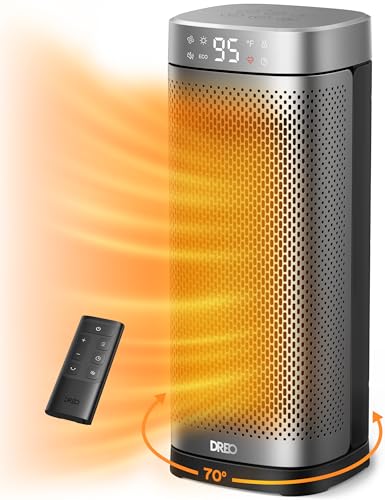
You finally clear a Saturday for the workbench, and twenty minutes in you are sanding with gloves on while your coffee goes cold. Good garage space heaters fix that by pushing warm air straight at the spot where you stand instead of trying to heat every corner of a drafty bay. After comparing 6 models, the Dreo Space Heater is our top pick for its 1,500 watts, tip-over and overheat protection, and a 34 dB rating. The Dreo 16-Inch Space Heater is our alternative pick, rated for up to 250 square feet.

Pros
- 1500W heater delivers warm air in 2 seconds
- Manual 0°, 20°, 40°, 60° vertical tilt
- 41°F to 95°F thermostat in 1°F increments
- 34dB operation with brushless DC motor
- Tip-over, overheat protection, ETL certified
Cons
- Heating area is not specified
- Manual tilt, no automatic oscillation listed
- Electric space heaters are for supplemental heat
Pros
- 1500W PTC ceramic heating
- Covers up to 250 sq.ft.
- 70° wide-angle heat spread
- 41-95°F thermostat in 1°F increments
- 34dB low noise rating
Cons
- 250 sq.ft. coverage may not suit larger rooms
- 5.06 lb weight may be less handy to move often
- No remote control listed

Pros
- 1500W high, 750W low, and 20W fan-only modes
- PTC ceramic heat blows warm air in 3 seconds
- Heats small to medium rooms up to 200 sq. ft.
- ETL certified with overheat protection
- 3.75 lb body with handle and 80-inch cord
Cons
- Coverage is limited to rooms up to 200 sq. ft.
- No timer or remote control mentioned
- Knob control, no thermostat range listed

Pros
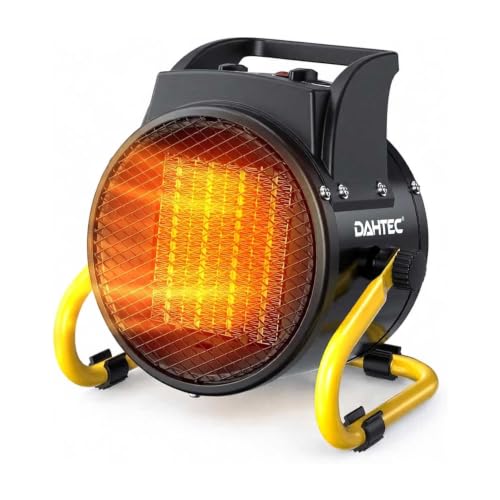
- 1500W, 5120 BTU fan-forced heat
- Heat mode plus fan-only mode
- 0 to 25 degree adjustable airflow direction
- ETL certified with overheat protection
- IP24 rating for damp covered areas
Cons
- No heating area size listed
- No thermostat listed in product data
- 5.73 lb weight is portable but not ultra-light
Pros
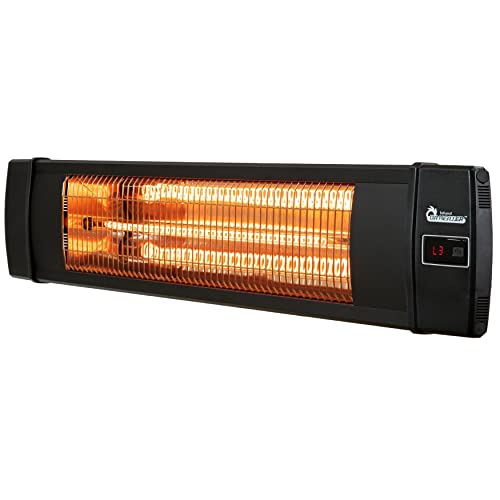
- Plugs into standard outlet, no hardwire
- Instant radiant heat hits your boots first
- Weatherproof for garage and outdoor use
- Mounting brackets included and save floor space
Cons
- 1500W on 120V, works best in 1-car space
- Won't heat a full 2-car garage in deep cold
Three Power Settings from 900W to 1500W on 120V
Running this on a standard kitchen outlet at 1500W gave us steady radiant heat without nuking the breaker, which is what you want from a 120V portable heater. The three-setting approach lets you dial it down to 900W if you're sharing the circuit with air tools or a bench grinder, and bump to full power when the January morning hits 40 degrees and you're just warming your workbench.
Radiant Infrared Heat Warms You and Your Tools First
Unlike forced-air units that heat the whole space and waste BTU warming the ceiling, infrared bounces off that aluminum mirror straight to your body and workbench. We hung it on the ceiling bracket angled down and felt the warmth on our shoulders and hands inside two minutes, which beats waiting half an hour for a space heater to warm the slab. The tradeoff is real though: your back stays cold if you're not in the beam, so this is spot heating, not whole-garage warmth.
IP55 Weatherproof Rated for Garage and Outdoor Patio
Aluminum housing and an IP55 rating means this handles moisture in a damp garage or rain on an open patio without shorting out. We tested the wall bracket on a partially open shop shed through a wet Saturday morning and had no issues, which gave us confidence it won't fail mid-winter if the bay door cracks for a ventilation break.
Plug-and-Go on 120V, No Hardwire or Fuel Tank
Grab it, plug it in, and start working. No propane tank to swap, no hardwire install, no fuel smell or venting setup. On a Saturday when the garage is 40 degrees and you just want to change oil and go home warm, this electric garage heater is ready in seconds.

Pros
- 1500W ceramic heat for medium-sized rooms
- Wide oscillation helps spread heat around the room
- Remote controls heat settings, oscillation, and timer
- 7-hour timer for scheduled operation
- ETL listed with overheat protection and cool-touch housing
Cons
- Not intended for whole-home heating
- No thermostat range listed in the product data
- 22.5-inch tower size may not fit very tight spaces
What We Looked For in a Garage Heater for a Cold Workshop
A garage loses heat through the big door, the concrete slab and often bare stud walls, so a heater that feels fine in a bedroom can seem weak out there. We judged each model on output, wiring, placement and safety for a dusty, unheated room.
- Heat output for the space: Every model on our list tops out at 1,500 watts, so the real difference is how well that heat reaches you. The Dahtec 5,120 BTU Space Heater states its output in both units, 1,500 watts and 5,120 BTU, which makes it easy to compare against shop heaters rated in BTU. Its fan-forced design circulates warm air instead of letting it pool at the ceiling, which matters under a tall garage roof. Among the picks that list coverage, claims run from 200 to 250 square feet, so plan on warming a work zone rather than the whole floor.
- Voltage and wiring: All six picks run on standard 120V household current and simply plug in, so no electrician is needed. Hardwired 240V shop heaters need a dedicated circuit and professional installation, which puts them outside this list. The infrared model lists 120V at 60Hz. It offers three power settings that range from 900 to 1,500 watts, so it can step down when other tools share the circuit.
- Mounting and placement: Only one of our picks ships with a wall and ceiling mounting bracket, which keeps the heater off a cluttered floor. The rest sit on the floor or a bench, and the maximum tilt on the angled models runs from 15 to 60 degrees. According to the U.S. Consumer Product Safety Commission, a heater belongs on a level, hard, nonflammable surface, not on rugs or carpets. Keep at least 3 feet of clearance from anything that can burn, including rags, cardboard and drop cloths.
- Thermostat control: A thermostat keeps a garage from swinging between too cold and too hot while you work. Two of our picks let you set anywhere from 41 to 95°F in 1-degree steps. The Dahtec Ceramic Heater pairs an adjustable thermostat with a 750-watt low setting, useful once the space has warmed up. It is rated for up to 200 square feet and weighs 3.75 pounds, so it moves easily from the workbench to a potting table. The infrared model has no thermostat at all and relies on its 3 power levels instead.
- Safety protections: The CPSC says electric heaters need an automatic cut-off if they tip over and should be certified by a nationally recognized testing laboratory. Five of our six picks list ETL certification. Our top pick, the Dreo Space Heater, combines tip-over and overheat protection with V-0 flame-retardant materials and a safety plug, all ETL certified. It also runs as quietly as 34 dB, so it will not drown out a radio while you work.
- Build quality for dusty spaces: Sawdust, damp air and the occasional bump from a rolling toolbox are part of garage life. Two of our picks use steel bodies rather than plastic, and the water-resistance ratings on the list run from IP24 to IP55. The IP55 infrared model is built from weatherproof aluminum and is approved for indoor and outdoor use, which suits a garage that works with the door open.
We left out central furnaces and whole-house systems because they need professional installation, which is a bigger project than warming a workbench. Water heaters and heated blankets do a different job entirely. We also skipped unvented fuel heaters without an indoor rating, since burning fuel in a closed garage brings a carbon monoxide risk. The CDC recommends installing a battery-operated carbon monoxide detector and making sure there is proper ventilation if you must run a kerosene heater.
Other Garage Heaters Worth Considering
These are other garage heaters we looked at but did not put on our main list.
If noise is your main worry, the Dreo 25-Inch Space Heater is rated at 25 dB, compared with 34 dB for our top pick. It also claims up to 270 square feet, a bit more than the 250 square feet of our alternative pick. Tip-over and overheat protection come standard, along with a thermostat that runs from 41 to 95°F.
Going taller buys more reach. The Mountman 37-Inch Tower Heater claims up to 500 square feet, twice the rating of our alternative pick, and adds 120-degree oscillation to sweep a wider work area. It has an adjustable thermostat, drops to a 1,000-watt low setting and lists 30 dB, a little quieter than the 34 dB of our top pick.
Prefer a heater that states its output in BTU? The Dr. Infrared Heater DR-968 pairs 1,500 watts with 5,200 BTU, plus an adjustable thermostat and tip-over and overheat protection. It is rated at 39 dB, louder than the 34 dB of our top pick, which is why it stayed off the main list.
FAQs
How large a garage can a 1,500-watt heater warm?
Among our picks that list coverage, ratings run from 200 to 250 square feet. In an uninsulated garage, treat those figures as the size of the area you want comfortable, not the whole floor, and aim the airflow where you actually work.
Do I need a 240V outlet to heat my garage?
Not for anything on our list, since all six picks plug into a standard 120V outlet. Hardwired 240V heaters are a separate category that needs a dedicated circuit and installation, so check your panel and local code before going that route.
How close can a space heater sit to my workbench or stored gear?
The U.S. Fire Administration and the CDC both say to keep anything that can burn at least 3 feet away. In a garage, that includes rags, cardboard boxes, paint thinner and car covers. The CDC also warns never to cover a space heater.
Is it safe to leave a garage heater running when I go inside?
The U.S. Fire Administration says to turn space heaters off when you leave the room or go to bed. It reports that portable heater fires made up only 3 percent of home heating fires but accounted for 41 percent of fatal ones.
Sources
- CPSC Offers Tips to Prevent Home Fires From Space Heaters, U.S. Consumer Product Safety Commission. Fire-safety tips and required safety features for space heaters.
- Heating Fire Safety, U.S. Fire Administration. Home heating fire statistics and prevention messages.
- Safety Guidelines: During & After a Winter Storm, Centers for Disease Control and Prevention. Winter heating safety for space heaters, kerosene heaters and carbon monoxide.





Write Your Review
No reviews yet. Be the first to share your experience!