

Free Delivery. Exclusive Deals. All Prime.
Prime members save on shipping and get first access to deals, plus Prime Video included. 30 days free.
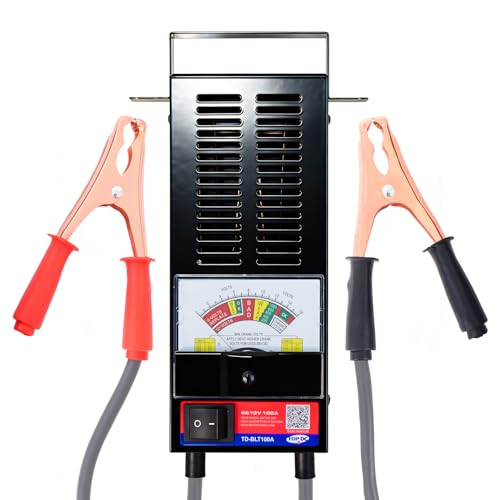
The first cold morning no-start always seems to happen when the coffee is in one hand and the scraper is in the other. Car battery load testers help separate a weak battery from a charging or starting problem before winter makes it obvious. After comparing 6 models, the Lianshi Battery Tester is the pick for its 12V coverage, 100 A load and 10-second load check. The Qwork Battery Tester is the alternative pick for 12V checks and a hand crank setup.

Pros
- Tests 6V and 12V automotive batteries
- 100A load test for 12V batteries
- 50A load test for 6V batteries
- Color-coded display for voltage readings
- Rubber insulated handles and heavy duty clips
Cons
- Load switch should be held for up to 10 seconds
- Voltmeter accuracy is ±0.3V
- Fixed load current limits test options

Pros
- Checks both 6V and 12V batteries
- Supports up to 1,000 CCA load testing
- Includes an alternator testing function
- Shock-resistant steel case
- Heavy-duty copper-plated clamps
Cons
- Warranty details are not specified
- Top reviews are not provided
- Product group is listed as BISS, not automotive

Pros
- Tests 12V batteries from 100-2000 CCA across all types
- 99.7% testing accuracy with results in milliseconds
- Tests battery, alternator, starter, and charging system
- Works on batteries both in-vehicle and out-of-vehicle
- Galvanized alloy clips provide durability and safety
Cons
- Limited to 12V systems only, not for other voltages
- Requires direct battery connection for each test
- No warranty information provided in product data

Pros
- Tests 6V and 12V batteries
- 100 A fixed load current
- 100 AMP load test for 12V batteries
- 50 AMP load test for 6V batteries
- Portable at about 0.99 lb
Cons
- Load switch is held for up to 10 seconds
- Fixed 100 A load current only
- Voltage accuracy is ±0.2V

Pros
- 500 amp variable load for diagnostics
- Tests 6V and 12V lead-acid batteries
- Supports batteries up to 1000 CCA and 160Ah
- Color-coded voltage and amperage meters
- Checks battery, alternator, and regulator
Cons
- Lead-acid batteries only
- 15-second test needs a 1-minute cool-down
- Recommended limit is 3 tests every 5 minutes

Pros
- Tests 12V lead-acid batteries from 100 to 2000 CCA
- Shows SOH, SOC, CCA, voltage and internal resistance
- Includes cranking and charging system tests
- 6.5 ft cable helps with solo testing
- 2.8 inch color screen for easier reading
Cons
- Not designed for lithium batteries
- Only for 12V battery systems
- Requires connection to the battery to power on
How To Choose Battery Testers For Winter Battery Checks
Cold weather exposes weak batteries because the starter asks for a lot of current just when battery output is harder to deliver. A useful tester should do more than show voltage, and it should make the result readable enough that a driver can decide whether to recharge, replace or keep driving.
- What it measures: The most useful tools here measure voltage and apply a load, while the digital analyzers also report CCA or internal resistance. Among our picks, load ratings include 100 A fixed load testers and a 500 amp carbon pile model. The Lianshi Battery Tester is aimed at basic 12V load checks, with a 100 A load for 12V batteries and a 50 A load for 6V batteries. That makes it practical for spotting a battery that reads acceptable at rest but drops under demand.
- Display and readability: Readability matters because a driveway check is often done in low light or with gloves on. The analog models use color-coded displays, while one digital pick uses a 2.8-inch color screen. The Foxwell Battery Tester also has a 6.5-foot cable, so the display can be brought closer to the driver during a 12V cranking or charging test. That extra reach is useful when one person is following prompts and starting the engine.
- Compatible battery types: The group covers 6V and 12V lead-acid batteries, but not every model has the same battery chemistry range. Some choices focus on 6V and 12V automotive batteries, while the digital analyzers cover 12V batteries from 100 to 2000 CCA. One model also lists flooded, AGM flat plate, AGM spiral and gel batteries. The Konnwei Battery Tester fits drivers who want 12V battery analysis plus cranking and charging checks, with a hand crank process noted for winter starting diagnosis.
- Build quality and leads: Leads and clamps are not glamorous, but they affect whether the reading is stable. Across the group, the better physical details include copper clips, copper-plated clamps and heavy-duty 3-inch clamps. Rubber handles appear on the basic load testers, which helps with grip when connecting red positive and black negative clips. One pick also uses a shock-resistant steel case, a useful detail for a tool that may live in a trunk or garage drawer.
- Safety features: Load testing creates heat, so test duration limits matter. The basic 100 A load testers specify holding the load for up to 10 seconds, while the carbon pile model uses a 15-second test cycle and a 1-minute cool-down period. One listing recommends no more than 3 tests every 5 minutes. For winter work, also remember that the CDC says a snow-blocked tailpipe can let odorless, colorless carbon monoxide build up quickly inside a vehicle, so clear the tailpipe before running the engine.
Jump starters and battery chargers were excluded because they solve different problems than measuring battery condition under load. Shop-grade workshop compressors were also left out because powering tools is a different job than checking vehicle battery health before cold weather.
Other Battery Testers Worth Considering
These are other battery testers we looked at but did not put on our main list.
If you want another basic load-style tool, Tnaiyh Battery Tester brings 6V coverage and a rubber build. It is a different size and feature mix than our top pick, which is centered on a 12V check with a 100 A load.
For drivers who mainly maintain smaller 6V batteries, Crlitsiy Battery Tester keeps the focus narrow. That can be enough for a limited garage setup, but our main picks cover broader 12V winter starting checks or combine voltage with charging and cranking information.
Prefer a 12V tester with a hand crank style of operation? Ancel Battery Tester fits that direction, but it remains an alternative because our list already includes options that pair 12V checks with clearer load, CCA or charging-system roles.
And if rubber build is the reason you are shopping, Yaegoo Battery Tester is another 12V option to consider. It has a different size and feature mix, while our top pick keeps the basic load test easy to interpret with a 10-second load window.
FAQs
What should a battery tester measure before winter?
For winter preparation, voltage alone is not enough. A better check includes load behavior, and some testers add CCA, internal resistance, cranking results or charging-system results. Among our picks, CCA coverage reaches up to 2000 on the digital analyzers.
Is a 100 A load test enough for a driveway battery check?
A 100 A load test can be useful for a quick pass or fail style check on common 12V automotive batteries. The key is following the stated time limit, since the basic load testers specify up to 10 seconds under load.
Should I choose an analog or digital battery tester?
Analog testers are direct and simple, especially when they use color-coded scales. Digital testers can show more numbers, including CCA, state of health and state of charge. In this group, the digital models cover 12V batteries from 100 to 2000 CCA.
What winter safety step matters when testing with the engine running?
Before running a vehicle in snowy conditions, check that the tailpipe is clear of snow. According to the CDC, a blocked tailpipe can cause carbon monoxide, an odorless and colorless gas, to build up quickly inside the vehicle.
Sources
- Clear Snow from Tailpipes, Centers for Disease Control and Prevention. CDC warning about snow-blocked vehicle tailpipes.
- Safety Guidelines: During & After a Winter Storm, Centers for Disease Control and Prevention. Winter heating safety for space heaters, kerosene heaters and carbon monoxide.




Write Your Review
No reviews yet. Be the first to share your experience!