

Free Delivery. Exclusive Deals. All Prime.
Prime members save on shipping and get first access to deals, plus Prime Video included. 30 days free.
The flashlight works, then flickers, then makes you question every loose cell in the junk drawer. Battery testers for aa and aaa batteries solve that small winter headache by showing whether a cell is still useful before you need it. After comparing 6 models, the Dlyfull Battery Tester stands out for its 70g weight, 18-month warranty, and 3 status zones. The Umlife Battery Tester is the alternative pick because it comes as a 2 pack.

Pros
- Checks AA, AAA, C, D, 9V and button-cell batteries
- 70g compact design for easy storage
- Color indicators show Good, Low or Replace
- Includes 18-month warranty
- No built-in power supply needed
Cons
- Not specified for testing vehicle batteries
- No digital voltage readout mentioned

Pros
- Includes 2 battery testers
- Checks AA, AAA, C, D, 18650, 9V and button cells
- No battery required for operation
- Color-coded scale shows good, low or replace status
- Compact ABS body is lightweight and portable
Cons
- Product data mentions both LCD and analog needle display
- No warranty information provided
- No storage case listed

Pros
- LCD bar graph shows remaining battery power
- Adjustable slider fits multiple listed battery types
- Tests C, AA, AAA, D, N, 9V, and 1.5V button cells
- No external power source needed
- Compact 0.11 lb design for a toolbox or drawer
Cons
- Operating range is 0°C to 40°C
- No warranty details provided
- Only supports the battery types listed in the data

Pros
- Handheld analog battery tester
- Double color-coded scales for power level
- Compact 5 x 2.7 x 1 inch size
- Lightweight at 0.1 pounds
- Red color, pack of 1
Cons
- No supported battery types listed
- No warranty details listed
- No review excerpts provided
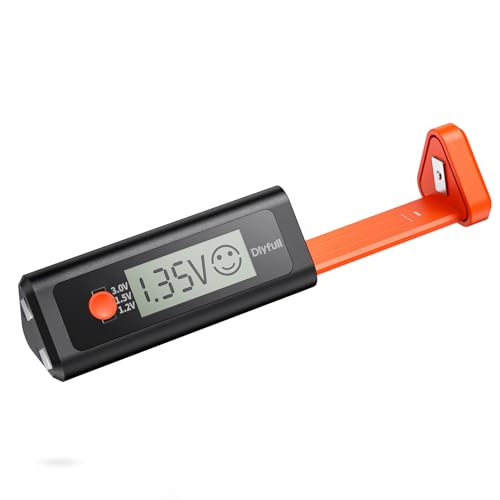
Pros
- Tests AAA, AA, C, D, 9V, CR123A and button cells
- Supports 1.2V rechargeable AA and AAA batteries
- LCD shows voltage plus Good, Weak or Poor icons
- Magnetic hold helps keep batteries steady
- Compact 3.77 x 1.29 x 1.18 in; weighs 1.41 oz
Cons
- Not listed for vehicle batteries
- Only tests compatible household batteries
- No warranty details listed
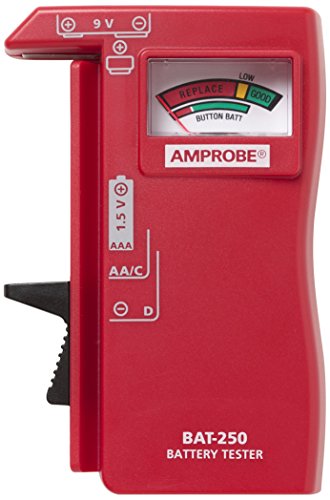
Pros
- Color coded Good, Low, and Replace/Recharge indicators
- Tests 9V, AA, AAA, C, D, and 1.5V button batteries
- Works with standard and rechargeable batteries
- No batteries required to operate
- Compact 3.5 x 3.2 x 6.42 inch size
Cons
- No digital readout mentioned
- No warranty information provided
- Limited to listed battery types
What Matters in Battery Testers for Winter Readiness
Drivers tend to think about the car battery first, but winter also puts pressure on flashlights, carbon monoxide detectors, remotes, emergency radios, and small tools. A useful household battery tester should make a fast call on common cells without adding another powered gadget to maintain.
- What it measures: The main picks focus on household battery health rather than car-starting diagnostics such as CCA or a load test. The Dlyfull Battery Tester is built around everyday 1.5V cells, 9V batteries, and button cells, so it fits the kind of drawer check most people do before winter weather. If you need cold-cranking amps for a vehicle battery, that is a different tool category from these compact testers.
- Display and readability: The easiest testers reduce the result to a simple status scale, not a tiny number you have to interpret while standing in a cold garage. Among the 6 picks, displays include LCD bars, color-coded analog needles, and green, yellow, and red zones. That 3-color approach is useful when you are sorting several cells quickly and only need to know what stays and what goes.
- Compatible battery types: Compatibility matters because AA and AAA cells are rarely the only batteries in a winter drawer. Across the main list, supported formats include AAA, AA, C, D, 9V, and 1.5V button cells, with some models also covering rechargeable cells. Several picks can handle both standard household batteries and rechargeable AA or AAA cells, which helps if you rotate cells through flashlights or emergency gear.
- Build quality and leads: Compact testers are handled, dropped into drawers, and pulled out when batteries are already scattered on the counter. The Tekcoplus Battery Tester lists ABS and stainless steel construction, which is useful for a small tool that relies on clean contact with the cell ends. Its stated operating range is 0°C to 40°C, a practical detail if the tester lives in a garage rather than a kitchen drawer.
- Safety features: A battery tester is not a substitute for winter safety equipment, but it can help you avoid leaving weak cells in devices that matter. The Gardner Bender Battery Tester uses double color-coded scales, which makes the result easier to read at a glance. The CDC also advises installing a battery-operated carbon monoxide detector, and checking those cells before severe weather is a sensible routine.
We excluded jump starters and battery chargers because those are covered in other guides and solve different problems. We also left out shop-grade workshop compressors for tools, since that is a different job than tire inflation and does not help sort AA or AAA cells.
Other Battery Testers Worth Considering
These are other battery testers we looked at but did not put on our main list.
If you want to compare beyond the main 6 picks, Vtechology Battery Tester is another household battery tester with a different size and feature mix. It may make sense if its listing matches the exact cells you keep on hand, but our main picks give a clearer comparison across common AA, AAA, C, D, 9V, and button-cell needs.
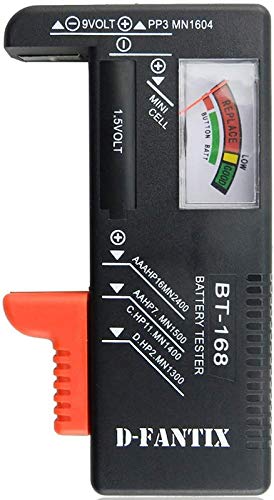
For shoppers who want a familiar compact checker style, D-FantiX Battery Tester is another alternative with a different size and feature mix. The reason it stayed outside the main list is simple: the 6 selected models already cover the core formats most winter drawers collect, while offering clearer stated details about displays or compatibility.
Kkeanic Battery Tester has a 1-year warranty, which is the clearest number attached to this option. That warranty may appeal if support terms matter most, but our top pick lists an 18-month warranty and a 70g weight, giving it more concrete everyday-use detail for a small household tester.
And if you are still comparing compact battery checkers, Tenergy Battery Tester is another alternative with a different size and feature mix. It was not placed on the main list because the selected 6 models already span LCD, analog, and color-zone displays, which gives readers a cleaner set of choices for winter prep.
FAQs
Do I need a battery tester just for AA and AAA batteries?
If your winter gear uses mostly AA and AAA cells, a small tester can save you from guessing which loose batteries are still worth keeping. The main picks also cover other common formats such as C, D, 9V, and 1.5V button cells, so the tool is not limited to only 2 sizes.
Are color zones or LCD readings better for quick winter checks?
Color zones are faster when you only need a keep-or-replace decision, especially with green, yellow, and red status areas. LCD displays can give a more detailed readout, and among the main picks that means either bar-style information or voltage-style feedback depending on the model.
Can these testers check rechargeable AA and AAA batteries?
Some of the main picks list compatibility with rechargeable AA and AAA cells, including 1.2V rechargeable formats. That matters if you use rechargeables in flashlights, radios, or remote controls and want to avoid recharging cells that are still usable.
Why does battery checking matter for winter safety?
The CDC advises installing a battery-operated carbon monoxide detector, and weak cells can undermine that safety step. The CDC also warns that a snow-blocked tailpipe can let carbon monoxide build up quickly inside a vehicle, so winter preparation should include both battery checks and basic vehicle safety checks.
Sources
- Clear Snow from Tailpipes, Centers for Disease Control and Prevention. CDC warning about snow-blocked vehicle tailpipes.
- Safety Guidelines: During & After a Winter Storm, Centers for Disease Control and Prevention. Winter heating safety for space heaters, kerosene heaters and carbon monoxide.




Write Your Review
No reviews yet. Be the first to share your experience!