

Free Delivery. Exclusive Deals. All Prime.
Prime members save on shipping and get first access to deals, plus Prime Video included. 30 days free.
When your desk chair feels like it came from a walk-in freezer, a tall electric heater can help warm one room without turning up the heat for the whole house. The best tower heaters on the market combine focused warmth, shutoff protections, simple controls, and a slim footprint. Our top pick, Hineiber Ceramic Heater, offers 1,500 watts, a 750-watt low setting, and coverage up to 300 square feet. Our alternative pick, Micosong 25-Inch Tower Heater, also delivers 1,500 watts with tip-over and overheat protection.
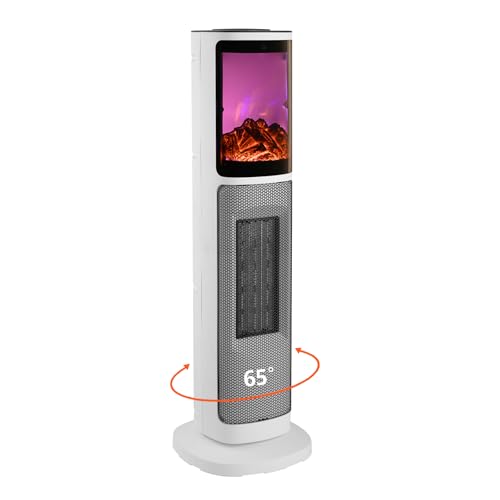
Pros
- 750W and 1500W ceramic heat settings
- Rated for spaces up to 300 sq ft
- 65° oscillation helps spread warmth
- Thermostat adjusts from 59°F to 95°F
- 12-hour timer, remote, tip-over and overheat protection
Cons
- 300 sq ft rating limits it to smaller rooms
- Electric space heaters are for supplemental heat
- 7.87 x 7.87 x 25.2 inch tower needs floor space

Pros
- 1500W PTC ceramic heating
- 75 degree oscillation with two high speed fans
- Tip-over and overheat protection
- Remote control works up to 25 ft
- Low setting noise rated as low as 25 dB
Cons
- Heating area is not specified
- Only one wattage level is listed
- 25 inch tower size may take more floor space
What Matters Most When Comparing Tower Heaters On The Market
A tower heater is usually bought for one cold room, not for replacing a furnace. That makes the practical details important: wattage, shutoff protection, thermostat control, noise and how far the warm air can spread.
- Heat output for the room size: A 1,500-watt high setting is the common ceiling for plug-in ceramic tower heaters, and both of our picks reach that output. The Hineiber Ceramic Heater adds a 750-watt low setting and is rated for up to 300 square feet, which makes it easier to match heat level to a bedroom, office or similar enclosed space. That lower setting matters when steady warmth is more useful than running at full power the whole time.
- Tip-over and overheat protection: Both main picks include tip-over and overheat protection, two safety features worth prioritizing before style or extras. The U.S. Consumer Product Safety Commission says an automatic cut-off is required to turn off electric or kerosene heaters if they tip over. It also advises choosing a heater certified by a nationally recognized testing laboratory and keeping the unit at least 3 feet from bedding, drapes, furniture or other flammable materials.
- Thermostat range and controls: A useful tower heater should let you choose a temperature, not just blast warm air until the room feels too hot. Among our picks, thermostat control includes a 59 to 95°F range and degree-by-degree adjustment. Remote control also matters for bedrooms and offices, since both picks include remote operation rather than relying only on buttons on the heater body.
- Noise level: Heater noise can be the difference between background comfort and a distraction during sleep or work. One of our picks lists operation as low as 25 dB on its low setting, which is the only specific noise figure available among the main choices. For a quiet room, that number is more useful than a general claim about being quiet.
- Oscillation and heat spread: Oscillation helps a tower heater warm more than the spot directly in front of it. Our top pick has 65-degree oscillation, while the alternative pick has 75-degree oscillation. That 10-degree difference may matter if the heater is placed near the side of a room and needs to sweep across a wider seating or sleeping area.
- Size, weight and portability: A tower shape is meant to fit beside a desk, bed or chair without taking over the floor. One of our picks is 25 inches tall, which gives it a true tower profile while staying easy to place in a room. Weight is also worth checking before buying, especially if the heater will move between an office during the day and a bedroom at night.
We excluded central furnaces and whole-house systems because they need professional installation. We also left out water heaters and heated blankets because they solve different problems, and we avoided unvented fuel heaters without an indoor rating because carbon monoxide risk is the wrong tradeoff for room-by-room warmth.
Other Tower Heaters Worth Considering
These are other tower heaters we looked at but did not put on our main list.
If a very light heater is the priority, Lasko Ceramic Heater is worth a look because it weighs 1 pound versus 4.4 pounds for our top pick. It has 1,500 watts, an adjustable thermostat, ETL certification and an 8-hour timer, but the main list gives clearer room-coverage and thermostat-range details.
For a larger stated coverage area, Mountman 37-Inch Tower Heater lists 1,500 watts with a 1000-watt low setting and coverage up to 500 square feet. Its 120-degree oscillation is wider than either main pick, but it is a different design and feature mix rather than a direct upgrade, especially if you want the lower 750-watt setting on our top pick.
Prefer a more familiar feature set at similar heat output? Pelonis Ceramic Heater has 1,500 watts, an adjustable thermostat, tip-over and overheat protection, and 75-degree oscillation. That matches the alternative pick on oscillation angle, but the main list keeps the comparison tighter around stated room coverage, thermostat range and specific noise information.
Another room-focused option, Uthfy Tower Heater, combines 1,500 watts with a 1000-watt low setting and coverage up to 350 square feet. It also includes an adjustable thermostat plus tip-over and overheat protection. Compared with our top pick, the stated coverage is larger by 50 square feet, but its low setting is 250 watts higher, which gives less separation between low and high heat.
FAQs
What heat output should I look for in a tower heater?
For this group, 1,500 watts is the shared high setting, while low settings range from 750 to 1000 watts among the models with stated low modes. A lower setting can be useful once the room is warm because it gives the heater a less aggressive way to maintain comfort.
Are tower heaters safe to use in a bedroom?
Safety depends on both the heater and how it is placed. The U.S. Fire Administration says to keep anything that can burn at least 3 feet from space heaters and to turn space heaters off when leaving the room or going to bed.
How much thermostat range is useful?
Among our picks, the clearest stated thermostat range is 59 to 95°F. That span gives enough room to choose a modest setting for background heat or a higher setting for a colder room.
Do I need oscillation on a tower heater?
Oscillation is helpful when more than one person shares the room or when the heater sits off to one side. Our picks range from 65 to 75 degrees of oscillation, which is enough to spread warm air beyond a single narrow stream.
Sources
- CPSC Offers Tips to Prevent Home Fires From Space Heaters, U.S. Consumer Product Safety Commission. Fire-safety tips and required safety features for space heaters.
- Heating Fire Safety, U.S. Fire Administration. Home heating fire statistics and prevention messages.
- Safety Guidelines: During & After a Winter Storm, Centers for Disease Control and Prevention. Winter heating safety for space heaters, kerosene heaters and carbon monoxide.





Write Your Review
No reviews yet. Be the first to share your experience!