

Free Delivery. Exclusive Deals. All Prime.
Prime members save on shipping and get first access to deals, plus Prime Video included. 30 days free.
When the garage feels like a walk-in freezer and your coffee cools too fast, a 240-volt heater can deliver the stronger output a small plug-in unit cannot. In this guide to 240v heaters, our top pick is Dura Heat EUH4000, with 4,000 watts, 13,648 BTU, and coverage for spaces up to 500 square feet. For smaller areas, Dr. Infrared Heater DR218 is our alternative pick, offering 3,000 watts in a more compact setup.

Pros
- 5,000 watt electric forced air heater
- 16,400 BTU heat output
- Heats up to 700 sq. ft.
- Compact 13 in. H x 9 in. W x 11 in. D size
- Weighs 9.75 pounds
Cons
- Requires 240 volts and 30 amps
- Coverage is limited to up to 700 sq. ft.
- No safety features listed in the product data

Comfort Zone CZ230ER 7500W Hard-Wired Ceiling Mount Garage Heater
What Stands Out
- 7500W output, the strongest on this list for a 3-car space
- Digital thermostat holds a setpoint instead of running full blast
- Remote control and 12-hour timer for convenience
- Overheat protection built into the hardwired design
Pros
- Real enough wattage to heat a full 3-car garage from cold
- Digital thermostat saves energy over manual-only units
- Remote and timer add genuine daily convenience
Cons
- Highest price point on this list
- Needs a dedicated 240V circuit sized for 7500W draw

Pros
- 3000W output with separate high and low heat settings
- IPX4 rated, protected against water splashing
- Weighs just 13 pounds for easy portability
- Enclosed heating element and heating system for low maintenance
Cons
- Requires a 240V, 20A outlet rather than a standard household plug
- No thermostat, timer or remote control mentioned in the listing
- Compact 10 x 10 x 15 inch size may limit coverage in larger spaces
How to Choose a 240-Volt Heater for a Room, Garage or Workshop
A 240-volt heater is not a casual countertop appliance. It should match the room size, the circuit, and the way people move through the space.
For this category, the most useful comparison points are output, safety hardware, controls, sound and placement. A heater rated for 700 square feet serves a different job than one rated for 1250 square feet.
- Heat output and room size: Start with watts and stated coverage, because both numbers shape how useful the heater will be. The Dura Heat EUH5000 gives you 5,000 watts and 16,400 BTU, with coverage up to 700 square feet. That makes our top pick better suited to a garage bay or workshop than a small office corner. Among our picks, output runs from 3,000 watts to 7,500 watts.
- Tip-over, overheat protection and certification: Safety matters more with high-output heaters because they often run in garages, storage areas or workrooms with clutter nearby. According to the U.S. Consumer Product Safety Commission, portable or fixed local heaters were associated with about 10,900 residential fires and about 190 deaths in a recent year. The agency says an automatic cut-off is required to shut off electric or kerosene heaters if they tip over. It also advises choosing a heater certified by a nationally recognized testing laboratory.
- Thermostat range and controls: Controls decide whether the heater can hold a steady temperature or simply blast heat until someone intervenes. The Comfort Zone CZ230ER includes an adjustable thermostat and a 12-hour timer, and it is rated at 7,500 watts. It also lists coverage up to 1250 square feet, so the remote and digital thermostat make sense for a heater that may be mounted overhead. Two of our picks include thermostat control, while the greenhouse-style option focuses on high and low operation.
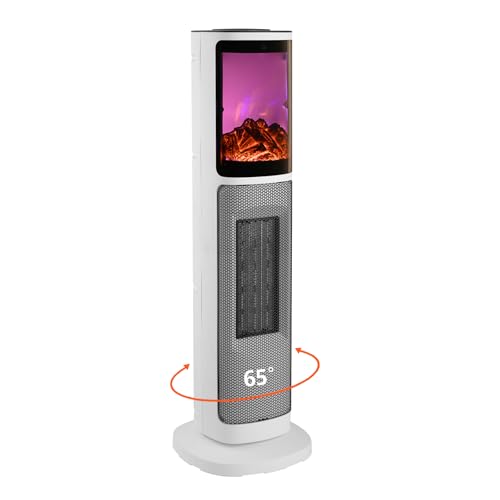
- Noise level: Fan-forced heaters move heat quickly, but the moving air can matter in a shop where you listen for tools, calls or machinery. Only one other option in this article gives a listed sound figure, at 65 dB, which is useful as a comparison point for shoppers who care about noise. For our main picks, the available product information does not give a decibel rating. When no dB number is listed, it is better to compare placement, fan type and room size rather than assume one model is quieter.
- Oscillation and heat spread: Heat spread depends on fan force, louvers, mounting angle and coverage area. One main pick uses adjustable louvers and a variable mounting angle, which helps direct warm air across a larger work area. Coverage among our picks ranges from 700 square feet to 1250 square feet for the models that state a room-size rating. If you need heat in one bench area, directed airflow can be more useful than wider coverage.
- Size, weight and portability: Weight matters if you plan to move the heater between a greenhouse, garage and workshop. The Dr. Infrared Heater DR218 is described as lightweight and portable, with a 240V, 20A outlet requirement and 3,000 watts of output. Our alternative pick is aimed at users who want a movable unit rather than a hard-wired ceiling installation. The main list includes both portable and mounted designs, so placement should be decided before purchase.
We excluded central furnaces and whole-house systems because they call for professional installation. We also left out water heaters and heated blankets because they solve different problems, and we avoided unvented fuel heaters without an indoor rating because carbon monoxide risk is not a trade-off worth making indoors.
The Competition
These are other heaters we looked at but did not put on our main list.
If you want a ceiling-mounted unit but do not need the strongest match for this search, Comfort Zone Ceiling Heater has 5,000 watts and an adjustable thermostat. Its 20.4-pound weight is more than a portable shop heater, and it does not line up with the main list as closely for shoppers comparing stated coverage, controls and installation type.
For a similar power class with a safety credential, Comfort Zone CZ220BK offers 5,000 watts, an adjustable thermostat and ETL certification. That is 1,000 watts more than the top-pick fi gure stated in the comparison, but its 20.4-pound weight points to a more fixed installation mindset than a portable one.
If high wattage is the main draw, InoKraft Space Heater reaches 7,500 watts and is rated for up to 750 square feet. Its listing also gives a 65 dB noise figure, which is helpful if sound matters in a work area. The coverage number is lower than the 1250-square-foot ceiling-mounted main pick, even though both share the same wattage figure.
Prefer a lower-output ceiling heater with safety features called out plainly? Mr. Heater Ceiling Heater has 3,000 watts plus tip-over and overheat protection. At 19.5 pounds, it is much heavier than a portable greenhouse-style option, so it makes more sense for a set location than for frequent repositioning.
FAQs
What size room can a 240-volt heater handle?
Among our main picks, stated coverage reaches up to 700 square feet on one model and up to 1250 square feet on another. A 3,000-watt heater can make sense for a smaller or more focused area, while a 7,500-watt unit is aimed at a larger garage or workshop.
Are 240-volt heaters safe for garages?
They can be, but placement and shutoff features matter. The U.S. Fire Administration says to keep anything that can burn at least 3 feet from space heaters and to turn space heaters off when leaving the room or going to bed.
Do I need a special outlet for a 240-volt heater?
Many 240-volt heaters require a dedicated 240V circuit, and one main pick specifies a 240V, 20A outlet. Another uses a hard-wired ceiling-mounted installation, so the electrical setup should be checked before choosing a model.
What safety features should I look for in this kind of heater?
The Centers for Disease Control and Prevention recommends electric space heaters with automatic shut-off switches and non-glowing elements. The Consumer Product Safety Commission also says heaters should be certified by a nationally recognized testing laboratory and placed on a level, hard, nonflammable surface.
Sources
- CPSC Offers Tips to Prevent Home Fires From Space Heaters, U.S. Consumer Product Safety Commission. Fire-safety tips and required safety features for space heaters.
- Heating Fire Safety, U.S. Fire Administration. Home heating fire statistics and prevention messages.
- Safety Guidelines: During & After a Winter Storm, Centers for Disease Control and Prevention. Winter heating safety for space heaters, kerosene heaters and carbon monoxide.





Write Your Review
No reviews yet. Be the first to share your experience!