

Free Delivery. Exclusive Deals. All Prime.
Prime members save on shipping and get first access to deals, plus Prime Video included. 30 days free.
When seed trays look healthy at dinner but droop by breakfast, your greenhouse may need steadier heat. The right space heaters for greenhouse use add directed, portable warmth where plants need it most. Vevor 5,100 BTU Ceramic Heater is our top pick, with 1,500 watts, 5,100 BTU output, and ETL certification. SmterCon Space Heater is our alternative pick, with 1,500 watts rated for coverage up to 120 square feet.

Pros
- 1500W PTC heater with 5100 BTU output
- 3 speed setting with three level adjustment knob
- Hot and cold modes for year round fan use
- ETL certified with overheat protection
- 3.57 lb weight with portable handle
Cons
- No heating area coverage listed
- No timer or thermostat range listed
- IP20 protection is not listed as water resistant

Pros
- 1500W heater warms up in 3s
- Heats spaces up to 120 sq. ft.
- Digital thermostat powers heater on and off
- Independent overheat protection
- Adjustable ventilation for air circulation
Cons
- 120 sq. ft. coverage limits larger spaces
- No tip-over protection listed
- No noise level or cord length listed

Pros
- 1500W electric PTC heater
- Low and high heat modes
- Fan mode for air circulation
- 40° manually adjustable heat angle
- 2.8 lb weight with portable handle
Cons
- Heating area is not specified
- No thermostat range listed
- No tip-over shutoff listed

Pros
- 1500W high and 750W low heat settings
- Thermostat range from 50 to 95°F
- Tip-over protection beyond 45 degrees
- Overheat shutoff above 144°F
- Compact 5.5 x 9 x 7 inch size
Cons
- Small electric heater, not a whole-home heating system
- Heating works only above current room temperature
- No timer or remote listed in the product data

Pros
- 1500W heating element for fast, even warmth
- Heating and fan modes with two temperature settings
- 25° adjustable angle directs heat to the desired area
- IPX4 rated with overheat shutoff for dependable operation
- Lightweight at 7.12 pounds with a portable carry handle
Cons
- No thermostat range or remote control mentioned in the listing
- No timer function included
- Flame-retardant PP housing is a basic safety feature, not a full certification
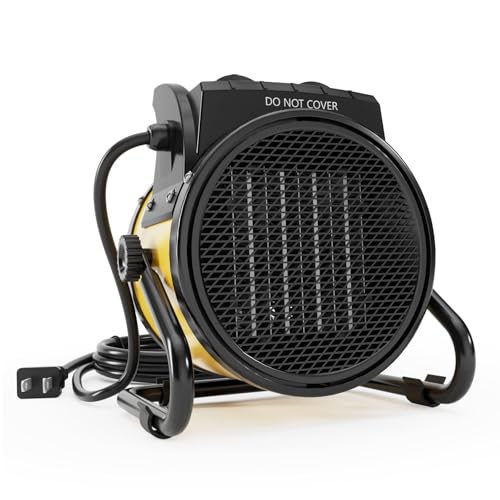
Pros
- 3 heat settings: 20W, 750W, and 1500W
- 3S PTC ceramic element for quick heat-up
- Covers spaces up to 160 sq ft
- Overheat protection is built in
- Compact 8 x 9 x 7 inch portable design
Cons
- Coverage is limited to up to 160 sq ft
- No thermostat is listed in the product data
- Best for covered patios or well-ventilated garages
What We Looked For in Space Heaters for Greenhouse Use
A greenhouse heater has to do more than make a corner feel warm. It should move enough heat for the room size, shut itself down when conditions get unsafe, and be simple enough to adjust before a cold night.
- Heat output for the room size: Most of our picks top out at 1,500 watts, which is the common ceiling for plug-in electric heaters. The Vevor 5,100 BTU Ceramic Heater adds a stated 5,100 BTU output, giving it the clearest heat-output claim among the main list. It also has 3 heat levels, so it can run ventilation or lower warmth when full output is not needed.
- Tip-over protection, overheat protection and certification: Safety mattered because greenhouses often have plastic pots, dry leaves and extension-cord temptation nearby. The U.S. Consumer Product Safety Commission says heaters should be certified by a nationally recognized testing laboratory, and it says electric heaters need an automatic cut-off if they tip over. Among our picks, overheat protection appears repeatedly, while tip-over protection appears on 1 main-list model.
- Thermostat range and controls: Greenhouse heat is easier to manage when the heater is not simply on or off all night. The Vevor Space Heater combines 1,500 watts with an adjustable thermostat, which gives it a more plant-focused control setup than models that only list fixed heat modes. Across the group, controls range from 2 heat settings to 3 selectable modes.
- Noise level: A heater in a greenhouse does not need to be silent, but a fan that runs for hours should not be distracting if the structure is attached to a workshop or home office. One non-main alternative lists 43 dB, giving shoppers a useful reference point for what a quieter ceramic heater may claim. Among the main picks, only 1 product states low-noise operation, so this category favored heaters that also offered fan or ventilation modes.
- Oscillation and heat spread: We did not require oscillation because the main picks focus more on angled airflow and fan-assisted heating. Heat direction still matters, and the group includes adjustable angles from 25 degrees to 40 degrees. Those numbers are useful in a greenhouse because a heater aimed at the walking path wastes heat that could be directed toward a bench or plant row.
- Size, weight and portability: Moving a heater between a grow tent, potting bench and overwintering corner should not be a chore. The Garveetech Ceramic Heater pairs 1,500 watts with a 750-watt low setting, tip-over protection and overheat protection. At 3.1 pounds, it is the lightest featured main-list model, while another featured pick is 3.6 pounds.
We excluded central furnaces and whole-house systems because they require professional installation. We also left out water heaters and heated blankets because they do a different job, and we avoided unvented fuel heaters without an indoor rating because carbon monoxide is too serious a risk indoors.
Other Space Heaters Worth Considering
These are other space heaters we looked at but did not put on our main list.
If you want a familiar ceramic-heater layout rather than a greenhouse-specific housing, Amazon Basics Ceramic Heater is an alternative with 1,500 watts and a 900-watt low setting. It also lists an adjustable thermostat, tip-over protection and overheat protection, but it does not match our top pick’s stated 5,100 BTU greenhouse-oriented heat claim.
Noise-sensitive shoppers may still pause on that model because its listing gives 43 dB, a number the main picks generally do not provide. That makes it easier to judge for an attached sunroom or work area, although our main list gives more attention to angled heat direction and greenhouse use.
For a closer safety-certification match, Fanspex Space Heater is an alternative with 1,500 watts, a 750-watt low setting and ETL certification. It also lists tip-over and overheat protection, which puts its safety feature set closer to what the CPSC recommends for portable heaters.
Controls are the main reason to keep Fanspex Space Heater in mind. Its adjustable thermostat and 2 heat levels resemble the control patterns on several main picks, but our alternative pick has a stated coverage figure of up to 120 square feet, which is more helpful when sizing heat for a small greenhouse.
FAQs
How much power should a greenhouse space heater have?
Our picks cluster around 1,500 watts, with several also offering lower settings such as 750 watts. That matters because a small greenhouse may need full heat before sunrise but less output once the sun warms the structure.
What safety features matter most in a greenhouse?
Overheat protection is important, and tip-over protection is especially useful around pots, hoses and uneven work areas. The CPSC says electric heaters need an automatic cut-off if they tip over, and the CDC recommends automatic shut-off switches and non-glowing elements.
Where should a space heater sit in a greenhouse?
Place it on a level, hard, nonflammable surface, not on a rug or carpet. The CPSC and CDC both say to keep space heaters at least 3 feet from drapes, furniture, bedding or anything else that can burn.
Should a greenhouse heater run overnight?
A heater with automatic shut-off features is safer than a basic unit, but placement and supervision still matter. The U.S. Fire Administration says to turn space heaters off when leaving the room or going to bed, so consider whether your plants need backup heat, insulation or a monitored thermostat instead.
Sources
- CPSC Offers Tips to Prevent Home Fires From Space Heaters, U.S. Consumer Product Safety Commission. Fire-safety tips and required safety features for space heaters.
- Heating Fire Safety, U.S. Fire Administration. Home heating fire statistics and prevention messages.
- Safety Guidelines: During & After a Winter Storm, Centers for Disease Control and Prevention. Winter heating safety for space heaters, kerosene heaters and carbon monoxide.




Write Your Review
No reviews yet. Be the first to share your experience!