

Try Amazon Prime free for 30 days
Fast free delivery on heavy items, plus Prime Video, Prime Music and member-only deal prices.
When the garage feels like a walk-in freezer and your coffee cools before the first sip, small kerosene heaters can bring focused heat without an outlet. After comparing 4 models, the Soixehet 9,000 BTU Kerosene Heater is our top pick for its 9,000 BTU output and tip-over protection. The Papaba 13-Inch Kerosene Heater is the alternative pick if you want another compact 9,000 BTU heater with cooking use.

Pros
- 9000 BTU heat output
- Runs without electricity
- 15 x 15 x 15 inch portable size
- Tip-over protection included
- Flat top can heat food or boil water outdoors
Cons
- Requires kerosene fuel
- Heating area is not listed
- Run time is not listed

Pros
- 9000 BTU radiant heat output
- Heats spaces up to 15 square meters
- 16 to 21 hours burn time per 4.5L refill
- 2-in-1 heater and stove for cooking
- Non-electric operation for power outages
Cons
- 15 square meter heating area limits room size
- Requires kerosene fuel refills
- Fuel heaters require proper ventilation
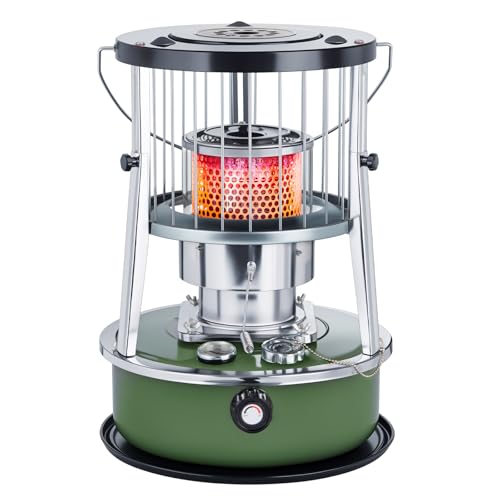
Pros
- 9,000 to 10,000 BTU heat output
- Warms spaces up to 200 to 500 sq ft
- 1.4 gallon tank runs up to 20 hours
- Anti-tip base and protective safety net
- Includes funnel, siphon pump, gloves and extra wicks
Cons
- Heating area is limited to 500 sq ft
- Requires kerosene fuel and refills
- No thermostat is listed
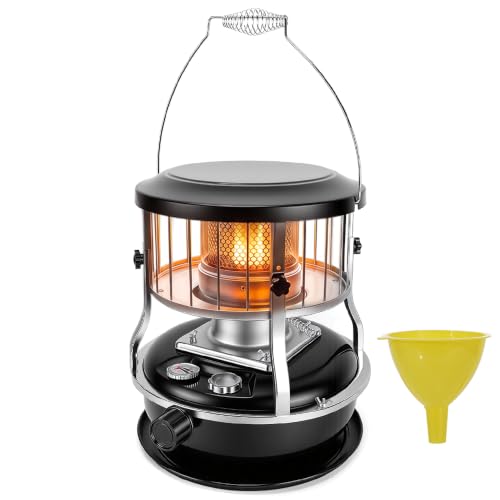
Pros
- 9000 BTU radiant heat output
- Heats spaces of 15 to 20 square meters
- 4.5 L tank runs about 16 to 21 hours
- Non electric design with cooking surface
- Transparent fuel gauge and included funnel
Cons
- 15 to 20 square meter coverage limits larger spaces
- Fuel is not included
- Kerosene heaters need proper fuel handling
What Matters Most in Small Kerosene Heaters
A kerosene heater has to do more than get hot. For a garage, cabin, workshop or outage kit, the useful question is how much heat you get, how long it runs and what safety margins you can maintain indoors.
- Heat output and coverage: The main picks cluster around 9,000 BTU, which is enough for focused heat in a small room, tent, shop corner or emergency zone. The Ahuawa 10,000 BTU Kerosene Heater stands out on paper because it reaches 10,000 BTU and is rated for up to 500 square feet. That wider coverage rating matters if you are trying to warm more than the space directly around your chair or workbench.
- Indoor rating and oxygen depletion: Several of our picks are marketed for indoor use, but that does not remove the need to manage air quality. According to the U.S. Consumer Product Safety Commission, unvented gas heaters should have an oxygen depletion sensor that shuts the heater off if oxygen drops too low. For kerosene models, an indoor claim should be treated as only 1 part of the decision, alongside local rules, fuel type and ventilation.
- Ventilation and carbon monoxide precautions: Kerosene heat is useful during outages because it does not need household electricity, but combustion still changes the air in the room. The Centers for Disease Control and Prevention says to make sure there is proper ventilation if you must use a kerosene heater and to install a battery-operated carbon monoxide detector. The same CDC guidance says to keep space heaters at least 3 feet from drapes, furniture or bedding, which is a simple clearance rule to plan around before you fill the tank.
- Fuel type, tank size and run time: Among the main picks, tank capacity runs from 4.5 liters to 1.4 gallons where capacity is listed. Run time spans about 16 to 21 hours on the 4.5-liter models, while the 1.4-gallon model lists up to 20 hours. That means the longest claims are close, so the practical difference is whether you prefer a liter-marked portable tank or a larger gallon-marked tank.
- Ignition and safety shut-offs: The Soixehet 9,000 BTU Kerosene Heater earns the top slot because it pairs 9,000 BTU heat with tip-over protection. That feature matters because the CPSC says an automatic cut-off is required to turn off electric or kerosene heaters if they tip over. A low, hard, nonflammable surface is still needed, because the same safety guidance says not to place heaters on rugs or carpets.
- Size and portability: Compact heaters are most useful when they can move between a workshop, cabin or outage room without becoming a storage problem. The Lithomy 9,000 BTU Kerosene Heater lists a protective-panel size of about 31 cm by 31 cm by 38 cm, while still providing 9,000 BTU. That combination makes sense for buyers who want a space-saving heater more than maximum coverage.
We excluded central furnaces and whole-house systems because they need professional installation. We also left out water heaters and heated blankets because they solve a different problem, and outdoor-only patio heaters because they are not rated for enclosed spaces.
The Competition
These are other kerosene heaters we looked at but did not put on our main list.
If low weight is your main concern, the Vevor 9,000 BTU Kerosene Heater has a 9.2-pound listing and the same 9,000 BTU output as our top pick. It did not make the main list because the primary picks fit the indoor backup and outage use case more directly, especially where listed safety features or run-time claims are clearer.
For shoppers comparing watt-style output claims, the Titunjian 9,000 BTU Kerosene Heater lists 2,600 watts along with 9,000 BTU. That gives it comparable heat output to our alternative pick, but it does not separate itself enough on coverage, run time or safety details to displace the main list.
Need a much larger heated area? The Dyna-Glo 23,800 BTU Kerosene Convection Heater is rated for up to 1000 square feet and weighs 28 pounds. Those numbers move it into a bigger-heater category than our small picks, which is useful for broader coverage but less convenient if the goal is a compact emergency unit.
And if a higher-output compact heater is appealing, the HeatMate 10,000 BTU Kerosene Heater lists 10,000 BTU and tip-over protection. Its 22.5-pound weight makes it much heavier than the 9.2-pound Vevor, so it was not as strong a match for buyers prioritizing small, easily moved backup heat.
FAQs
How many BTUs should a small kerosene heater have?
Our main picks range from 9,000 BTU to 10,000 BTU, which is the practical zone for focused supplemental heat. For larger spaces, one compared model reaches 23,800 BTU and is rated for up to 1000 square feet, but that is a different size class.
Can small kerosene heaters be used indoors during a power outage?
Some models are marketed for indoor use, but indoor use still requires ventilation and carbon monoxide precautions. The CDC says to make sure there is proper ventilation if you must use a kerosene heater and to install a battery-operated carbon monoxide detector.
How far should a kerosene heater be from furniture or bedding?
The CPSC and CDC both point to a 3-foot clearance from bedding, drapes, furniture or other flammable materials. That clearance can be hard to maintain in a crowded bedroom or small tent, so measure the spot before relying on the heater there.
How long can a small kerosene heater run on one tank?
Among our picks with run-time claims, the range is about 16 to 21 hours from a 4.5-liter tank, with another model listing up to 20 hours from a 1.4-gallon tank. Real-world run time can vary with flame setting, but those numbers show why tank size matters for overnight or outage use.
Sources
- CPSC Offers Tips to Prevent Home Fires From Space Heaters, U.S. Consumer Product Safety Commission. Fire-safety tips and required safety features for space heaters.
- Safety Guidelines: During & After a Winter Storm, Centers for Disease Control and Prevention. Winter heating safety for space heaters, kerosene heaters and carbon monoxide.
- Heating Fire Safety, U.S. Fire Administration. Home heating fire statistics and prevention messages.


Write Your Review
No reviews yet. Be the first to share your experience!