

Try Amazon Prime free for 30 days
Fast free delivery on heavy items, plus Prime Video, Prime Music and member-only deal prices.
When the garage feels cold enough to make a wrench stick to your hand, propane radiant heaters can put heat where a corded space heater cannot. After comparing 6 models, the GasBRUH 15,000 BTU Propane Radiant Heater is the best fit because it reaches 15,000 BTU and includes tip-over protection. The Benass 30,000 BTU Propane Radiant Heater is the stronger alternative, with 30,000 BTU and tip-over protection for larger open areas.

Pros
- 3 heat settings: 9,000, 12,000 and 15,000 BTU
- Up to 28 hours of use on a 20 lb propane tank on high
- Tip-over switch shuts off gas flow if knocked over
- Safety stop valve cuts gas flow when heater is extinguished
- Includes USB windproof lighter for quick ignition
Cons
- Outdoor use only, not rated for indoor or RV interior use
- Propane tank and 20 lb cylinder not included, adds setup cost
- Metal mesh guards and burner surfaces get hot during use
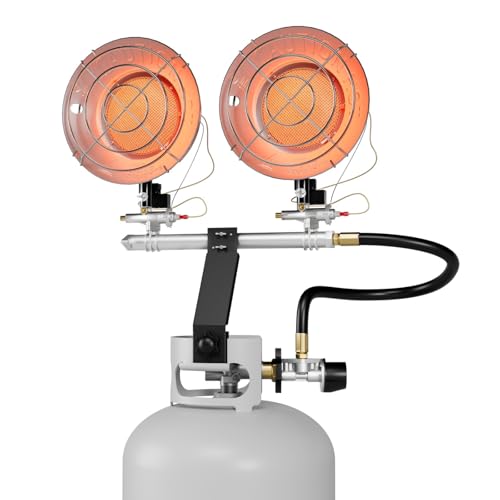
Pros
- 22,000, 26,000, and 30,000 BTU heat settings
- Rated heating area up to 800 sq ft
- Runs up to 20 hours
- Tip-over switch and shut-off valve
- Less than 5 lb heater weight
Cons
- Propane tank is not included
- No thermostat listed
- No indoor-use rating stated

Pros
- 18,000 BTU/hr output
- Heats up to 700 sq. ft.
- Built-in thermostat
- Electronic ignition
- Low oxygen safety shut-off
Cons
- Blower fan kit sold separately
- Requires liquid propane
- 20.66 lb weight

Pros
- 125,000 BTU output for large spaces
- Heats up to 3,125 square feet
- 10 ft hose and regulator included
- Quiet burner technology for forced air operation
- Portable design at 19.67 pounds
Cons
- Built for well ventilated construction sites, barns, warehouses and workshops, not sealed indoor rooms
- No thermostat or temperature control setting listed
- At nearly 20 pounds it is bulkier than small portable heaters

Pros
- 10,000 BTU/HR radiant heater warms spaces up to 300 sq ft
- Piezo ignition allows simple lighting without matches
- 2 heat settings let you adjust warmth level
- No electricity required, useful during power outages
- Weighs 14.46 pounds for easy portability
Cons
- Heating area limited to about 300 sq ft, not for larger rooms
- Restricted for use above 4500 ft elevation
- Runs on liquid propane, requiring a fuel supply on hand
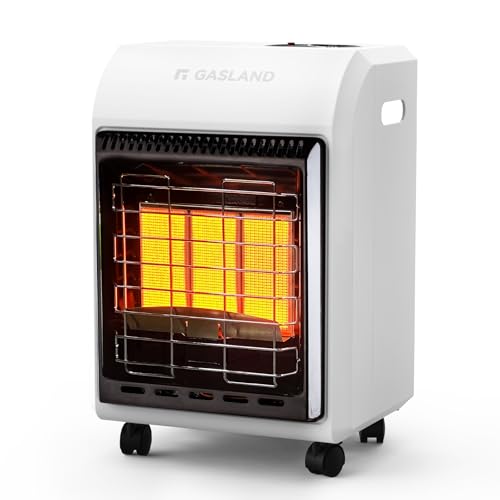
Pros
- 18,000 BTU output heats up to 450 sq ft
- 3 heat modes, High, Medium and Low
- Tip-over and low oxygen shut-off
- Rolling wheels and Easy-Carry handle
- Uses a 20 lb propane cylinder, no electricity needed
Cons
- Requires a 20 lb liquid propane cylinder
- For ventilated garages, offices, workshops and outdoor uses
- 450 sq ft max heating area may not suit larger spaces
How We Chose Propane Heaters for Backup Heat
Propane heat is useful when electricity is limited, but it asks more of the buyer than a simple plug-in heater. Output, room size, fuel setup and safety controls matter because combustion appliances can create fire and carbon monoxide risks.
- Heat output and coverage: BTU output tells you how much heat a heater can produce, but coverage tells you where that output makes sense. The Mr. Heater 125,000 BTU Propane Forced Air Heater is the big-area pick here, with 125,000 BTU and a rating for up to 3125 square feet. That is the right scale for a well ventilated jobsite, barn, warehouse or workshop, not a small bedroom.
- Indoor rating and oxygen depletion sensing: For enclosed spaces, an indoor-safe rating and an oxygen depletion sensor carry more weight than raw heat. The Mr. Heater 18,000 BTU Propane Radiant Heater is rated for up to 700 square feet, has 18,000 BTU output and includes a built-in thermostat. It also weighs 20.7 pounds, which keeps it more planted than the lighter tank-top picks.
- Ventilation and carbon monoxide precautions: According to the Centers for Disease Control and Prevention, any kerosene heater use should have proper ventilation, and a battery-operated carbon monoxide detector should be installed. The U.S. Consumer Product Safety Commission also says unvented gas heaters should have an oxygen depletion sensor that shuts the unit off if oxygen drops too low. Among our picks, coverage ranges from 300 square feet to 3125 square feet, so the ventilation plan should match the space rather than the heater alone.
- Fuel type, tank size and run time: Every main pick here is built around propane rather than kerosene or gasoline. Several are designed for a 20 lb propane cylinder, and one tank-top option lists up to 28 hours of use on high. Another tank-top option lists up to 20 hours, which is useful when judging whether a single cylinder can cover an evening in a cold shop.
- Ignition and safety shut-offs: Shut-off behavior is not a small detail when a heater sits near tools, gear or foot traffic. The GasBRUH 15,000 BTU Propane Radiant Heater delivers 15,000 BTU and includes tip-over protection. The U.S. Consumer Product Safety Commission says heaters should be kept at least 3 feet from bedding, drapes, furniture and other flammable materials.
- Size and portability: Portable propane heaters range from less than 5 pounds for a tank-top head to 20.7 pounds for a larger vent-free cabinet-style unit. Two main picks use wheels or tank mounting to make movement easier, while the biggest forced-air unit weighs 19.7 pounds. Portability matters most if the heater moves between a garage, shed and work area rather than staying in one spot.
We excluded central furnaces and whole-house systems because they call for professional installation. We also left out water heaters and heated blankets because they solve different problems, and we avoided outdoor-only patio heaters when the use case required enclosed-space consideration.
Other Propane Heaters Worth Considering
These are other propane heaters we looked at but did not put on our main list.
If you want more heat than our top pick without jumping to a forced-air jobsite heater, Mr. Heater 30,000 BTU Propane Radiant Heater is worth a look. It produces 30,000 BTU and is rated for up to 1000 square feet, which doubles the BTU output of our top pick. Its 26.2-pound weight also makes it heavier than the indoor radiant pick in our main list.
For a smaller space, Mr. Heater Buddy moves in the opposite direction. Its 9,000 BTU output and 225-square-foot rating are both lower than our top pick, so it is better suited to a compact work area than a broad garage bay. At 7.1 pounds, it is one of the easier alternatives to carry.
Need a tank-top heater with more output than our top pick? Mr. Heater 45,000 BTU Propane Radiant Heater reaches 45,000 BTU and includes tip-over protection. Its 5.6-pound weight is still portable, but that much output calls for careful placement and ventilation.
For a lower-output indoor-style setup, ProCom ML100TPA offers 10,000 BTU and a rating for up to 500 square feet. It includes an adjustable thermostat and an oxygen depletion sensor, which are the right safety details to look for in an unvented gas heater. Compared with our top pick, it gives up 5,000 BTU but adds more room-control features.
FAQs
How many BTU do I need for a garage or workshop?
Our picks range from 10,000 BTU to 125,000 BTU, which is a large spread because garages and workshops vary widely. A 300-square-foot space and a 3125-square-foot space should not be treated as the same heating job.
Are propane heaters safe to use during a power outage?
Some propane heaters require no electricity, which can help during an outage, but combustion safety still matters. The CDC recommends installing a battery-operated carbon monoxide detector and using only the type of fuel the heater is designed to use.
How much clearance should a propane heater have?
The U.S. Consumer Product Safety Commission and the U.S. Fire Administration both recommend keeping anything that can burn at least 3 feet from a space heater. That includes furniture, bedding, drapes, boxes and other garage clutter.
What safety features matter most on a propane radiant heater?
Look for tip-over protection, a shut-off valve and, for unvented indoor gas heaters, an oxygen depletion sensor. The U.S. Consumer Product Safety Commission says unvented gas heaters should have an oxygen depletion sensor that shuts the heater off if oxygen drops too low.
Sources
- CPSC Offers Tips to Prevent Home Fires From Space Heaters, U.S. Consumer Product Safety Commission. Fire-safety tips and required safety features for space heaters.
- Safety Guidelines: During & After a Winter Storm, Centers for Disease Control and Prevention. Winter heating safety for space heaters, kerosene heaters and carbon monoxide.
- Heating Fire Safety, U.S. Fire Administration. Home heating fire statistics and prevention messages.


Write Your Review
No reviews yet. Be the first to share your experience!