

Free Delivery. Exclusive Deals. All Prime.
Prime members save on shipping and get first access to deals, plus Prime Video included. 30 days free.
The first cold morning is when a weak battery likes to introduce itself, usually while you are holding coffee and running late. Lithium ion battery testers help show battery condition before the car refuses to cooperate. After comparing 6 models, the Vehlive Battery Tester is the strongest fit because it covers 6V systems, supports hand crank checks, and reads 5 to 3000 CCA. The Dlyfull Battery Tester is the alternative pick for smaller cells, including 3.7V Li-ion batteries.

Pros
- Tests 6V, 12V, and 24V batteries from 5-3000CCA across multiple types
- Multiple testing modes: load, cranking, charging, and sulfation detection
- Reports over 99.99% accuracy with voltage waveform analysis capabilities
- Large backlit digital display for easy reading in low light conditions
- Free software updates and PC printing functionality for test results
Cons
- Requires PC connection for software updates and printing features
- Complex multiple testing modes may require learning curve for new users
- Only includes 3.28 feet of diagnostic cable with some vehicles

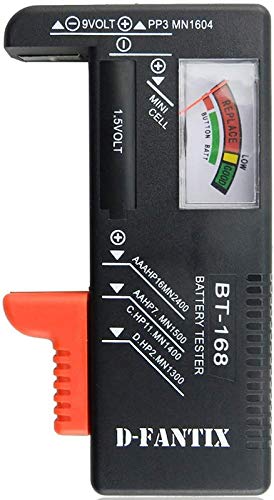
Pros
- Tests 9+ battery types including AA, AAA, C, D, 9V, button cells, and 18650
- LCD display shows voltage and health status: good, weak, or poor
- USB-C rechargeable with up to 15 hours battery life per charge
- Magnetic slot keeps battery secure for one-handed testing
- Compact at 3.7 x 2.5 x 1.1 inches, easy to store and carry
Cons
- USB-C cable included but no power adapter provided
- Only indicates general health categories, not precise capacity readings
- Small 2.5-inch width may be tight for larger hands during operation
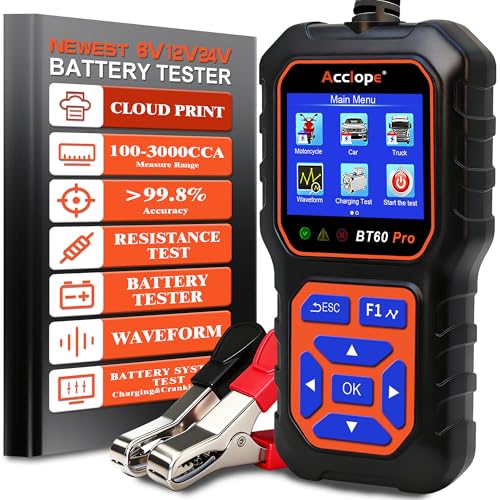
Pros
- Tests 6V, 12V, and 24V batteries with CCA range of 100-3000
- Supports multiple battery types: lead-acid, AGM, GEL, EFB, and lithium
- QR code cloud printing for easy result sharing and record-keeping
- Built-in LED light and wide-mouth clamps for safe testing in low light
- 3.2-inch HD screen with intuitive menu in 12 languages
Cons
- LiFePO4 lithium battery CCA results not guaranteed, voltage/health only
- Not compatible with 48V systems or OBD2 diagnostic functions
- Cannot perform load testing; conductance-based diagnostics only
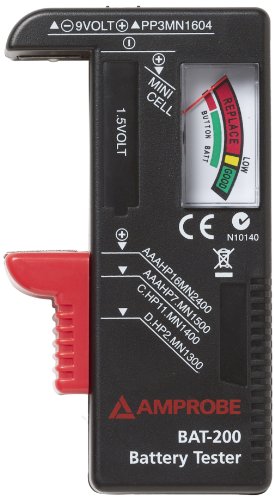
Pros
- Color-coded display clearly shows Good, Low, or Replace/Recharge status
- Tests 9V, AA, AAA, C, D, and 1.5V button-type batteries
- Operates without requiring batteries to function
- Compact size of 7.5 x 4 x 1.25 inches fits easily in a vehicle
Cons
- Does not test larger battery formats needed for some vehicles
- No information provided about display visibility in low light conditions

Pros
- Tests 12V lead-acid and lithium batteries with 40-3000 CCA range
- High precision conductance technology with up to 99.8% accuracy
- Multidimensional diagnostics including charging, voltage, and health tests
- Works on cars, RVs, ships, and lawn mowers
- Instructions in 8 languages including English and Spanish
Cons
- Limited to 12V batteries only, not compatible with other voltages
- No information on warranty, durability, or long-term reliability
- Requires direct battery connection for operation

Pros
- Tests 12V and 24V battery systems
- Supports lead-acid and lithium-ion batteries
- Checks SOC, SOH, voltage and internal resistance
- 2.4-inch color TFT screen with day and night modes
- 31.5-inch cables help reach battery connections
Cons
- Gets power from the battery being tested
- Only supports 12V and 24V systems listed
- No customer review details provided
What Matters in Lithium Ion Battery Testers for Winter Checks
Cold weather makes weak batteries harder to ignore, so a winter battery tester should do more than show a simple pass or fail. The most useful models make the important numbers readable, support the battery types you actually own, and reduce avoidable connection mistakes.
- What it measures: A good automotive pick should report more than voltage, because voltage alone can miss a battery that sags under starting load. The Vehlive Battery Tester covers 6V systems and reads from 5 to 3000 CCA, which makes it useful for a broad winter starting check. It also includes load, cranking, charging, and sulfation test modes, so the reading can point toward the battery, starter, or charging system rather than leaving you with one number.
- Display and readability: Winter checks often happen in a dim garage or driveway, so the screen matters. Among our picks, display styles include color coded indicators, smart LCD readouts, a 2.4-inch color TFT screen, and a 3.2-inch HD screen. A backlit digital display is easier to read when the hood blocks light, while a color coded scale is simpler for quick household battery sorting.
- Compatible battery types: The right tester depends on whether you are checking vehicle batteries, household cells, or both. The Lancol Battery Tester focuses on 12V batteries and supports 40 to 3000 CCA checks across lead-acid and lithium battery types. Other picks cover small cells such as 1.2V Ni-MH, 1.5V alkaline, 3.0V lithium, and 3.7V Li-ion, which is better for flashlights, remotes, and rechargeable cells.
- Build quality and leads: Clamp design and cable reach matter when the battery is tucked under a cowl or mounted in a tight compartment. The Acclope Battery Tester covers 6V systems and supports hand crank checks, with a shock-resistant ABS casing and a 3.2-inch screen for shop-style use. Across the group, one automotive pick lists 31.5-inch cables, while another lists 3.28 feet of diagnostic cable, so lead length is worth checking if your battery access is awkward.
- Safety features: Battery testing should be straightforward, but reversed clamps and shorts are real risks around vehicle batteries. Among our picks, safety details include reverse polarity protection, short-circuit protection, wide-mouth clamps, and an LED light for low-light work. One pick also operates without separate batteries, while another is powered by the battery under test, which reduces the number of power sources you have to manage during a roadside check.
We excluded jump starters and battery chargers because those are different jobs from diagnosing battery health. We also excluded shop-grade workshop compressors for tools, since compressors solve air supply needs rather than battery evaluation.
Other Battery Testers Worth Considering
These are other battery testers we looked at but did not put on our main list.
If you want another automotive-style tester, Topdon Battery Tester is an alternative with 12V coverage and hand crank support. Its feature mix differs from our top pick, which reaches 6V systems and covers 5 to 3000 CCA, so the main list is easier to match to mixed vehicle needs.
For shoppers drawn to onboard power, Dweii Product lists a 99,999 mAh battery. That is a notable number, but it does not line up as closely with this search because our main picks emphasize measured battery health, including voltage, CCA, cranking, and charging diagnostics.
La Crosse Technology Battery Tester is another alternative for people comparing a different size and feature mix. Because our selected group includes small-cell coverage down to 1.2V and vehicle coverage up to 24V, the main list gives a clearer split between household batteries and automotive checks.
And if basic battery checking is the whole reason you are shopping, Tenergy Product remains a capable unit to compare. It was not a main pick because the selected models better match winter vehicle concerns, including 12V and 24V systems, plus cranking or charging system information.
FAQs
What should a lithium ion battery tester measure before winter?
For vehicle use, look for voltage plus a health reading such as CCA, SOC, or SOH. Among our picks, automotive CCA ranges run from 40 to 3000 CCA, which gives more context than a voltage-only check.
Is a small-cell tester enough for a car battery?
Usually no, because small-cell testers are built around formats such as 1.2V, 1.5V, 3.0V, and 3.7V batteries. A car-focused tester should support 12V systems and, if needed, 24V systems for larger vehicles.
Why does display type matter in cold weather?
A readable display helps when you are checking a battery in a garage, driveway, or parking lot with limited light. The selected group includes simple color indicators, LCD screens, a 2.4-inch color screen, and a 3.2-inch screen, so the best fit depends on how much detail you want to read.
What other winter safety checks should drivers remember?
According to the Centers for Disease Control and Prevention, a snow-blocked tailpipe can allow carbon monoxide to build up quickly inside a vehicle. Before driving in snowy conditions, check that the tailpipe is clear of snow, and use a battery-operated carbon monoxide detector at home.
Sources
- Clear Snow from Tailpipes, Centers for Disease Control and Prevention. CDC warning about snow-blocked vehicle tailpipes.
- Safety Guidelines: During & After a Winter Storm, Centers for Disease Control and Prevention. Winter heating safety for space heaters, kerosene heaters and carbon monoxide.




Write Your Review
No reviews yet. Be the first to share your experience!