

Free Delivery. Exclusive Deals. All Prime.
Prime members save on shipping and get first access to deals, plus Prime Video included. 30 days free.
The flashlight works, then it does not, and the junk drawer suddenly becomes a battery guessing contest. Battery testers for all batteries solve that by showing whether a cell is usable before you blame the remote, toy or car. After comparing 6 models, the Dlyfull Battery Tester stands out for 1.5V household coverage, 9V support and 3 status zones. The Kkeanic Battery Tester is the alternative pick, with a 1-year warranty.

Pros
- Tests AAA, AA, C, D, 9V and button-cell batteries
- Magnetic hold helps keep most batteries in contact
- Shows Good, Low and Replace status indicators
- No built-in power supply needed
- Includes an 18-month warranty
Cons
- No magnets on the 9V terminal
- Only listed for household batteries
- Status display is limited to 3 condition levels

Pros
- Tests 20+ battery types including AA, AAA, C, D, 9V, and button cells
- LCD display shows exact voltage readings plus Good/Weak/Poor status indicator
- Real-load testing provides accurate power level assessment in 0.1 seconds
- Compact size (4.7 x 2.8 inches) fits easily in toolboxes or drawers
- Auto power-on at 0.7V and 3-second auto-shutoff conserves battery life
Cons
- Requires one AAA battery for operation (not included with tester)
- LCD screen lacks backlighting for low-light visibility
- Cannot test lithium batteries or provide battery storage case

Pros
- Magnetic tip holds batteries for stable contact
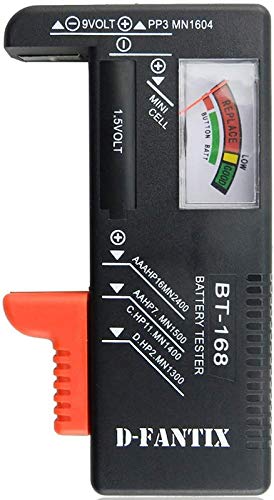
- Checks AAA, AA, C, D, 9V and button cells
- Large analog display for easy reading
- Compact 4.33 x 2.32 x 0.98 inch size
Cons
- Analog display only, no digital readout listed
- No warranty information provided
- Designed for household batteries, not vehicle batteries
Pros
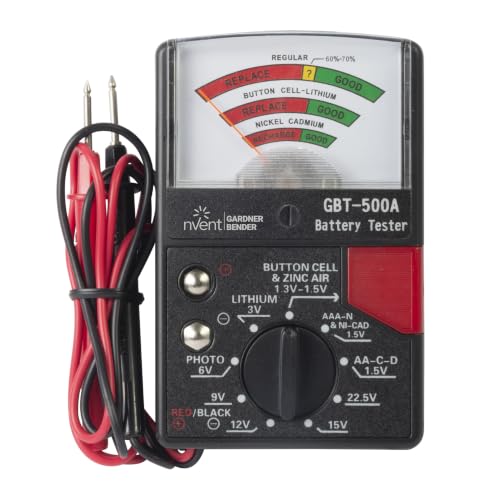
- Analog battery tester with 14 battery ranges
- Includes test leads for easy testing
- Tests common batteries for charge or replacement
- Compact 1.5 x 2.5 x 3.8 inch size
- Light 0.22 pound weight
Cons
- Analog display, not a digital readout
- No warranty terms listed in the data
- Product group is Home Improvement, not automotive
Pros
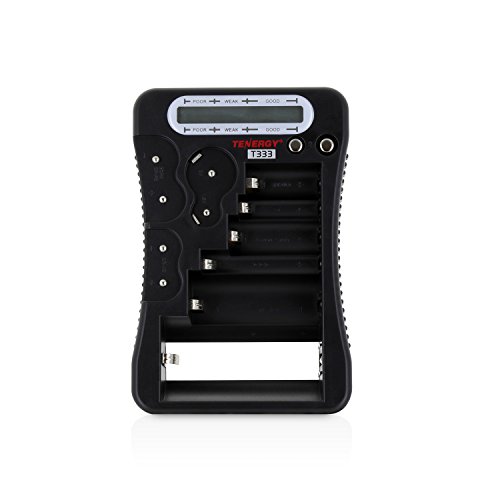
- Tests AA, AAA, C, D, 9V, CR123A, CR2, and button cells
- LCD screen shows poor, weak, or good battery status
- Small 5.25 x 3.5 x 1 inch size
- Includes a battery for tester power
- Includes 1 year warranty support
Cons
- Does not list support for vehicle batteries
- Needs its included battery as a power source
- Made for household batteries, not tire or jump-start tasks

Pros
- Tests 12V batteries from 100-2000 CCA with support for multiple battery types
- Reads State of Health, State of Charge, voltage, current, and cranking/charging system
- Built-in 4-in-1 protection against reverse polarity, short circuits, overcurrent, overvoltage
- Black-and-white screen with adjustable contrast and white backlight for all-light visibility
- Works with cars, trucks, boats, RVs, ATVs, and other 12V vehicles over 30Ah
Cons
- Not compatible with 6V, 8V, 24V batteries, or motorcycles below 30Ah
- Requires entering exact battery type and CCA rating for accurate results
- Cannot test lithium batteries
What Matters in Battery Testers for Winter Battery Checks
Cold weather is hard on batteries, especially when a weak 12V vehicle battery has to crank an engine. A useful tester should tell you more than whether something is dead, while still being simple enough to use before a trip or during a garage cleanup.
- What it measures: Household testers in this group focus mainly on voltage and condition bands, while the automotive pick goes further into CCA, state of health and charging checks. The Ancel Battery Tester is the better match for drivers because it is built for 12V batteries and a 100 to 2000 CCA load capacity. It also includes cranking and charging system checks, which matter more before winter than a simple good or replace reading.
- Display and readability: Readability ranges from analog needles to LCD screens with exact voltage. The Dlyfull Battery Tester keeps the decision simple with 3 color zones, green for good, yellow for low and red for replace. That format is easier when you are sorting AA and AAA cells quickly, while the digital models give more detail when exact voltage matters.
- Compatible battery types: The main group covers common 1.5V household cells, 9V batteries and button cells, with some models adding CR2 or CR123A support. One pick also supports 1.2V rechargeable AA, AAA and AAAA cells, which is useful if you rotate rechargeable batteries through remotes, flashlights and toys. For vehicle use, one pick is limited to 12V batteries over 30Ah and is not meant for lithium batteries.
- Build quality and leads: Contacts matter because a poor connection can make a good battery look weak. The Gardner Bender Battery Tester uses test leads and covers a 12V range, which can be easier than fixed slots when the battery shape is awkward. Among the compact household picks, magnetic or spring-loaded contacts help keep small cells aligned during a quick check.
- Safety features: For car batteries, protection features are more important than they are for a drawer of AA cells. One automotive model includes 4 protections against reverse polarity, short circuits, overcurrent and overvoltage. Winter prep should also include the surrounding safety check: according to the Centers for Disease Control and Prevention, a snow-blocked tailpipe can let carbon monoxide build up quickly inside a vehicle.
We excluded jump starters and battery chargers because they solve different problems after or during a battery failure. We also excluded shop-grade workshop compressors for tools, since that is a different job than tire inflation and not part of checking battery health.
Other Battery Testers Worth Considering
These are other battery testers we looked at but did not put on our main list.
If you want a different size and feature mix, La Crosse Technology Battery Tester is worth a look as an alternative to the household-focused picks. The main list already includes coverage for 1.5V and 9V formats, so this one makes the most sense if its layout better fits how you store and sort batteries.
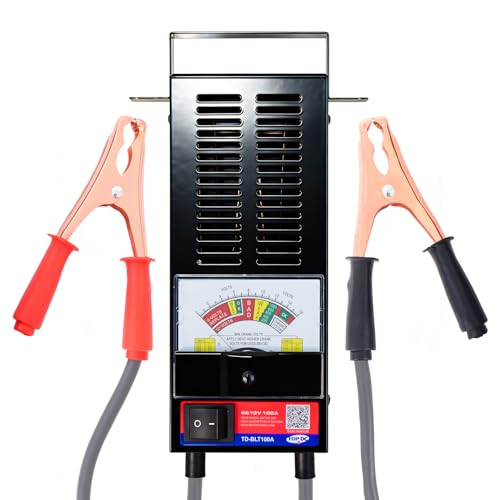
For a driver-first alternative, Topdon Battery Tester belongs in the same conversation as our automotive pick because it is a 12V option with hand crank coverage noted. Compared with our main list, it is less about AA and AAA sorting and more about checking a vehicle battery before a cold start.
FAQs
Do I need one battery tester for household batteries and another for a car?
Often, yes. Household models in our picks cover formats such as 1.5V cells and 9V batteries, while the automotive model is built around 12V vehicle batteries. If winter starting is the concern, look for CCA and cranking checks rather than only a good or replace gauge.
What should a battery tester show before winter driving?
For a vehicle battery, useful readings include 12V battery condition, CCA and cranking performance. For household backup items, a simple good, weak or poor display can help confirm whether flashlights and detectors have usable batteries before a storm.
Are analog or digital battery testers easier to read?
Analog testers can be quick when they use a clear needle and a small number of status zones. Digital testers can show exact voltage, and one pick lists accuracy as plus or minus 1 percent of reading plus 0.02V. The better choice depends on whether you want a fast sorting tool or a more precise number.
What other winter safety checks go with battery testing?
Battery checks are only one part of winter readiness. The CDC says to make sure a vehicle tailpipe is clear of snow before driving, because carbon monoxide is odorless, colorless and deadly. It also advises keeping space heaters at least 3 feet from drapes, furniture or bedding.
Sources
- Clear Snow from Tailpipes, Centers for Disease Control and Prevention. CDC warning about snow-blocked vehicle tailpipes.
- Safety Guidelines: During & After a Winter Storm, Centers for Disease Control and Prevention. Winter heating safety for space heaters, kerosene heaters and carbon monoxide.




Write Your Review
No reviews yet. Be the first to share your experience!