

Free Delivery. Exclusive Deals. All Prime.
Prime members save on shipping and get first access to deals, plus Prime Video included. 30 days free.
The dash clicks, the coffee is cooling, and the driveway has become a very small waiting room. Car battery tester and chargers help you check battery health, cranking ability and charging output before winter turns a weak battery into a late start. After comparing 6 models, the Konnwei Battery Tester is the top pick because it combines 5 amp charging, 12V coverage and hand crank checks. The Lancol Battery Tester is the alternative pick for 12V checks with hand crank support.
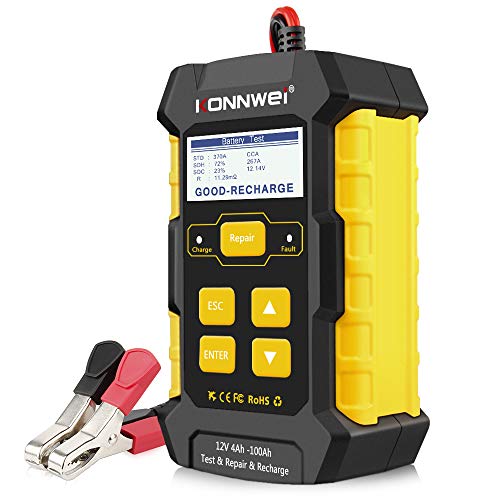
Pros
- 3 in 1 tester, charger, maintainer with pulse repair
- Tests 12V 100 to 2000 CCA lead-acid batteries
- Charges batteries as low as 2V with 12V 5 amp output
- Large color LCD with button controls
- Temp compensation and 8 safety protections
Cons
- For 12V lead-acid batteries only
- Max charging output is 5 amp
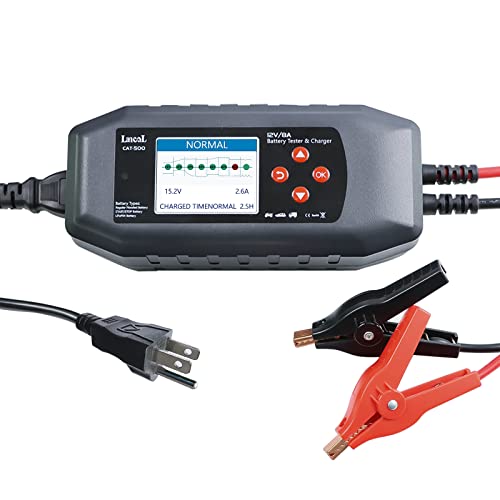
Pros
- Tests 100-3000 CCA batteries
- 8A charging core with 8-step smart charging
- Forced pre-charging for batteries as low as 3V
- Tests battery health, starting, and charging performance
- Works from -20°C to 50°C
Cons
- Only 12V battery support is listed
- No warranty details are provided
- Lithium and lead-acid support, but no battery sizes listed

Pros
- Tests 12V and 24V batteries with 99.9% accuracy across 100-2000 CCA range
- 3-in-1 diagnostics includes cranking, charging, and overall battery health tests
- Operates reliably in extreme temperatures from -4°F to 140°F
- 2.4-inch color LCD display remains readable in direct sunlight
- Compatible with cars, SUVs, trucks, RVs, boats, motorcycles, and equipment
Cons
- Only works with 12V and 24V batteries, not suitable for other voltages
- Requires direct connection to battery terminals for testing
- 1-year warranty is limited compared to some competitor products

Pros
- Tests SOC, SOH, internal resistance and CCA
- Checks starting and charging system performance
- 8-step automatic charging and maintenance process
- Selectable 1A, 3A and 5A charge currents
- IP65-rated resistance to dust and water spray
Cons
- Not for 6V or lithium batteries
- Only compatible with 12V lead-acid battery types
- Larger than a simple handheld tester at 7.09 x 11.22 x 3.74 inches
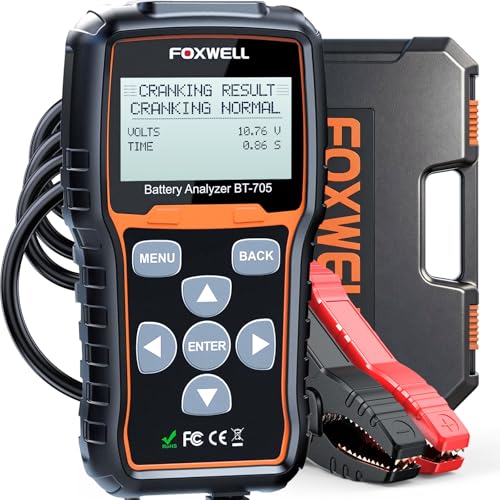
Pros
- Tests 12V and 24V battery systems across 100-2000 CCA range
- 5.9 ft cable allows one-person testing from driver's seat
- Clear results displayed as GOOD, RECHARGE, or REPLACE
- Compatible with Flooded, AGM, GEL, and EFB lead-acid batteries
- Includes hard carrying case for protection and organization
Cons
- Requires step-by-step guidance on screen for each test
- Limited to lead-acid battery types only
- Device dimensions may be bulky for compact storage spaces

Pros
- Works with 12V batteries in cars, trucks, motorcycles, and other vehicles
- LED display shows real-time voltage, battery health, and charging status
- Reverse connection protection with buzzer alarm prevents wiring errors
- Over-voltage protection triggers automatically if voltage exceeds safety limits
- Compact size at 4.72 x 2.75 x 0.79 inches fits easily in any vehicle
Cons
- Only compatible with 12V battery systems, not suitable for 24V vehicles
- No information provided about measurement accuracy or calibration requirements
- LED display readability depends on ambient lighting conditions
What Matters in Battery Testers for Winter Readiness
A battery tester for cold weather has to do more than flash a voltage number. The useful models help you decide whether to recharge, maintain or replace a battery before a freezing morning exposes the problem.
- What it measures: The most useful testers look beyond voltage and check cranking performance or charging system output. Among our picks, CCA coverage runs as high as 3000 CCA, which matters when you are checking larger vehicle batteries. The Konnwei Battery Tester focuses on 12V batteries and adds 5 amp charging, so it fits drivers who want one device for health checks, charging and hand crank assessment.
- Display and readability: A winter battery check is often done in a dim garage or driveway, so screen clarity matters. One pick uses a 2.4-inch color LCD, while another uses a 2.8-inch screen with guided prompts. The Topdon Battery Tester is notable here because it supports 12V systems, includes hand crank checks and carries a 1-year warranty, which gives it a practical mix of visibility and support.
- Compatible battery types: Battery types vary by vehicle, especially if you maintain a car, truck, boat or lawn equipment. Across the main list, compatibility includes flooded, AGM, GEL and EFB lead-acid batteries, depending on the model. Several picks cover 12V batteries, while some also handle 24V systems for larger vehicles.
- Build quality and leads: Cable length and housing design affect whether you can run a cranking check without help. One pick has a 5.9 ft test cable, long enough to reach from the battery area toward the driver’s seat in many vehicles. Protective housings, durable clamps and carrying cases also matter if the tester will live in a trunk or garage cabinet.
- Safety features: Charging and testing around a battery call for protection against connection mistakes and heat. The Ancel Battery Tester offers 5 amp charging, 12V lead-acid support and water resistant IP65-rated protection. Across the group, safety features include reverse-polarity, overcurrent, overvoltage and overheat protection.
We excluded jump starters and standalone battery chargers because those are covered in other guides, even though some overlap with maintenance. We also left out shop-grade workshop compressors for tools, which serve a different job than tire inflation and do not answer the battery-health question.
The Competition
These are other battery testers we looked at but did not put on our main list.
If you want a capable unit with several winter-friendly claims, Foxwell Product brings 5 amp, 12V, hand crank and water resistant details. It still does not match this keyword’s need as closely as the main list because our top pick more directly combines 12V testing with charging and maintenance in one comparison set.
For a higher-output charging angle, Schumacher Electric Product lists 15 amp support and 6V compatibility. That can be useful for some batteries, but the main picks are more focused on the 12V health, cranking and charging checks most drivers are comparing before cold weather.
Craftsman Product takes a similar route with 12 amp output and 6V support. The drawback is fit: the main list stays closer to the everyday automotive need for 12V battery diagnosis, and several picks add cranking or charging-system checks rather than only emphasizing charging current.
And if long support coverage is the reason you are shopping, NOCO Product lists 1 amp, 12V and a 3-year warranty. The low 1 amp output can make sense for maintenance, but shoppers comparing battery health before winter may prefer the broader measuring tools and higher charging current found among the main picks.
FAQs
What should a battery tester measure before winter?
At minimum, it should show 12V battery condition and voltage, but better models add CCA, cranking performance and charging-system checks. Among our picks, CCA ranges reach up to 3000 CCA, which helps with larger batteries and cold-start decisions.
Is a charger function useful on a battery tester?
Yes, especially if the tester can identify a low battery and then maintain it with a controlled current. In this group, charging output ranges from 5 amp to 8 amp on models that include charging, which is enough for maintenance and routine recovery rather than emergency starting.
Do I need 24V support?
Most passenger vehicles use 12V systems, so 12V support covers the common driveway use case. If you also maintain trucks, RVs or commercial equipment, a model with 24V coverage and 100 to 2000 CCA support gives you a wider diagnostic range.
What winter safety steps matter around a car battery check?
According to the Centers for Disease Control and Prevention, a snow-blocked tailpipe can cause carbon monoxide to build up quickly inside a vehicle. Before running a vehicle during any battery or charging-system check, make sure the tailpipe is clear of snow.
Sources
- Clear Snow from Tailpipes, Centers for Disease Control and Prevention. CDC warning about snow-blocked vehicle tailpipes.
- Safety Guidelines: During & After a Winter Storm, Centers for Disease Control and Prevention. Winter heating safety for space heaters, kerosene heaters and carbon monoxide.




Write Your Review
No reviews yet. Be the first to share your experience!