

Free Delivery. Exclusive Deals. All Prime.
Prime members save on shipping and get first access to deals, plus Prime Video included. 30 days free.
When bathroom tile feels like a frozen dinner tray, a wall panel heater can add focused warmth without bringing out a bulky floor unit. The right choice matches wattage, controls, and installation to the room. In this guide to panel heaters under 100, Rovsun Panel Heater is our top pick for its 1,500 watts, coverage up to 400 square feet, and 59 to 99°F thermostat range. FrauSonne Infrared Heater is our alternative pick when 350 watts is a better fit for a smaller area.

Pros
- 1500W output for rooms up to 400 sq ft
- Temperature adjusts from 59 to 99°F
- Three heat levels and 12H timer
- Remote control plus LCD touch panel
- Tip-over and overheat shutoff, under 45 dB
Cons
- Coverage is listed only up to 400 sq ft
- No safety certification is listed in the data
- Under 45 dB operation is quiet, but not silent

Pros
- 350W infrared panel for 3 to 8㎡ areas
- Heats up to 248°F in 3 minutes
- Wall mounting kit and 1.8m power cable included
- One-switch control with no complicated settings
- Overheat protection and TÜV certification
Cons
- Ceiling installation needs additional hardware
- No thermostat, timer, remote, or heat settings listed
- 350W output is suited only to small areas

Pros
- 250W, 853 BTU/hr output for small rooms
- Heats rooms up to 80 sq ft
- Slim 1 x 18 x 24 inch wall panel
- ETL certified and meets UL 2021 standards
- Runs silently with dust-free convection heat
Cons
- Covers only up to 80 sq ft
- 250W output is not for larger rooms
- Wall mounted design is less portable
How We Chose Panel Heaters Under 100 for Room Heating
A panel heater is only useful if its electrical draw and heat output make sense for the room. For a wall-mounted or semi-permanent setup, controls, wiring and safety features matter as much as the heat itself.
- Wattage and room size: A higher-watt heater can warm a larger room faster, while a lower-watt panel is better suited to tight spaces. The Rovsun Panel Heater is the strongest fit here because it is rated at 1,500 watts and up to 400 square feet. Its thermostat range of 59 to 99°F also gives it more adjustment room than a simple on-off panel. It also includes tip-over and overheat protection, which matters for a freestanding or mounted heater.
- 120V versus 240V wiring: For this list, plug-in convenience mattered because a 120V heater can use standard household power when the product is designed for it. One of our picks lists 120V operation, which is useful for bedrooms, bathrooms, RVs and other small rooms where adding a 240V circuit would complicate the job. Hardwired 240V heaters can make sense in a renovation, but they are less friendly for a simple under-cabinet or wall-panel upgrade.
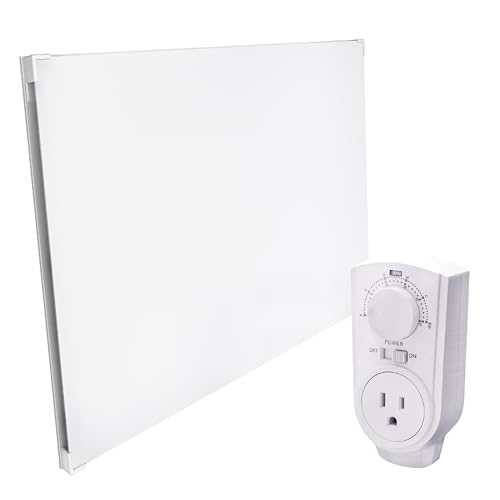
- Thermostat accuracy and controls: Adjustable controls help prevent a small room from swinging between too cold and too warm. The Amaze-Heater Wall Heater is rated at 250 watts and up to 80 square feet, and it works with an adjustable plug-in thermostat. It is also ETL certified, which is important because the U.S. Consumer Product Safety Commission recommends choosing heaters certified by a nationally recognized testing laboratory.
- Installation type: We favored panel heaters that make wall placement part of the design rather than an afterthought. Among our picks, one model measures 1 inch deep and includes a wall mount kit, while another includes mounting hardware for wall installation. A thinner panel is easier to place where floor space is limited, but mounting still needs a flat location and clearance from flammable items.
- Safety protections: Automatic shutoff is not a minor feature. The U.S. Fire Administration says portable heater fires accounted for 41 percent of fatal home heating fires in a multi-year period, even though they were only 3 percent of home heating fires. The Centers for Disease Control and Prevention also recommends electric space heaters with automatic shut-off switches and non-glowing elements, and it says to keep heaters at least 3 feet from drapes, furniture or bedding.
- Surface temperature: Surface heat affects where a panel can be placed and how carefully it needs to be managed around people, towels and furniture. Among our picks, one infrared panel is listed as reaching 248°F in 3 minutes, so placement and clearance are not optional details. Another pick uses non-conducting materials and is described for accidental touch, which is a different approach to managing the surface people may brush against.
We excluded central furnaces and whole-house systems because they usually require professional installation. We also excluded water heaters and heated blankets because they do a different job, and unvented fuel heaters without an indoor rating because carbon monoxide risk is not worth treating as a small-room convenience.
The Competition
These are other panel heaters we looked at but did not put on our main list.
If a timer is high on your list, HotCalyto Space Heater brings a 12-hour timer with a 300-watt panel and a listed weight of 6.4 pounds. That makes it easier to understand than a no-control panel, but it does not match our top pick for room coverage or thermostat range.
For shoppers focused on a lower-power wall panel, SoliSnug Space Heater uses 300 watts. That puts it closer to our alternative pick than to our top pick, but the main list gives clearer reasons to choose by room size, controls and installation details.
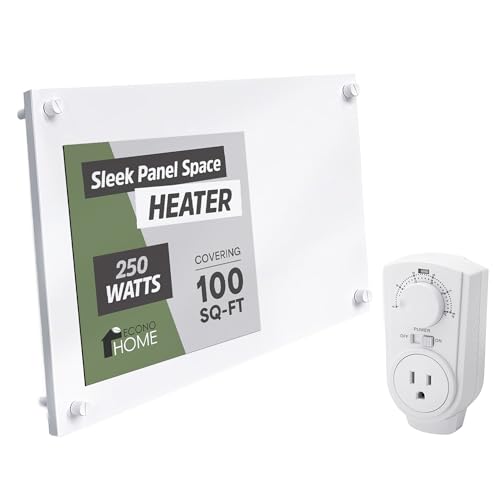
Prefer a compact wall heater with certification clearly stated? EconoHome Wall Heater is a 250-watt panel rated for up to 100 square feet, with a thermostat range of 41 to 86°F and UL certification. Those numbers are useful, but our main list balances similar small-room wattage with wall-kit details and thermostat compatibility.
And if high output is the reason you are shopping, De’Longhi HMP1500 offers 1,500 watts, an adjustable thermostat and both tip-over and overheat protection. Its listed weight is 10.1 pounds, which is a practical detail for moving or mounting, but it was not as closely aligned with the permanently installed or wall-mounted focus as the main picks.
FAQs
What wattage should a wall panel heater have for a small room?
Our picks range from 250 to 1,500 watts, which is a wide spread because room size changes the right answer. A 250-watt panel is aimed at a much smaller area than a 1,500-watt heater rated for up to 400 square feet.
Do panel heaters under 100 need special wiring?
Not always. One of our picks is listed for 120V operation, while 240V wall heaters are a different installation category and may require electrical work beyond plugging into a standard outlet.
Are thermostat controls worth it on a panel heater?
Yes, especially in a bedroom, bathroom or office where overheating a small space gets uncomfortable quickly. Among our picks, thermostat control ranges from plug-in thermostat compatibility to an onboard range of 59 to 99°F.
How much clearance should I leave around a panel heater?
The U.S. Consumer Product Safety Commission and the Centers for Disease Control and Prevention both advise keeping space heaters at least 3 feet from bedding, drapes, furniture and other things that can burn. The CDC also says never to cover a space heater, which matters even when a panel looks flat and unobtrusive.
Sources
- CPSC Offers Tips to Prevent Home Fires From Space Heaters, U.S. Consumer Product Safety Commission. Fire-safety tips and required safety features for space heaters.
- Heating Fire Safety, U.S. Fire Administration. Home heating fire statistics and prevention messages.
- Safety Guidelines: During & After a Winter Storm, Centers for Disease Control and Prevention. Winter heating safety for space heaters, kerosene heaters and carbon monoxide.




Write Your Review
No reviews yet. Be the first to share your experience!