

Free Delivery. Exclusive Deals. All Prime.
Prime members save on shipping and get first access to deals, plus Prime Video included. 30 days free.
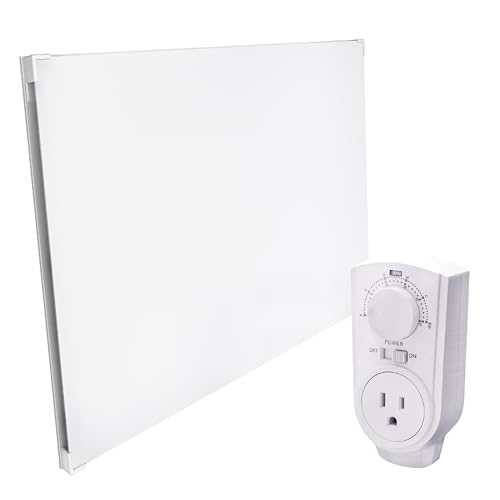
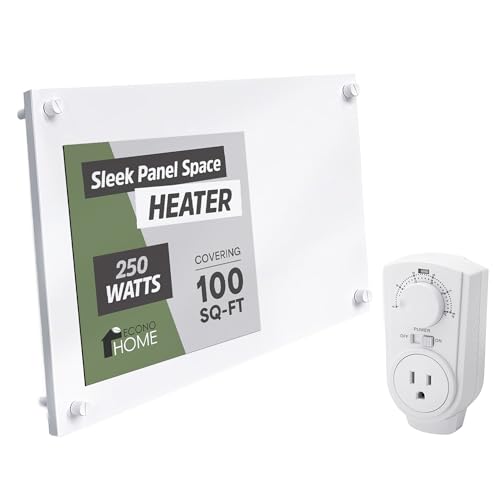
Everyone at dinner gathers on the warm side of the table, while the seat by the far window still feels chilly. Panel heaters for large room corners can mount flat on a wall and add quiet warmth to that cold zone without a fan blowing dust around. Our top pick is EconoHome Wall Heater, a 400-watt option rated for up to 120 square feet per panel with a thermostat range of 41 to 86°F. Our alternative pick is pasapair Panel Heater, with 1,500 watts for rooms up to 250 square feet.
Pros
- 400W convection heater rated for rooms up to 120 sq ft
- Adjustable thermostat with 41-86°F temperature range
- cETL approved and UL-2021 & RoHS compliant for safety standards
- Heat guard cover keeps exterior casing safe to touch
- No fan operation for quiet, dust free heating
Cons
- Limited to smaller spaces, not suited for rooms larger than 120 sq ft
- No mention of tip-over or overheat protection in the provided data
- Installation may require wall mounting or hard wiring, which adds setup effort

Pros
- 1500W heat with 600W, 900W, and 1500W settings
- Covers rooms up to 250 sq. ft.
- 41°F to 97°F thermostat range
- Wi-Fi app, Alexa, remote, and touch controls
- Tip-over and overheat protection
Cons
- Limited to rooms up to 250 sq. ft.
- Requires 2.4 GHz Wi-Fi, 5 GHz not supported
- Remote needs 2 AAA batteries, not included

Pros
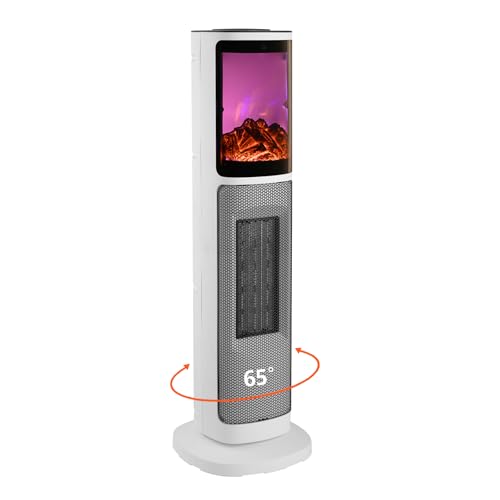
- 1500W output for rooms up to 400 sq ft
- Temperature adjusts from 59 to 99°F
- Three heat levels and 12H timer
- Remote control plus LCD touch panel
- Tip-over and overheat shutoff, under 45 dB
Cons
- Coverage is listed only up to 400 sq ft
- No safety certification is listed in the data
- Under 45 dB operation is quiet, but not silent
Pros
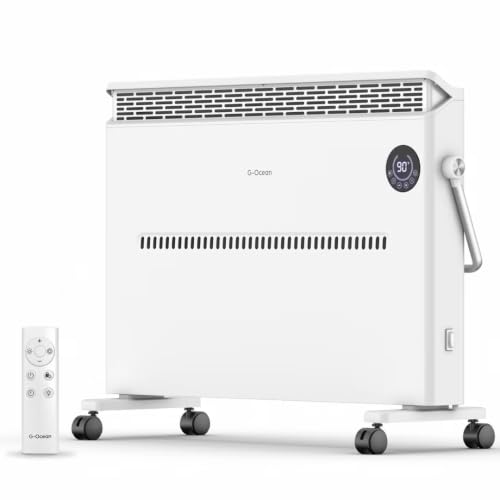
- 1500W, 1000W, and 500W heat settings
- Thermostat range from 60°F to 90°F
- 25 to 30 dB quiet convection operation
- 12H timer and remote control
- Tip-over protection and overheat shutoff
Cons
- No square footage heating area is listed
- Convection heat may feel slower than fan-forced heat
- Large 29.49 x 23.43 inch panel needs wall or floor space

Pros
- 1500W electric convection panel heater
- Primary heat for rooms up to 250 sq ft
- WiFi app, remote, digital panel, and Alexa control
- Tip-over protection, overheat protection, 24-hour timer
- Freestanding on casters or wall-mounted
Cons
- Primary heating listed only up to 250 sq ft
- May take 1 to 2 hours to warm an entire room
- Electric convection heat is not for outdoor use
What We Looked For in Panel Heaters for a Large Room
A large room loses heat in more places than a small one, so a panel heater has to match the space, the wiring behind the wall and the people living in it. These are the points we weighed, in order of importance.
- Wattage and room size: Among our picks, output runs from 400 to 1,500 watts. Rated coverage runs from 120 to 400 square feet. The Rovsun Panel Heater sits at the top of that range: it pairs 1,500 watts with a rating of up to 400 square feet, which makes it the most direct answer for an open living room. Another pick is rated for 250 square feet as a primary heater and only for supplemental warmth beyond 500 square feet. A low-wattage panel works best in a large room as one of several units.
- 120V versus 240V wiring: Many permanently installed wall heaters run on 240-volt circuits, which means a dedicated breaker and usually an electrician. Two of our picks list 120 volts outright, so they work from a standard household outlet. One pick draws just 3.33 amps, low enough to share a circuit with lamps and a TV. Check your breaker before adding a full-power unit to a circuit that already carries other loads.
- Thermostat range and controls: Thermostat ranges across our picks start as low as 41°F and top out at 99°F. The G-Ocean Wall Heater steps between 1,500, 1,000 and 500 watts, so it can hold a large room at its set point instead of cycling hard at full power. Its thermostat covers 60 to 90°F, and the listing puts operation at 25 to 30 dB, quiet enough for a bedroom. Four of our picks include a remote, and two also connect to an app and Alexa.
- Installation type: Four of our picks can either hang on a wall or stand on a base or casters, which helps renters. The EconoHome Wall Heater is the true fixed option: a 24 by 24-inch panel about 0.4 inches thick that mounts with included hardware and can be hard-wired. At 400 watts, it suits one cold zone of up to 120 square feet, so a large room can take two panels on separate walls. Its plug-in thermostat runs from 41 to 86°F, and it carries cETL approval.
- Safety protections: The U.S. Consumer Product Safety Commission says electric heaters need an automatic cut-off that turns them off if they tip over. It also recommends a heater certified by a nationally recognized testing laboratory. Four of our picks list both tip-over and overheat shutoff, and one adds a child lock. According to the U.S. Fire Administration, portable heater fires accounted for 41 percent of fatal home heating fires, which is why those switches matter.
- Surface temperature: The CDC recommends electric heaters with non-glowing elements. Four of our picks describe convection or mica elements behind a panel or grille. One ships with a heat guard that keeps the exterior casing warm but safe to touch, and another uses a flame-retardant shell. Even so, the CPSC and the U.S. Fire Administration both say to keep anything that can burn at least 3 feet away.
We left out central furnaces and whole-house systems because they need professional installation. Water heaters and heated blankets do a different job. We also skipped unvented fuel heaters without an indoor rating, since they carry a carbon monoxide risk indoors. A few more electric panels came close, and they are worth a look.
Other Panel Heaters Worth Considering
These are other panel heaters we looked at but did not put on our main list.
Want a familiar brand at full power? The De’Longhi HMP1500 delivers 1,500 watts, nearly four times the 400 watts of our top pick, with an adjustable thermostat plus tip-over and overheat protection. At 10.1 pounds it moves easily between rooms, but our alternative pick matches its output and adds a 600-watt low setting.
Its sibling, the De’Longhi HCX9115E, also runs at 1,500 watts and keeps the same tip-over and overheat protection. What it adds is a 24-hour timer, useful if you want the heat off before the room empties. It is a reasonable swap for our alternative pick, though it lacks that pick’s 250-square-foot rating.
Closer in spirit to our top pick, the ENVI Wall Heater is a 500-watt panel that weighs 10 pounds. That is only 100 watts more than our top pick, so it fits the same low-draw, wall-mounted approach. It is a fair choice if you plan to run several small panels across one big room.
And if raw coverage is the whole reason you are shopping, the Ballu Convection Heater is rated for up to 500 square feet, with an adjustable thermostat and a 24-hour timer. It is capable, but it does not suit a wall-mounted, room-by-room setup as closely as the main list.
FAQs
How many watts does a panel heater need for a large room?
Our picks range from 400 to 1,500 watts, with rated coverage from 120 to 400 square feet. A single 1,500-watt panel can carry a big space, while 400-watt or 500-watt panels work better in pairs on opposite walls.
Do I need a 240-volt circuit for a wall-mounted panel heater?
Not for the models on our list. The picks that state their voltage use 120 volts and plug into a standard outlet, and one of them can be hard-wired if you prefer a built-in look.
How far should a panel heater be from furniture and curtains?
The CPSC, the U.S. Fire Administration and the CDC all say at least 3 feet from bedding, drapes and furniture. The CDC adds that you should never cover a space heater, so skip drying heavy laundry over one.
Can I leave a panel heater running overnight?
The U.S. Fire Administration advises turning space heaters off when you leave the room or go to bed. If you do run one at night, choose a unit with automatic overheat shutoff and set the thermostat low, such as a 41°F frost-protection setting in an empty room.
Sources
- CPSC Offers Tips to Prevent Home Fires From Space Heaters, U.S. Consumer Product Safety Commission. Fire-safety tips and required safety features for space heaters.
- Heating Fire Safety, U.S. Fire Administration. Home heating fire statistics and prevention messages.
- Safety Guidelines: During & After a Winter Storm, Centers for Disease Control and Prevention. Winter heating safety for space heaters, kerosene heaters and carbon monoxide.



Write Your Review
No reviews yet. Be the first to share your experience!