Skip to content
Hoomerly: Home Product Reviews, Buying Guides & Smart Picks
  • Categories
    • Home & Kitchen
    • Outdoor Living
  • About Hoomerly
    • About us
    • How We Score
    • How We Tested
    • Privacy Policy
    • Terms of Service
    • Affiliate Disclaimer
    • DMCA
    • Contact
  • Garden Tools
    • Garden hose
    • Expandable hose
    • Metal hose
    • Hose reel
  • Garage Storage
    Today's Deals
    Menu
      • Home & Kitchen
        • Robot Vacuum
        • Robot Vacuum + Mop
        • Air purifier
        • Tower Fan
        • Humidifier
        • Steam mop
        • Air fryer
        • Electric skillets
        • Waffle makers
        • Toaster ovens
        • Rice cooker
      • Outdoor Living
        • Patio furniture
        • Egg chair
        • Fire pit
        • Outdoor umbrella
        • Deck box
        • String lights
      • About us
      • How We Score
      • How We Tested
      • Privacy Policy
      • Terms of Service
      • Affiliate Disclaimer
      • DMCA
      • Contact
      • Garden hose
      • Expandable hose
      • Metal hose
      • Hose reel
    • Garage Storage
    Today's Deals
    ESC

    As an Amazon Associate I earn from qualifying purchases. Learn more ›

    Home — Informational

    Guide to Pressure Washing PSI, GPM, Heat, and Chemicals

    Too many people are only concerned about pressure washer PSI rating when buying, renting or using a pressure washer.

    Tom Woody
    Tom Woody
    May 30, 2026 Updated May 31, 2026 4 min read 2 views
    Be the first to review

    Table of Contents

    2 sections 4 min read
    • 1 Which is the most important single factor in pressure cleaning?
    • 2 FAQs
    • 2.1 Which factor is most important for commercial jobs?
    • 2.2 Which factor is most important when power washing large surfaces?
    • 2.3 Is there a difference between using a gas-powered pressure washer or an electric pressure washer?
    • 2.4 Wouldn’t using the highest PSI always be best?

    Too many people are only concerned about pressure washer PSI rating when buying, renting or using a pressure washer.

    The stripping power the pump can deliver is important only to knocking dirt and grime loose from the surface. PSI doesn’t tell you anything about the pressure washer’s ability to carry the debris away from the surface before it sticks again. For that, we need to look at the rinsing power and flow rate in gallons per minute (GPM). The higher the GPM, the faster the debris will move after being forced off by the pressure.
    pressurewasher guide

    More experienced pressure washer users know about cleaning units (CUs), which is GPM x PSI. For example, a 2,000 PSI machine with 2 GPM has 4,000 CUs. Combining PSI and GPM into one number gives a better idea of total cleaning power/ability. Finding the correct combination of GPM and PSI will make all the difference in getting your pressure washing job done efficiently.

    But professionals know even the CU number is not enough to properly gauge what work one pressure washer can do compared to another unit. This is because there are five total pressure washer cleaning factors to consider:

    1. Pressure – Pounds per square inch (PSI) is the force of water hitting an area of a surface.
    2. Flow rate – Gallons per minute (GPM) refers to the water volume coming out of the nozzle.
    3. Heat – The higher the temperature of the water, the more heat (energy) it has. Hot water pressure washers can increase the temperature of incoming water by 130 degrees F (55C).
    4. Chemicals – Soap, detergent, and other cleaning agents used to remove tough stains from specific surfaces.
    5. Nozzle spray pattern – There are many different nozzle spray patterns suited to specific tasks, from getting gum off concrete to adding soap to a surface.

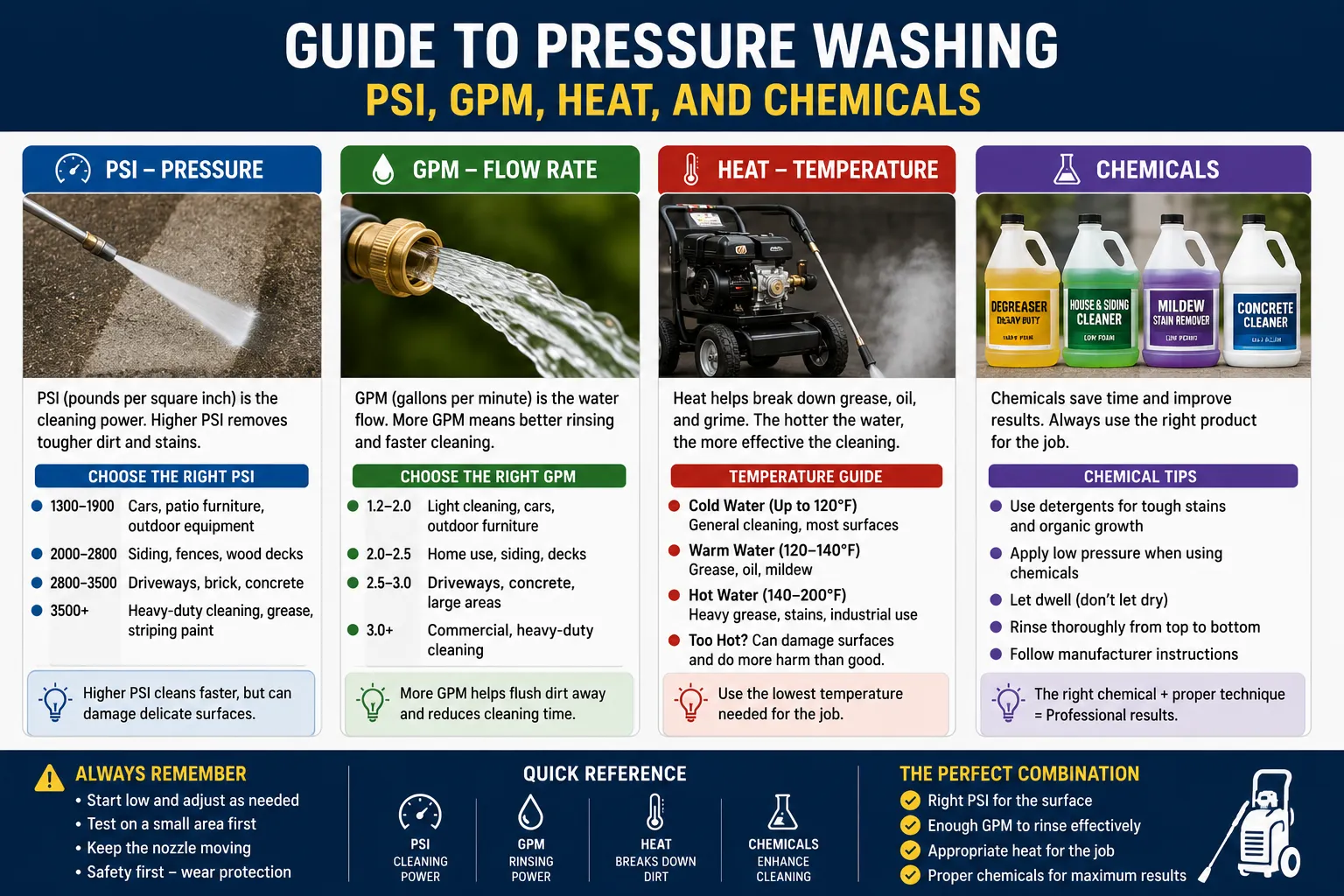
    Take a look at this infographic to understand why each cleaning factor is important.

    Pressure washer cleaning factors psi gpm hot water chemicals infographic

    Which is the most important single factor in pressure cleaning?

    There is no scientific answer to this because there are too many factors and situations to look at.

    If all other cleaning factors are the same (PSI, GPM, Soap), adding more heat is probably the biggest game-changer in terms of cleaning efficiency. More heat in the form of hot vs. cold or warm water will scrub more debris and solids from a surface – and faster.

    Just think of washing dishes in your sink.

    The tap water is 50 PSI, 8 GPM, 60 degrees Fahrenheit and no soap added.

    Now play with these factors a bit to see which gets the best result.

    • What happens if you double the PSI? 100 PSI is like blocking half the flow at the spout with your thumb. You are creating a nozzle that gives more pressure and a higher PSI. Still, this won’t do much extra.
    • What happens if you double the GPM? More mass of water is hitting the surface, but the stains and stuck-on cheese aren’t being knocked loose. This will waste a lot of water without doing much to clean on its own.
    • What happens if you double the temperature? If you go from 60 F to 120 F, you are essentially going from a cool pool temp to a scalding hot jacuzzi. Thermal injuries will occur after 5 seconds of contact with 140 F water. So 120 F is safe but very hot. Will it clean better than doubling PSI and GPM? Yes, it will – even at standard tap PSI and GPM.
    • What happens if you add soap or detergent? Soap and detergent may help if given time. It is a better option than double GPM and double tap water PSI.

    FAQs

    Which factor is most important for commercial jobs?

    Professional pressure washers used for commercial work tend to need a higher GPM. Contractors use special chemicals to help clean, so they need to focus more on rinsing power and get a commercial pressure washer with a high water flow.

    Which factor is most important when power washing large surfaces?

    The best pressure washer for large surfaces will have a higher GPM.

    Is there a difference between using a gas-powered pressure washer or an electric pressure washer?

    Gas-powered pressure washers tend to have higher PSIs. Most electric pressure washers’ PSI range starts at 1,300, while most gas-powered pressure washers start at 2,000.

    Wouldn’t using the highest PSI always be best?

    You don’t always want to use a high PSI because too much cleaning pressure can severely damage certain items such as wood decks or paint on cars. You should always make sure your pressure washer’s PSI matches the job you’re doing.
    Tags: No tags
    Written by Tom Woody Tom Woody

    Author

    View all posts
    Share your experience with this product...

    Write Your Review

    Cancel reply

    No reviews yet. Be the first to share your experience!

    Related Articles

    View All
    11 Best Lawn Mowers for Small Yard Tested by Real Homeowners (2026)

    11 Best Lawn Mowers for Small Yard Tested by Real Homeowners (2026)

    Most people buying a mower for a small yard end up with...

    Tom Woody 3 Jun 2, 2026
    9 Best Self-Propelled Gas Lawn Mowers of 2026

    9 Best Self-Propelled Gas Lawn Mowers of 2026

    After 15 years of mowing my own 0.4-acre Bermuda grass lot in...

    Tom Woody 2 Jun 2, 2026
    Japandi Style Living Room: Where Minimalism Meets Warmth

    Japandi Style Living Room: Where Minimalism Meets Warmth

    A Japandi style living room blends Japanese minimalism with Scandinavian comfort, offering...

    Jessica Lane 1 Jun 1, 2026
    5 Best Pressure Washers for Home Use (2026  Review + Tests)

    5 Best Pressure Washers for Home Use (2026 Review + Tests)

    The right best pressure washers for home use is not as simple...

    Tom Woody 2 May 31, 2026
    10 Best Greenworks Pressure Washers (2026 Updated)

    10 Best Greenworks Pressure Washers (2026 Updated)

    Picking the right best greenworks pressure washers is not as simple as...

    Tom Woody 6 May 31, 2026
    The 8 Best Gas Pressure Washer: A Definitive Buying Guide

    The 8 Best Gas Pressure Washer: A Definitive Buying Guide

    Today you’re going to learn everything there is to know about gas...

    Tom Woody 5 May 31, 2026
    3 Simple Steps for Adjusting Your Pressure Washer’s Unloader Valve

    3 Simple Steps for Adjusting Your Pressure Washer’s Unloader Valve

    Why Need To Adjust Unloader Valves? First, let’s go over why we...

    Tom Woody 2 May 30, 2026
    What PSI Pressure Washer Do I Need? A Comprehensive Guide

    What PSI Pressure Washer Do I Need? A Comprehensive Guide

    This guide aims to simplify the process by explaining what PSI means,...

    Tom Woody 3 May 30, 2026
    6 Mistakes Most People Make with a Power Washer

    6 Mistakes Most People Make with a Power Washer

    TRANSFORM THE TASK of pressure washing into an effortless Before heading outside...

    Tom Woody 1 May 30, 2026
    How to Use Soap with A Pressure Washer

    How to Use Soap with A Pressure Washer

    Can I Pressure Wash With Soap? The type of soap you should...

    Jessica Lane 0 May 30, 2026
    Hoomerly: Home Product Reviews, Buying Guides & Smart Picks

    We independently review products we recommend. When you buy through our links, we may earn a commission. As an Amazon Associate, we earn from qualifying purchases.

    CategoriesHome & KitchenRobot VacuumRobot Vacuum + MopAir purifierTower FanHumidifierSteam mopAir fryerElectric skilletsWaffle makersToaster ovensRice cookerOutdoor LivingPatio furnitureEgg chairFire pitOutdoor umbrellaDeck boxString lightsAbout HoomerlyAbout usHow We ScoreHow We TestedPrivacy PolicyTerms of ServiceAffiliate DisclaimerDMCAContactGarden ToolsGarden hoseExpandable hoseMetal hoseHose reelGarage Storage

    © 2026 by Hoomerly.com

    1

    Contents

    • 1 Which is the most important single factor in pressure cleaning?
    • 2 FAQs
    • 2.1 Which factor is most important for commercial jobs?
    • 2.2 Which factor is most important when power washing large surfaces?
    • 2.3 Is there a difference between using a gas-powered pressure washer or an electric pressure washer?
    • 2.4 Wouldn’t using the highest PSI always be best?
    0% completed