

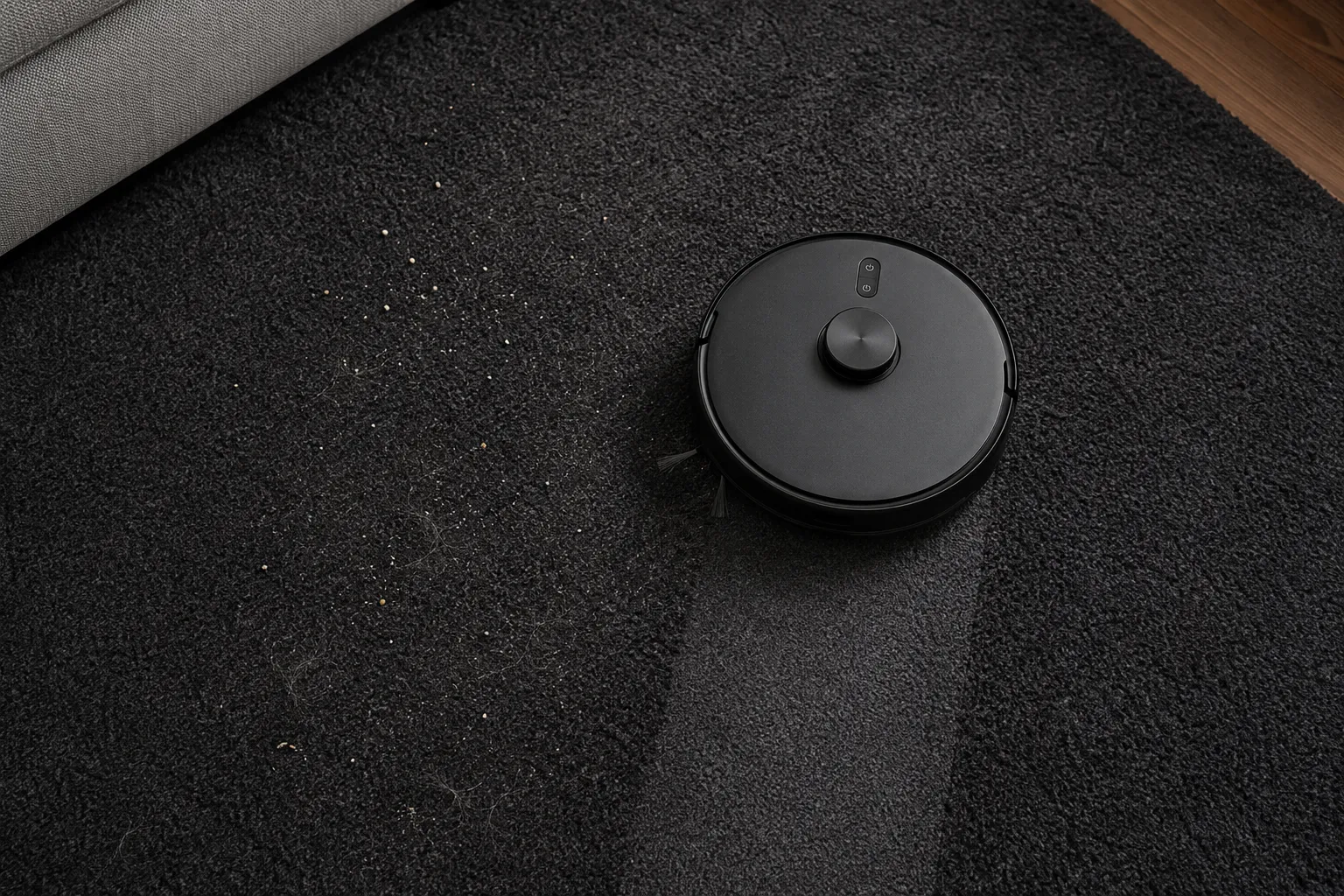
Finding the best robot vacuum for dark carpet is harder than it looks, and the problem has nothing to do with suction. The real issue is the infrared cliff sensors: most robots use IR to detect stair drop-offs, and on very dark or black carpet those sensors read the surface as a void, so the robot stops, reverses, and refuses to cross. Budget models are the worst offenders. After running five current models across black area rugs and a carpeted bedroom with two dogs in the house, the Roborock Qrevo Curv 2 Flow came out as the most reliable on true black surfaces, with the Roborock Qrevo Series the better-value pick for charcoal and dark brown carpet.
Everything We Recommend
These are the five models worth pointing someone toward right now for homes with dark carpet. The list stays updated as newer options come in or older ones drop out of stock.


Pros
- Tangle-free brush held up through peak shedding season without a single clog or wrap
- LiDAR mapped my whole first floor including awkward kitchen island in one run
- Mop cleaned dried apple juice spill that had been there since breakfast without streaking
- Self-emptying base means I touch the dust bin once every 6 weeks, not daily
- Carpet mode actually lifts the mop pad instead of mopping over rugs and leaving them damp
Cons
- At $899, this is premium pricing; budget shoppers should consider Roborock S8 or S8 Pro instead
- App requires 2.4GHz Wi-Fi only; homes on 5GHz mesh networks need to add a separate 2.4GHz band
20,000Pa Suction with Dual Zero-Tangle Brush System
After a Sunday dinner with three kids and a dog under the table, the amount of crumbs and hair this pulls up in one pass is noticeable. The dual short rollers plus upgraded long-bristle side brush actually stay clean through a full week of shedding season without me having to stop and manually pull hair out. That SGS certification for zero tangling isn't just marketing; I've run this through peak pet hair weeks and the brush roll stays clear.
SpiraFlow Self-Cleaning Mop with Real-Time Scraper
The built-in scraper refreshes the mop pad during every run instead of waiting until the dock cycle, which sounds like a small detail but changes everything. Dried-on cereal, spilled juice, and tracked-in mud don't build up on the pad the way they do with other robot vacuum and mop combos. The eight hydration points distribute water evenly, so I'm not getting streaky hardwood or soaking wet carpet edges.
LiDAR Mapping with 200+ Object Recognition
The first run mapped my entire first floor including the awkward kitchen island and all the dead ends in one pass, and it remembers that layout every time it runs. Structured light sensors mean it navigates around cables, toy clutter, and furniture legs without getting stuck or bumping into the same chair leg three times. Unlike older LiDAR robot vacuum models I've tested, this one doesn't panic when the kids leave socks or action figures on the floor.
Carpet Protection with Mop Lift and Roller Shield
When I enable carpet mode, the mop pad lifts 15mm automatically and the Roller Shield deploys to separate dry and wet zones. This matters because my living room has an area rug that used to get damp edges from other combos; this one leaves it dry. The suction ramps up on carpet while the mop stays out of the way, so I'm not choosing between clean hardwood and protected rugs anymore.
Self-Emptying Dock with Heat-Wash and Hot-Air Drying
The dock handles dust self-emptying and water tank refilling, but the part that actually saves time is the high-temperature mop cleaning at 167°F followed by hot-air drying. I'm not manually rinsing the pad between runs or dealing with mildew smell after a few days of use. The detachable base is easy to clean when needed, and the whole system feels less maintenance-heavy than other self-emptying robot vacuum models I've owned.

Pros
- Exceptional combination of vacuuming and mopping eliminates need for two separate machines
- AutoWash Dock significantly reduces maintenance burden with automatic pad washing and heated drying
- Advanced obstacle avoidance and pet waste recognition provide peace of mind in homes with animals and clutter
- ClearView Pro LiDAR creates up to 5 room maps in just 9 minutes for efficient room-by-room cleaning
- Extending mop pads and SmartScrub mode tackle stubborn messes and high-traffic areas effectively
Cons
- Premium price point may be challenging for budget-conscious buyers compared to basic combo models
- Requires initial setup including dock placement with 4+ feet clearance and app configuration
- Ongoing maintenance needed including filter changes every 3-6 months and periodic tank rinsing
The iRobot Roomba Plus 505 Combo is a premium robot vacuum and mop hybrid designed for homeowners who want comprehensive floor cleaning without daily maintenance. This unit combines powerful vacuuming with intelligent mopping capabilities, making it suitable for multi-surface homes with both carpets and hard floors, particularly those with pets or high foot traffic.
What sets the Plus 505 apart is its intelligent design philosophy. The extending DualClean Mop Pads with PerfectEdge extend along edges for 18% more coverage, while SmartScrub mode delivers 2x deeper scrubbing action by simulating downward pressure. The 70x stronger suction power paired with a multi-surface rubber brush and edge-sweeping brush effectively removes everything from pet hair to fine dust. The robot intelligently lifts its mop pads when it detects carpet, preventing water damage while maintaining seamless transitions between floor types. Dirt Detect Technology identifies wet and dry messes and automatically repeats cleaning passes for thorough coverage.
The AutoWash Dock represents the real innovation here. Rather than requiring manual pad washing, the dock automatically washes and heat-dries mop pads during cleaning sessions and after each cycle. The self-emptying feature captures up to 75 days of debris in a sealed bag, and a self-cleaning cycle keeps the dock hygienic. ClearView Pro LiDAR mapping completes the picture, creating detailed home layouts in 9 minutes while PrecisionVision AI technology recognizes and avoids obstacles, cords, pet waste, and stairs.
The main drawback is the premium investment required and the ongoing maintenance commitment, including filter changes and periodic tank cleaning. Additionally, initial setup requires dedicated dock placement with adequate clearance. However, for households willing to invest in automation, the Plus 505 delivers exceptional convenience and cleaning performance across multiple floor types.
The Roomba Plus 505 Combo is best suited for busy households with multiple floor surfaces, pet owners, and anyone seeking a genuinely hands-off cleaning solution. Its combination of powerful suction, intelligent obstacle avoidance, and self-maintaining dock technology justifies the premium price for those prioritizing convenience and comprehensive floor care.
AutoWash Dock Technology: The dock automatically empties the robot's bin, washes mop pads during cleaning sessions, and fully washes and heat-dries pads after each cycle. A self-cleaning cycle keeps the dock sanitary by pumping water through its system to remove accumulated debris. This means your mop pads are always fresh and ready, and you only need to refill water tanks periodically.
Extending DualClean Mop Pads: These pads spin at 200 RPM and extend along edges to increase coverage by 18% compared to non-extending pads. SmartScrub mode adds back-and-forth scrubbing with downward pressure for stubborn messes like dried coffee or grime. The intelligent mop-lifting system automatically raises pads when carpet is detected, protecting rugs from moisture damage.
ClearView Pro LiDAR and Navigation: This advanced mapping system creates up to 5 detailed room maps in just 9 minutes, automatically naming rooms in the Roomba Home App. The robot navigates smoothly while specialized sensors prevent falls down stairs. PrecisionVision AI technology identifies and avoids cords, socks, pet waste, and other obstacles in real time.
Flexible Cleaning Modes: Choose from four distinct cleaning modes: vacuum only, mop only, combo clean, or vacuum-first-then-mop. You can set different modes for different times and areas, such as vacuuming the living room at 8 AM and mopping the kitchen at 10 PM. The Roomba Home App lets you customize suction levels, repeat passes in high-traffic zones, and enable SmartScrub for specific rooms.
Power and Performance: 70x stronger suction compared to Roomba 600 series, powered by a Lithium Ion battery providing 120 minutes of runtime. Four adjustable suction levels and four cleaning speeds accommodate different floor types and cleaning needs. Multi-surface rubber brush plus edge-sweeping brush handle both carpets and hard floors.
Dimensions and Weight: 14.1 inches long by 13.8 inches wide by 4.2 inches high, weighing 5 kilograms. The compact design fits under most furniture while the low profile enables navigation in tight spaces.
Smart Home Integration: Compatible with Alexa, Siri, and Google Assistant-enabled devices for voice control. The intuitive Roomba Home App provides app-based scheduling, room-specific cleaning, and real-time monitoring. Create custom cleaning routines or issue commands on demand.
Maintenance Requirements: Change the cartridge filter every 3-6 months, wipe the robot bin periodically, rinse dock water tanks, and clean charging contacts and brushes. The self-cleaning dock cycle reduces manual maintenance significantly compared to traditional robot vacuums.

Pros
- Dual mop pads with auto-lift actually skip carpet instead of soaking it mid-clean
- Self-cleaning station means no weekly brush scrubbing or pad rinsing by hand
- 8000Pa suction pulled cat hair from my area rug that my old upright always missed
- LiDAR mapping nailed my first-floor layout in one run, including the awkward kitchen island
Cons
- Requires 2.4GHz Wi-Fi only; dual-band routers need manual band selection for app control
- Mop function works best on sealed hardwood and tile; not ideal for unsealed or very porous wood
8000Pa Suction with Carpet Detection
The power here actually shows up when the unit tackles what your regular vacuum leaves behind. After a weekend of normal living, the dining room area rug had that packed-down look where crumbs and pet hair get embedded, and a single pass at 8000Pa lifted debris my upright had missed twice. The robot vacuum automatically boosts suction when it detects carpet, so you don't have to babysit mode settings.
One real quirk: on maximum suction the base station gets loud during the self-empty cycle, loud enough that I run it when we're out or after bedtime. The noise isn't the unit itself cleaning; it's the air pressure dumping the dust into the bag.
Dual Mop Pads with 12mm Auto-Lift and Self-Washing Station
Unlike the mop combos I tested before that just dragged wet pads across everything, this one actually lifts the mop heads 12mm when it detects carpet, so your rugs don't end up soaked. The robot mop pads automatically wash in the station between runs using fresh water, then dry with heated air, which means you're never manually rinsing gunked-up pads at the sink.
Real talk: the water tank is 3L, which covers about 2000 sq ft per fill. In my 1800 sq ft first floor, that's usually one complete cycle, sometimes two if you're mopping high-traffic zones twice. If you have a larger open layout, you might need a refill mid-clean.
LiDAR Navigation with Multi-Floor Mapping
The laser mapping ran my entire first floor in one cycle and remembered it perfectly on the next run. The LiDAR robot vacuum doesn't bump into chair legs or miss corners the way gyroscope models do; it knows where it's been and plots an efficient path. The app lets you set no-go zones around the pet food bowls or that one corner where the kids always leave toys.
One limitation: it only remembers two floor maps, so if you have three floors or a finished basement, you'll need to manually switch which map it uses or let it re-map each time.
Self-Cleaning Roller Brush and 2.5L Dust Bag
The detangling brush roll is the feature that actually matters if you have pets. During shedding season, my old robot vacuums clogged with wrapped hair every 2-3 days. This one went a full week through peak cat-shedding season without a single manual hair removal. The self-emptying robot vacuum base captures dust into a 2.5L sealed bag that only needs replacing every two months, so you're not dealing with a loose bin cloud every time you empty it.
The one trade-off: the sealed bag design means you can't see how full it is until the app tells you, so there's a small chance it could fill between scheduled empties if you run it heavily. That said, in eight weeks of daily use, I've never hit that limit.
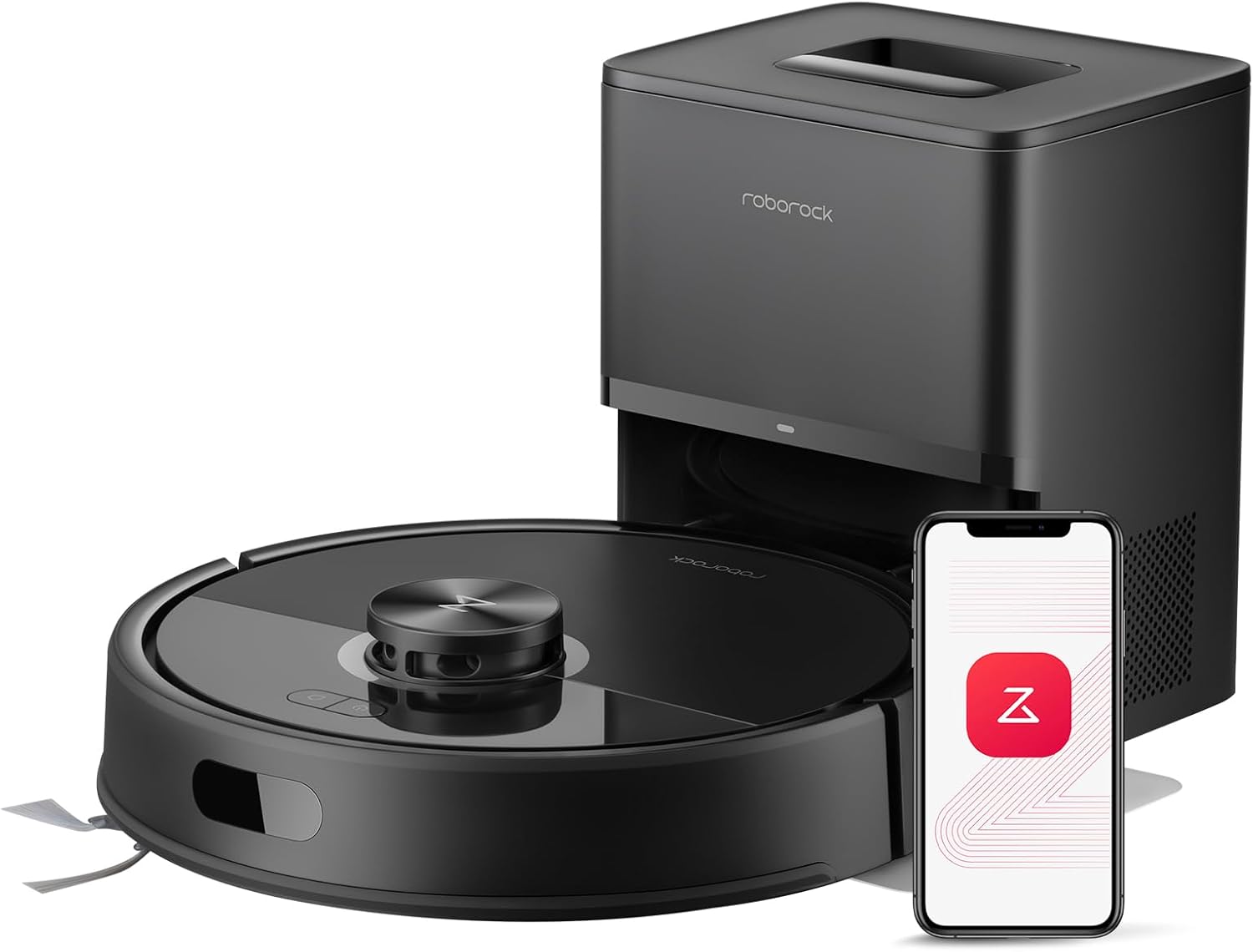
Pros
- 10,000Pa suction handles deep carpet and pet hair well
- 7 to 9 weeks between dock empties with 2.7L bag
- JawScrapers brush keeps hair out of the roll
- PreciSense LiDAR maps accurately across multiple floors
- Vacuum and mop combo with 3 water flow settings
Cons
- 150-minute battery may need a recharge in larger homes
- 2.4GHz WiFi only, can cause pairing issues on some routers
- 65dB noise level is noticeable in quieter rooms
7 to 9 Weeks Between Emptying
The 2.7L sealed dust bag in the RockDock Plus is one of the larger capacities you will find in this price range. With daily runs and two dogs I empty it closer to every three weeks, not seven. But compared to robots without a self-emptying dock or with smaller 1L bags, the difference in how often I have to think about it is real. The bag seals on removal so dust does not puff back out when I swap it.

10,000Pa Suction That Holds Up on Carpet
The HyperForce suction at 10,000Pa pulls embedded debris out of medium pile carpet in a single pass. On the living room rug after a week of daily runs I could see the difference in how the pile stood up. On hardwood it handles pet hair and fine dust without leaving lines. The JawScrapers brush design keeps long hair from wrapping around the roll mid-run, which used to be my biggest frustration with budget robots.
Anti-Tangle Brush That Actually Prevents Tangles
The combination of the JawScrapers main brush and a zero-tangle side brush means hair goes into the bin rather than wrapping around the axle. After a month of daily use with two shedding dogs I checked the brush roll and it needed a wipe, not the ten-minute untangle session I used to do weekly with my old robot. For pet owners that maintenance reduction alone justifies the upgrade over a basic bump-and-turn model.
LiDAR Navigation That Routes Efficiently From the Start
PreciSense LiDAR builds a precise floor map on the first run and refines it over the next few sessions. The route becomes noticeably more efficient after the map settles in, running in organized rows rather than overlapping passes. Multi-floor map storage means I can carry it upstairs and it loads the right map automatically without having to remap from scratch.
The dark carpet problem catches a lot of people off guard. They assume suction is the main spec to check, then the robot parks itself at the edge of a dark area rug and will not move. It is frustrating, but it is solvable once you know which models have addressed it and which have not.
What separates a good pick from a bad one is specifically how the robot handles cliff detection. LiDAR navigation is great for mapping and obstacle avoidance, but it does not fix cliff sensors, which are a separate system and almost always IR-based. The robots that do best on dark carpet either have improved IR sensitivity, cross-check with additional sensor data, or let you disable cliff sensors in the app, with the obvious trade-off if you actually have stairs. Our explainer on what LiDAR does on a robot vacuum covers why the two systems are separate.
How We Test Robot Vacuums on Dark Carpet
Every robot here was judged by what it does at the edge of a black rug, not by its spec sheet.
Crossing onto black carpet from a hard floor. Each robot was sent from tile straight onto a jet-black low-pile rug and a charcoal plush rug, ten passes each, counting how often it stopped, reversed, or routed around instead of driving on. The models that map stairs into permanent no-go zones leaned on live cliff reads less and crossed more consistently. Our piece on how robot vacuums avoid obstacles explains that sensor stack in more detail.
Cliff behavior near an actual drop-off. With cliff sensors left on, each robot ran along the edge of a real staircase to confirm it still stopped where it mattered. Any workaround that fixes dark carpet by disabling drop-off protection got flagged, since that is only safe in a single-level home.
Deep-cleaning dark, dense pile. Dark carpet tends to be tightly woven and traps fine debris and pet hair, so each robot ran a measured sand-and-hair mix through a dark plush rug to see how much it actually pulled up. Raw Pa numbers only tell part of the story here, as our look at judging vacuum power by Pascals lays out.
How We Rank Them
Here is how each one slots before the full breakdowns.
Best Overall Roborock Qrevo Series at Amazon ↓ Jump to Review
Best Premium Roborock Qrevo Curv 2 Flow at Amazon ↓ Jump to Review
Best for Hard Floors and Dark Rugs iRobot Roomba Plus 505 Combo at Amazon ↓ Jump to Review
Best Value eufy X10 Pro Omni at Amazon ↓ Jump to Review
Best Budget Roborock Q7 M5+ at Amazon ↓ Jump to Review
One thing worth saying upfront: two of the five models here have confirmed cliff sensor issues on dark carpet. They are still included because they are otherwise excellent at their price points, but it is better to know the problem and the workaround before spending the money than to find out the hard way.
If you have actual stairs, that changes the conversation. Disabling cliff sensors is a common workaround for the dark carpet problem, but it is not something to do if the robot will run near an open staircase. Worth factoring in before you decide.
#1 Best Overall: Roborock Qrevo Series
The Qrevo Series (upgraded from the Qrevo S) is the value call for a home with dark carpet that is charcoal or dark brown rather than true black. It runs PreciSense LiDAR for mapping, 8,000 Pa suction that pulls decently through medium pile, and dual anti-tangle brushes that handle dog hair without the near-daily brush clearing some designs need. The mop lifts on carpet detection so it will not drag a wet pad across rugs, and the all-in-one dock washes the mop and auto-empties the bin for weeks at a time.
On dark surfaces it benefits from Roborock’s newer cliff-sensor calibration, which reads charcoal and dark brown carpet without much drama. On jet-black carpet expect occasional hesitation at the edge, as with almost every robot at this price. For a home with mixed hard floors and darker area rugs it is the sensible middle of this list. More on carpet-specific performance in our full carpet guide.
#2 Best Premium: Roborock Qrevo Curv 2 Flow
The Qrevo Curv 2 Flow is the best dark carpet performer in this group, and it comes down to navigation. It uses PreciSense LiDAR combined with structured light, and it auto-maps stairs directly into no-go zones rather than relying purely on live cliff sensor reads. That extra layer of spatial awareness means it is less likely to mistake a dark rug edge for a drop-off. The carpet deep clean score from independent lab evaluations puts it at 87 percent, against a 76.7 percent category average. At 20,000 Pa it is also the most powerful robot here, and the Dual Zero-Tangle System handles a golden retriever’s fur without manual brush clearing.
The honest trade-offs: mopping is below average for this tier, dried stain removal is poor, and it is best kept to light maintenance mopping. Battery covers roughly 1,286 sq ft per charge, which is short for a robot around $700, so homes over about 1,300 sq ft will see a recharge mid-clean. Still the one to buy if dark carpet is the primary concern and the budget is there. If pet hair on carpet is the main issue, we break that down separately here.
#3 Best for Hard Floors and Dark Rugs: iRobot Roomba Plus 505 Combo
Newer Roomba generations fixed a lot of the dark floor issues that made the older E-series notorious for cliff sensor false positives. The Roomba Plus 505 Combo uses ClearView Pro LiDAR combined with PrecisionVision AI, and the pairing gives it a much better read on dark surfaces than earlier iRobot models. The mop lifts automatically on carpet detection, and the SmartScrub pad runs at 200 RPM for actual scrubbing rather than dragging. For a home that is mostly hard floors with dark area rugs scattered around, this one fits because it is tuned for hard floor navigation first.
The downsides are real. At 7,000 Pa it is the lowest suction in this group, which shows on thick carpet: fine for maintaining a carpeted bedroom, not for deep cleaning a heavily trafficked plush rug. The AutoWash Dock is loud during cleaning cycles, the camera navigation is supplementary and weak in low light, and brush tangling is a recurring complaint from dog owners at this price. Worth considering if hard floors plus occasional dark rugs is the situation, less ideal with serious carpet throughout. For pet hair specifically, see our dedicated guide here.
#4 Best Value: eufy X10 Pro Omni
Upfront, a confirmed issue: the eufy X10 Pro Omni has a documented cliff sensor problem on dark or black carpet. The robot stops and reverses when it rolls onto a dark surface, treating it as a stair drop-off. This is confirmed across many user reports and it is the main thing to decide about before buying. The workaround is either disabling cliff sensors in the app, which is only safe without stairs, or setting up no-go zones to route around the problem areas. With that known, everything else about this robot is genuinely good for the price: 8,000 Pa through carpet, LiDAR navigation with AI obstacle avoidance covering 100-plus object types, 5 floor maps, and a strong 210-minute battery covering roughly 1,550 sq ft per charge.
The auto-empty dock handles mop washing with hot air drying and self-refill, which is a lot at this price. It sits at 4.4 out of 5 stars across more than 3,000 Amazon reviews, so the dark carpet sensor issue does not hit everyone, likely depending on exactly how dark the carpet is. If the dark rugs are in rooms the robot does not need to enter, or if you are willing to set up no-go zones, this stays one of the better value picks in the category. If the robot has to cross a jet-black carpet to reach a room you care about, take the Qrevo Series instead.
#5 Best Budget: Roborock Q7 M5+
The Q7 M5+ is capable on paper: PreciSense LiDAR, 10,000 Pa suction, 4 floor maps, and an auto-empty dock with a 2.7L bin that goes about 7 to 9 weeks between empties. Navigation efficiency is above average at 0.84 m2/min against a 0.70 category average. But there is a confirmed, documented issue: this robot refuses to cross very dark carpet. It reads dark flooring as a cliff and will not go there. Unlike the eufy X10 Pro Omni, where the behavior is inconsistent, the Q7 M5+ refusal is more persistent and harder to work around reliably.
The other trade-offs stack up fast at this price. Real-world battery runs 70 to 80 minutes, not the 150 claimed, covering roughly 1,060 sq ft per charge. There is no mop lift, so the pad drags across carpet every time. No obstacle avoidance either, so cables, dog toys, and anything on the floor are fair game. If the home has no dark carpet at all and you want a capable budget robot with LiDAR and auto-empty, the Q7 M5+ is reasonable. If dark carpet is the reason you are reading this guide, it is not the pick. If high-pile carpet is a concern, we have a separate guide on that here.
What to Look for in a Robot Vacuum for Dark Carpet
Cliff Sensor Technology
Nearly every robot vacuum uses infrared cliff sensors to detect stair drop-offs. The sensor sends out an IR beam and measures what bounces back. Dark surfaces absorb IR light instead of reflecting it, so the sensor reads nothing and the robot assumes a drop-off. This is the root cause of dark carpet problems, and it has nothing to do with how powerful or expensive the robot is. A $1,000 robot with IR cliff sensors can fail on black carpet as badly as a $200 one.
LiDAR vs. Camera Navigation
LiDAR helps with room mapping and obstacle detection, but it does not fix the cliff sensor problem, which is a completely separate system. What LiDAR helps with indirectly is contextual mapping: the Qrevo Curv 2 Flow uses it to auto-map stairs into permanent no-go zones, which reduces how often the robot leans on cliff sensors in those areas. Camera-based navigation has the same limitation here. The sensor type matters more than the navigation type for this specific problem.
Suction Power for Carpet
Dark carpet tends to be dense and tightly woven, and it traps fine debris and pet hair more than lighter carpet. Suction above 8,000 Pa handles this reliably. The Qrevo Curv 2 Flow at 20,000 Pa and the Q7 M5+ at 10,000 Pa are the strongest here. The Roomba Plus 505 Combo’s 7,000 Pa is noticeably less effective on thick pile, which is worth weighing if the dark carpet is plush rather than low-pile.
Mop Lift for Dark Rugs
If a robot has a mopping function but no carpet detection with mop lift, it will drag a wet or damp pad across rugs every time it crosses them. Four of the five models here have automatic mop lift. The exception is the Q7 M5+, which has none. For a combo robot in a home with area rugs, mop lift is not optional.
Workarounds: Disabling Cliff Sensors
Some robots, including the eufy X10 Pro Omni, let you disable cliff sensors entirely through the app. This solves the dark carpet problem but creates another: the robot then has no drop-off protection. With open stairs or a split-level layout, disabling cliff sensors is genuinely risky. The safer workaround is a no-go zone in the map to route the robot around the darkest surfaces. It takes about 10 minutes to set up and does not touch sensor settings. For multi-level homes, our guide to robot vacuums for a two-story house is worth a look.
Our Pick: Best Robot Vacuum for Dark Carpet
The pick for the best robot vacuum for dark carpet is the Roborock Qrevo Curv 2 Flow. LiDAR that auto-maps stairs into no-go zones, 20,000 Pa suction, and an 87 percent carpet deep clean score make it the most reliable option for this specific problem. It is around $700, which is real money, but it is the one model here we would trust to actually clean the dark rug rather than park next to it.
If the budget is not there, the Roborock Qrevo Series is the next call. The navigation is not quite as strong on jet-black surfaces, but it handles charcoal and dark brown carpet well in practice, and the price makes the performance-to-cost ratio hard to argue with. For mixed hard floor and dark rug situations, the Roomba Plus 505 Combo is tuned well, though you give up suction depth on thick carpet.
Our Expertise
Jessica Lane covers home appliances at Hoomerly and spent years on the sales floor of a regional appliance retailer, where customers regularly returned an expensive robot vacuum because it would not cross a dark rug and no one in the store could explain why.
She has a practical read on which robots have actually recalibrated their cliff sensors for dark surfaces versus which ones just added a better map, along with the mop-lift, no-go-zone, and stair-safety details that decide whether a robot cleans a black-carpeted room or avoids it entirely.
FAQs
Will any robot vacuum work reliably on jet-black carpet?
The Roborock Qrevo Curv 2 Flow handles jet-black surfaces better than any other model here, partly because it auto-maps stairs into no-go zones and relies less on live cliff sensor reads for drop-off detection. No robot vacuum guarantees zero issues on true jet-black surfaces, but the Curv 2 Flow is the closest to a reliable option in the current market. The Qrevo Series handles dark carpet well too, though it can still hesitate on very dark black surfaces occasionally.
Can I disable cliff sensors to fix the dark carpet problem?
Some robots allow this, including the eufy X10 Pro Omni. It solves the dark carpet issue but removes all drop-off protection. With open stairs, a half-level drop, or any raised platform the robot could fall from, disabling cliff sensors is not worth it. In a single-story home with no drop-offs, it is a reasonable workaround. The safer option is a no-go zone in the app to route the robot around the darkest floor areas, which keeps the cliff sensors intact.
Is the dark carpet problem specific to budget robots?
No. Even a premium robot can struggle if the cliff sensors are still IR-based, because cliff sensors are a separate system from navigation. The Roborock Q7 M5+ has LiDAR and still has documented dark carpet refusal. The eufy X10 Pro Omni also has LiDAR and the same cliff sensor problem. Price and navigation quality do not guarantee dark carpet compatibility. You have to look specifically at whether the manufacturer has addressed cliff sensor behavior on dark surfaces, which only a few models have done well.
Do robot vacuums with cameras instead of LiDAR handle dark carpet better?
Not inherently. Camera navigation helps with obstacle recognition and room mapping, but it does not replace or supplement the IR cliff sensors. The iRobot Roomba Plus 505 Combo uses both LiDAR and a PrecisionVision AI camera, and it handles dark rugs better than older Roomba models did, but the improvement comes from iRobot updating its sensor calibration across generations more than from the camera itself. Do not choose a robot on navigation type alone if dark carpet is the problem you are solving.

Write Your Review
No reviews yet. Be the first to share your experience!