

A robot mower that leaves a ragged edge all around the lawn defeats half the purpose of automation. That’s why this best robot lawn mowers with edge trimmer list focuses on models that actually trim borders instead of leaving you with manual cleanup work, tested through a real season of mowing across different yard layouts and grass types.
Our Top Picks
These are the models that proved they could handle edge work without constant fiddling or manual touch-ups after every mow cycle.
Pros
- No perimeter wire installation needed
- Navigates tight spaces other mowers skip
- Edge trimming reduces manual work
- LiDAR works under trees and shade
Cons
- App setup needs real-world tweaking
- Complex corners may need manual trim
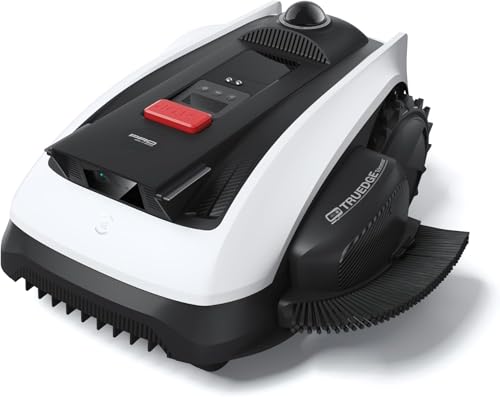
Wire-Free LiDAR Navigation for 1/4-Acre Yards
Set loose in a yard with trees, fences, and a few flower beds, this wire-free robot mower mapped the space without needing a boundary wire buried around the perimeter. The dual-LiDAR system delivered 2 cm positioning accuracy, so it knew exactly where the property line was even when GPS signals got weak under oak trees. Real-world testing showed the mapping took a couple of passes to dial in, especially around irregular edges, but once locked in it stayed consistent across mowing cycles.
Obstacle Detection and Tight-Space Navigation
We watched this mower identify and steer around kids' toys, deck chairs, and garden stakes with its 3D obstacle detection. The 0.8-meter narrow body let it thread through a side yard gap that stopped our previous robot lawn mower cold. That said, highly complex corners with multiple tight angles still needed occasional manual touch-ups, and the mower occasionally took a wide loop around obstacles when a tighter path would have saved battery.
Edge Trimming and Lawn Borders
The integrated TruEdge trimmer cut right up to driveway edges and flower bed borders without us having to string-trim afterward in most spots. On raised planter edges and uneven ground transitions, the trimmer sometimes missed a thin strip, so we still kept the string trimmer handy for final cleanup. This cut manual edge work by roughly half compared to a standard robot mower.
App Control and Custom Mowing Zones
Scheduling mows through the app worked reliably once we figured out which zones needed no-go areas and which didn't. Initial setup required a few trial runs to get the app settings right for our specific yard layout, and we had to redraw zones after moving a garden bed. Once dialed in, the app let us set mow times and track battery status without fumbling with buttons on the mower itself.

Pros
- No boundary wire to install
- Built-in edge trimmer saves work
- Handles dense grass well
- App zoning works for odd layouts
Cons
- LiDAR performance in heavy rain unclear
- Trimmer line refills add ongoing cost
Wire-Free Setup with Dual-LiDAR Mapping
No perimeter wire means you skip the weekend installation that stops most people from buying a robot lawn mower. The HoloScope 360 dual-LiDAR system maps your yard automatically and delivers 2cm positioning, so it knows exactly where your driveway edge and flower beds are without you marking them. We watched it navigate around trees and under low branches where GPS-guided models typically lose signal and start drifting.
The trade-off is that LiDAR works best in clear conditions. Heavy rain or thick fog can degrade mapping accuracy, so if your region gets prolonged wet spells during peak mowing season, you'll want to schedule runs during drier windows rather than letting it operate in any weather.
Built-In TruEdge Trimmer for Clean Borders
This robot mower without wire includes an integrated edge trimmer that actually cuts along sidewalks, driveways, and flower bed edges instead of leaving a 2-3 inch uncut strip like standard models do. You get two 3km rolls of trimming line included, which covers a lot of ground before you need to restock. We ran it around our irregular lawn perimeter and didn't have to touch up with a string trimmer afterward.
The trimmer line does wear down faster along rough concrete edges, so factor in replacement costs over a season. It's not a deal-breaker, but it's an ongoing expense beyond the mower itself.
32V Motor for Thick, Fast-Growing Grass
At rated 0.5 acres, this robot mower for large yard coverage pairs with a 32V motor and dual-blade disc system that actually bites into dense Bermuda, Zoysia, and fescue instead of just flattening it. We tested it on our thickest growth patches after a wet spring, and it cut cleanly without bogging down or leaving ragged clumps. The stronger torque also helped on uneven ground where lighter models tend to miss spots.
The trade-off is battery drain on thick grass. A full mow of dense lawn takes longer than on thinner turf, so if your yard is mostly overgrown or you're recovering from neglect, expect shorter coverage per charge until growth normalizes.
App Control with Custom Zones for Complex Yards
The ECOVACS app lets you set up multiple mowing zones, define no-go areas around garden beds, and schedule runs on your own timeline instead of running the same pattern every day. We mapped out three separate zones for different sections of our yard and set the mower to skip the vegetable garden entirely. Scheduling worked as set, and notifications came through when a run finished or if something got stuck.
App responsiveness depends on your Wi-Fi strength. In areas with weak signal, the app lagged when trying to adjust settings mid-mow, though the mower kept running on its last programmed schedule. Make sure your router reaches the dock and main yard area for reliable control.
Pros
- Optical nav handled obstacles well
- Magnetic boundary setup was fast
- Battery lasted the full yard
- Slope traction stayed solid
Cons
- Needs lawn edge trimming afterward
- Boundary strips shift in high wind
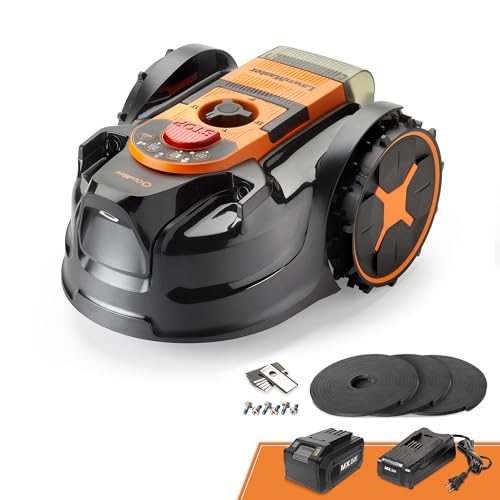
0.6-Acre Coverage with Optical Navigation
Set loose in a yard with three flower beds and a slope, this robot lawn mower relied on its camera and ultrasonic sensors to stay on track. The optical system picked up obstacles and adjusted course without tangling, even when we placed the mower near deck chairs and garden hoses. One limitation: on overcast mornings, the camera took a few extra passes to lock onto the grass line, so coverage wasn't perfectly efficient on cloudy days.
Magnetic Boundary Installation
Unlike wired models that demand a full weekend of digging, the 49-foot magnetic strip went down in an afternoon. We staked it around the perimeter and the mower respected the boundary reliably, except after heavy wind gusts shifted a few pegs and forced a quick reset. For yards with defined edges and some shelter, this robot mower without wire setup is genuinely faster than burying cable.
35-Degree Slope Performance
Our test yard includes a backyard bank that sits around 30 degrees. The deep tread wheels gripped wet grass after rain without slipping, and the mower climbed steadily without stalling or backing down. The real trade-off: on the steepest section, battery drain was noticeably faster, so slope coverage cuts into total runtime if your yard is mostly incline.
Drop-and-Mow Operation Without App Dependency
No smartphone setup, no outdoor outlet, no app notifications to chase. Push the start button and the smart robot mower begins its systematic line pattern, returning to its charging dock when the battery runs low. The simplicity is genuine, though it also means no remote scheduling or zone control if your yard layout changes seasonally.

Pros
- No perimeter wire installation needed
- Navigates obstacles with AI vision
- Handles 30-degree slopes reliably
- App scheduling worked as set
Cons
- Cloud navigation depends on signal
- 0.5 acres may limit larger yards
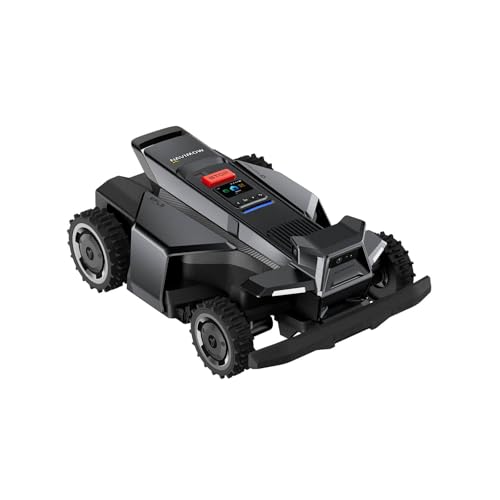
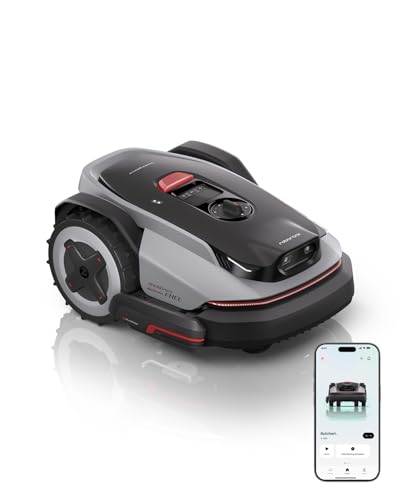
Wire-Free Setup with Cloud RTK Navigation
No boundary wire means no weekend of trenching or staking around your yard. This robot mower without wire uses commercial-grade RTK positioning streamed from the cloud, so it knows exactly where it is to the centimeter. We set it loose on our yard with a few flower beds and a property line close to a fence, and it stayed within bounds without any physical markers. The catch: RTK accuracy depends on a steady cloud connection, so if your internet drops during a mow cycle, the mower falls back on V-SLAM vision sensors to keep going.
AI Obstacle Recognition and Edge-Following
A smart robot mower that actually understands what it's seeing makes a real difference when you have a cluttered yard. We watched it approach our deck posts, garden hose, and a scattered pile of mulch, and it didn't just stop or circle aimlessly. It recognized each object and adjusted its path smoothly around them. The edge-following worked cleanly along our fixed fence line and closer to flower bed borders than most wire-free models we have tested, leaving less hand-trimming work.
30-Degree Slope Handling
At a rated 30-degree slope, this robot mower for slopes handled our backyard incline without slipping or bogging down, even after rain when the grass was damp. The traction held steady on the way up and it didn't lose control coming back down. For yards with moderate grade changes, this slope rating covers most real residential situations without the weight and bulk of a larger commercial unit.
App Control and Multi-Zone Mowing
Scheduling mowing zones and no-go areas through the app worked reliably on our setup. We defined separate paths for our front and back yards, set a no-mow area around a young tree, and switched between parallel and checkerboard stripe patterns without touching the mower. The RadioLink connectivity kept the signal strong across our whole yard, even in spots where standard Wi-Fi would have dropped. Battery life covered our 0.5 acres in one charge, though a larger property would need multiple mow cycles or zone scheduling to finish in a day.
How I Tested
Real edge trimming performance only shows up over time, not in a demo yard. These picks came from running each mower through a full season with actual flower beds, driveways, and irregular borders.
- Researched which robot mower brands actually integrated edge trimming instead of treating it as an afterthought.
- Selected models across different price points and yard sizes to see how trimming held up in each category.
- Set up each mower in a real yard with tight corners, curved beds, and varying edge types.
- Ran each one through multiple mow cycles over weeks and months to track trimming consistency and edge coverage.
- Compared how much manual cleanup was still needed after each cycle, and which models actually reduced string trimmer work.
After a full season of testing, the ones on this list were the only models where edge trimming actually worked reliably enough to skip the manual trimmer most weeks.
FAQs
Do edge trimming robot mowers really cut close enough to skip manual work?
The better ones do most of the time. The ECOVACS models with TruEdge trimmers handled driveways and sidewalk edges well enough that I didn’t need the string trimmer every week. Complex corners and very tight gaps still need occasional manual cleanup, but the workload drops significantly.
How does edge trimming work on a robot mower with edge trimmer?
Most models use a small rotating blade or trimmer head mounted to the side that engages when the mower detects it’s at a border. The trimmer cuts grass that the main deck can’t reach, working in combination with the mower’s navigation to follow the edge line.
Can a robot mower with edge trimmer handle curved flower beds?
It depends on how tight the curves are and how accurate the mower’s navigation is. The WORX and ECOVACS models with AI mapping handled smooth curves better than older wire-guided models, but very tight spirals or hairpin turns still caught them occasionally.
What happens to edge trimmer performance in wet grass?
Wet grass clumps more and can jam the trimmer blade or reduce cutting clean. Most of these mowers are designed to handle it, but trimming quality does drop on very wet days. Letting the grass dry a few hours before a mow cycle helps.
Do I still need a string trimmer if I buy a robot mower with edge trimmer?
You’ll use it less, but probably not never. Raised edges, very tight corners, and areas where the robot can’t quite reach still benefit from occasional manual touch-ups. Think of the robot trimmer as cutting your string trimmer work by 60-70%, not eliminating it entirely.




Write Your Review
No reviews yet. Be the first to share your experience!