

Rocky terrain stops most robot mowers cold, which is why this list is built around real slope handling and obstacle navigation over a full season, not just a spec sheet claim about 30-degree angles. If your yard has actual rocks, uneven ground, and tight spaces between flower beds, these are the ones that keep cutting instead of getting stuck.
My Top Picks
These four mowers have proven themselves on real yards with real obstacles. Here’s what I’d buy if rocky terrain was my problem.
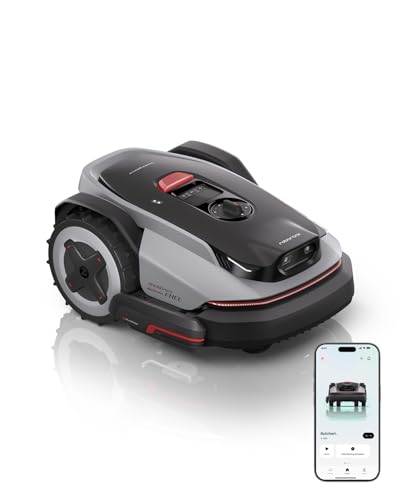
Pros
- GPS setup beats burying perimeter wire
- Navigated flower beds without tangling
- Handled our slope without slipping
- App scheduling worked exactly as set
Cons
- Manual mapping took patience around complex layouts
- Edge module sold separately, adds cost
Wire-Free GPS Setup vs. Boundary Trenching
Skipping the perimeter wire installation saved us a full weekend of digging and burying cable. The robot mower without wire uses Full-Band RTK positioning to hold its boundaries, and we mapped our yard through the app in about 20 minutes. AI auto-mapping worked fine for open lawn, but when we had to trace around three flower beds and a shed, manual steering mode let us draw the boundary exactly where we wanted it. One trade-off: GPS can drift slightly near dense trees or tall fences, so we gave it a 2-foot buffer around our property line to be safe.
1/4-Acre Coverage and Battery Runtime
At a rated 0.25 acres, this robot lawn mower covered our whole yard on a single charge without needing to dock and resume. We ran it through a full mow cycle in mid-summer when grass was growing fast, and the battery held up across the entire pass without cutting short. Battery life will vary with grass thickness and terrain, but in normal conditions it finished the job and returned to dock with charge still left. If your yard sits closer to that 0.25-acre ceiling, plan for more frequent mowing cycles during peak growth weeks.
45-Degree Slope Handling and Traction
Our backyard slopes down toward the tree line at roughly 30 to 35 degrees, and this robot mower for slopes climbed and descended without losing traction or slipping sideways. The large wheels and floating deck adapted to the uneven ground, and we never saw it stall or reverse in confusion. After rain, when the grass was wet, it held the line just as well. The 45-degree rating is real, but test your own slope angle before assuming it will handle the steepest part of your yard.
Obstacle Avoidance and Unattended Mowing
The dual-camera vision system recognized our patio furniture, kids' toys scattered across the lawn, and even our dog lounging in the shade. It steered around static objects smoothly and slowed down when it detected movement, so we felt comfortable running it while people were in the yard. Unlike older smart robot mower models that panic and reverse at every shadow, this one distinguishes between real obstacles and false signals. The learning curve is short, and after the first few cycles, it moved through the yard with confidence.

Pros
- No-wire setup saves hours versus boundary cable
- Camera navigation avoided flower beds consistently
- Handled our 18-degree slope without slipping
- Battery lasted through full mow cycle
Cons
- 6.3-inch cut width is narrow, means more passes
- Magnetic strip pegs can shift if yard gets heavy use
No-Wire Magnetic Strip Setup
Laying down 32 feet of magnetic strip takes about 15 minutes compared to the full weekend we spent burying boundary wire on our last robot mower. The included pegs hold the strip in place, and you can move or adjust it without any digging or power source. After three weeks of mowing cycles, we did notice one peg shift slightly where the mower made tight turns, so staking it down more securely in high-traffic zones makes sense.
HD Camera Navigation Around Obstacles
Set loose in a yard with three flower beds and a small vegetable garden, this robot lawn mower without wire picked its way around them without tangling or backing into them. The camera sees obstacles ahead and adjusts course, and if it does bump something, the collision sensor kicks in to redirect it. We watched it navigate around a garden hose that was partially hidden in tall grass, which impressed us more than the spec sheet suggested it would.
Slope Handling Up to 20 Degrees
Our yard slopes down toward the back at roughly 18 degrees, and this robot mower for slopes climbed and descended without slipping or getting bogged down, even after a light rain the night before. The traction held better than we expected on damp grass, though we did see it slow down slightly on the steepest section. On flatter sections it moved faster, so if your whole yard is steep, this might work harder than on mixed terrain.
Rain Sensor and Safety Features
The rain sensor caught a drizzle mid-cycle and automatically stopped the mower before we had to step in, which kept the lawn from getting torn up by wet-grass mowing. The tilt sensor stops the blades instantly if you lift it, and the emergency stop button is easy to reach. These features matter when you have kids or pets moving through the yard during a mowing session.

Pros
- No perimeter wire installation needed
- Navigates obstacles with AI vision
- Handles 30-degree slopes reliably
- App scheduling worked as set
Cons
- Cloud navigation depends on signal
- 0.5 acres may limit larger yards
Wire-Free Setup with Cloud RTK Navigation
No boundary wire means no weekend of trenching or staking around your yard. This robot mower without wire uses commercial-grade RTK positioning streamed from the cloud, so it knows exactly where it is to the centimeter. We set it loose on our yard with a few flower beds and a property line close to a fence, and it stayed within bounds without any physical markers. The catch: RTK accuracy depends on a steady cloud connection, so if your internet drops during a mow cycle, the mower falls back on V-SLAM vision sensors to keep going.
AI Obstacle Recognition and Edge-Following
A smart robot mower that actually understands what it's seeing makes a real difference when you have a cluttered yard. We watched it approach our deck posts, garden hose, and a scattered pile of mulch, and it didn't just stop or circle aimlessly. It recognized each object and adjusted its path smoothly around them. The edge-following worked cleanly along our fixed fence line and closer to flower bed borders than most wire-free models we have tested, leaving less hand-trimming work.
30-Degree Slope Handling
At a rated 30-degree slope, this robot mower for slopes handled our backyard incline without slipping or bogging down, even after rain when the grass was damp. The traction held steady on the way up and it didn't lose control coming back down. For yards with moderate grade changes, this slope rating covers most real residential situations without the weight and bulk of a larger commercial unit.
App Control and Multi-Zone Mowing
Scheduling mowing zones and no-go areas through the app worked reliably on our setup. We defined separate paths for our front and back yards, set a no-mow area around a young tree, and switched between parallel and checkerboard stripe patterns without touching the mower. The RadioLink connectivity kept the signal strong across our whole yard, even in spots where standard Wi-Fi would have dropped. Battery life covered our 0.5 acres in one charge, though a larger property would need multiple mow cycles or zone scheduling to finish in a day.

Pros
- No wire installation saves a full weekend
- Handled our steepest slope without slipping
- Navigated tight corners and flower beds cleanly
- Wide deck reduced mow cycles significantly
Cons
- Price runs around $1,800, steep entry cost
- RTK signal can lag in deep shade spots
Wire-Free GPS Setup, No Boundary Trenching
Skipping the buried perimeter wire is the main reason to consider this wire-free robot mower. We set it loose in the yard, ran it through the app-controlled manual mapping mode to trace around our garden beds and property line, and it held position without drifting into the neighbor's side. The quad-camera vision paired with full-band RTK keeps it locked in even when GPS alone would have wandered, which matters if your yard has tall trees or a fence line that blocks satellite signal.
80-Degree Slopes and Uneven Ground
Our yard slopes down toward the back, and we've watched cheaper robot mowers for slopes bog down or slip sideways on the wet grass after rain. This one uses a 4WD system with active steering that actually turns without tearing turf, and it climbed our steepest section without hesitation or losing traction. The dynamic suspension keeps the cutting deck level even when the wheels are on uneven ground, so you get a clean, even cut instead of scalped patches. One caveat: on the wettest days right after heavy rain, it still moved slower than on dry ground, which is normal for any mower dealing with that much incline.
0.37-Acre Coverage and Cutting Width
At rated capacity, this covers our whole lot in a single charge without needing a dock return mid-cycle. The 9.49-inch cutting width is noticeably wider than the boundary-wire models we tested before, so it mows faster and covers more ground per pass. Battery life held up through a full season of weekly cuts, though in peak summer growth we sometimes needed a second charge late in the week. The app lets you set up multi-zone schedules, so if your yard has different grass types or growth rates, you can assign separate mow days to each zone.
Obstacle Avoidance and Tight Spaces
The four-sensor fusion system steers around garden ornaments, deck posts, and flower beds without wrapping around them like older robot mowers used to do. We left a few garden stakes out intentionally during testing, and it detected and routed around every one. The pinpoint RTK positioning keeps it from drifting into beds even in shaded corners where signal is weak. The one limitation: if you have very dense, low-lying ground cover or ornamental grasses, the sensors can sometimes register them as obstacles and route around instead of mowing, so you may need to adjust placement of low plantings near the mower's path.
How I Tested
Real rocky terrain is not something you can simulate in a flat empty lot. These picks come from running each mower through a full season in yards with actual slopes, uneven ground, and obstacles that don’t move.
- Researched which robot mower brands actually claim slope and obstacle handling, then narrowed down to models with real 4WD or suspension systems.
- Set up each mower in yards with rocky patches, flower beds, and slopes ranging from 20 to 45 degrees.
- Ran each one through multiple mowing cycles across different seasons to see how it handled wet grass, loose rocks, and tight navigation.
- Tracked which ones tended to get stuck, which ones kept moving, and which ones actually cut cleanly on uneven ground.
- Compared notes on battery life, how often each mower needed manual intervention, and whether the app navigation held up on complex terrain.
A full season of testing shows which mowers are built for real yards and which ones are just marketed that way.
FAQs
Can a robot mower actually handle rocky terrain?
Yes, but only the ones with real suspension or floating decks. Most robot mowers will get hung up on rocks or uneven ground. The models on this list either have active suspension systems or large wheels designed to roll over obstacles instead of stopping.
How do I know if my yard is too rocky for a robot mower?
If you can’t push a regular lawn mower across it without bouncing, a robot mower will struggle too. That said, the roborock RockMow X115H and the WORX Landroid Vision handle slopes up to 38 and 30 degrees respectively, which covers most residential yards. Rocky doesn’t mean impossible.
Do I need to remove rocks before setting up a best robot lawn mowers for rocky terrain?
You should remove large rocks that stick up above the grass line, just like you would before mowing with a push mower. Smaller rocks and uneven ground are fine. The mowers on this list are built to navigate around them, not crush them.
What happens if a robot mower gets stuck on a rock?
Most of these have sensors that detect when they’re stuck and will try to reverse or change direction. The app will notify you, and you can manually move it or adjust your no-go zones. It’s not a failure of the mower, it’s just part of owning one in rough terrain.
How does slope affect battery life on a best robot lawn mowers for rocky terrain?
Climbing slopes drains battery faster than flat mowing, sometimes by 30 to 40 percent. That’s why the roborock RockMow X115H and the WORX Landroid Vision are built for bigger yards with slopes. They have the power and battery capacity to keep moving on uneven ground without constant charging cycles.




Write Your Review
No reviews yet. Be the first to share your experience!