

Try Amazon Prime free for 30 days
Fast free delivery on heavy items, plus Prime Video, Prime Music and member-only deal prices.
You light the grill on a crisp evening, and before long everyone is huddled over it with their hands out like it is a campfire. Good propane gas heaters fix that by throwing steady radiant warmth from a fuel tank, with no outlet needed. After comparing 4 models, the Amazon Basics 46,000 BTU Propane Heater is our top pick for its 46,000 BTU output, 18-foot heating diameter and 40-pound frame. The Newbulig 48,000 BTU Propane Heater is our alternative pick, pushing slightly more heat at 48,000 BTU.

Pros
- 46,000 BTUs for outdoor patio heat
- Heats up to an 18 ft diameter
- One-touch ignition button
- Wheels help move the 39.99 lb heater
- Tilt safety auto-shut off valve
Cons
- 20 lb propane tank required and not included
- Outdoor use only, not for indoor rooms
- 91.3 inches tall, needs open patio space

Pros
- 48,000 BTU propane patio heater
- 45° anti tilt and flame out gas shutoff
- 18 ft diameter heat reach within 1 minute
- One touch ignition with adjustable flame
- Rolling wheels and side cutout for repositioning
Cons
- 20 lb propane tank is not included
- Ground anchors are not for hard concrete surfaces
- 33 lb weight may be bulky to move often

Pros
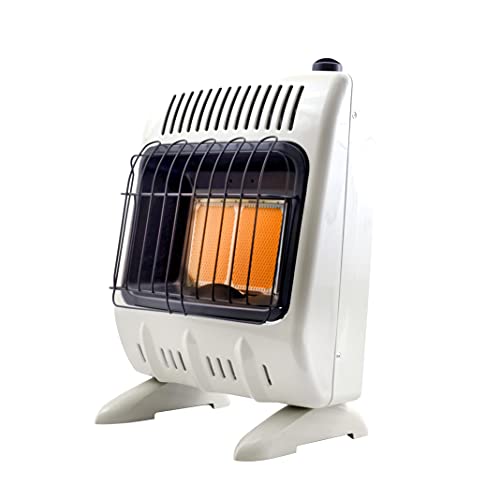
- 10,000 BTU propane heat output
- Heats up to 500 sq. ft.
- No electricity required
- 2 heat settings, Low and High
- Oxygen Depletion Sensor with automatic shutoff
Cons
- Propane only, not for other fuels
- Blower is sold separately
- Up to 500 sq. ft., not for larger spaces
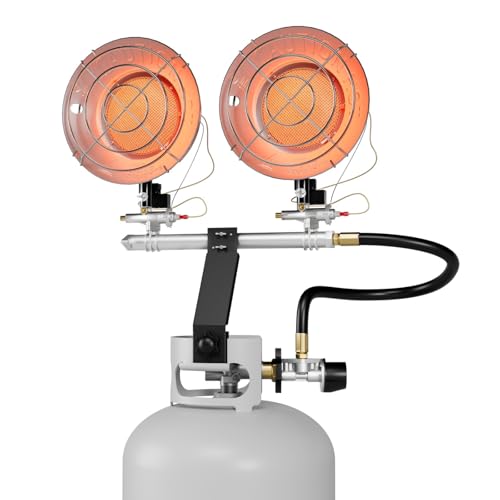
Pros
- 22,000, 26,000, and 30,000 BTU heat settings
- Rated heating area up to 800 sq ft
- Runs up to 20 hours
- Tip-over switch and shut-off valve
- Less than 5 lb heater weight
Cons
- Propane tank is not included
- No thermostat listed
- No indoor-use rating stated
How We Weighed These Propane Heaters for Heat Output and Carbon Monoxide Safety
A propane heater burns fuel right where you sit, so raw heat is only half the story. Where the heater is allowed to run, and what shuts it off when something goes wrong, matter just as much.
- Heat output and coverage: Among our picks, output runs from 10,000 to 48,000 BTU. The two tall patio models each reach an 18-foot heating diameter, while the smallest unit is rated for 500 square feet. A bigger BTU number only helps if the heater is meant for the space you put it in, so read the coverage figure and the intended setting together.
- Indoor rating and oxygen sensor: Only one of our picks is a ventless model with an oxygen depletion sensor. The ProCom ML100HPA puts out 10,000 BTU, heats up to 500 square feet and shuts itself off automatically if oxygen runs low. It needs no electricity, offers 2 heat settings and ships with both base feet and a wall bracket, which makes it the pick for a cabin or a power outage. According to the U.S. Consumer Product Safety Commission, unvented gas heaters should carry exactly this kind of sensor.
- Ventilation and carbon monoxide: Three of our picks list no oxygen depletion sensor, so they belong outdoors or in spaces with plenty of fresh air. The Centers for Disease Control and Prevention recommends a battery-operated carbon monoxide detector and proper ventilation whenever you burn kerosene, and the same caution makes sense for any fuel-burning heater. According to the U.S. Fire Administration, portable heaters caused only 3 percent of home heating fires but 41 percent of the fatal ones.
- Fuel, tank size and run time: Three of our picks run off a standard 20-pound propane tank sold separately. The Benass 30,000 BTU Propane Radiant Heater screws straight onto that tank and steps through 22,000, 26,000 and 30,000 BTU settings. It is listed to run up to 20 hours and to cover 800 square feet. A tip-over switch cuts the gas if it gets knocked over, and the gas also stops if the flame goes out.
- Ignition and safety shut-offs: Three of our picks light with a push button or one-touch igniter, and the fourth lights through an ignition hole on the panel. Every pick has some automatic gas cutoff, and one of the patio models is rated to shut off at a 45-degree tilt. The CPSC also advises choosing a heater certified by a nationally recognized testing laboratory.
- Size and portability: Our picks range from under 5 pounds to about 40 pounds. The Amazon Basics 46,000 BTU Propane Heater sits at the heavy end, stands 91.3 inches tall and rolls into place on wheels. That weight, plus a water box for ballast and a chain to secure the tank, helps keep its 46,000 BTU burner upright, and a tilt valve cuts the gas if it does go over.
We left out central furnaces and whole-house systems because they need professional installation, and we skipped water heaters and heated blankets because they do a different job. We also do not treat outdoor-only patio heaters as indoor heat: our two tall picks are built for open air and are not rated for enclosed spaces, so use the ventless model if you need warmth inside a cabin.
Other Propane Heaters Worth Considering
These are other propane heaters we looked at but did not put on our main list.
If you want radiant heat sized for a workshop rather than a patio, the Mr. Heater 30,000 BTU Propane Radiant Heater is rated for up to 1,000 square feet and adds an adjustable thermostat. It puts out 30,000 BTU against 46,000 BTU for our top pick, and at 26.2 pounds it is noticeably lighter to move.
Need warmth for one small room during an outage? The Mr. Heater Buddy weighs just 7.1 pounds and is rated for up to 225 square feet. At 9,000 BTU, it delivers roughly a fifth of our top pick’s output, so treat it as personal heat rather than area heat.
For larger indoor spaces, ProCom’s ML300HBA pairs 30,000 BTU with an oxygen depletion sensor and a rating of up to 1,400 square feet. That is less than two thirds of our top pick’s 46,000 BTU, but it carries the sensor that unvented indoor use calls for, and it weighs 26 pounds.
And if you want thermostat control on top of that safety sensor, the ProCom ML250TPA steps down to 25,000 BTU while covering up to 1,150 square feet. Its adjustable thermostat and oxygen depletion sensor suit a cabin better than our top pick, which offers 46,000 BTU but is built for open air.
FAQs
Can I use a propane heater indoors?
Only if it is designed for it. The U.S. Consumer Product Safety Commission says unvented gas heaters should have an oxygen depletion sensor that shuts the heater off when oxygen drops too low, and only one of our picks lists one. Whatever you run inside, add a battery-operated carbon monoxide detector, as the CDC recommends.
How many BTU do I need for a garage or workshop?
It depends on the floor area and how well the space holds heat. Our picks range from 10,000 BTU for 500 square feet up to 48,000 BTU, and the indoor-capable alternatives we looked at cover 1,000 to 1,400 square feet at 30,000 BTU. Pick the rated coverage first, then confirm the heater is approved for an enclosed space.
How far should a propane heater sit from furniture?
The CPSC, the CDC and the U.S. Fire Administration all say to keep at least 3 feet between a heater and anything that can burn, such as bedding, drapes or furniture. The CPSC adds that the heater should sit on a level, hard, nonflammable surface rather than a rug or carpet.
Will a propane heater work during a power outage?
Our ventless pick needs no electricity and lights with a push-button piezo igniter, which makes it the most outage-ready of the group. Use only the fuel a heater is designed for, as the CDC advises, and turn it off when you leave the room or go to bed, per the U.S. Fire Administration.
Sources
- CPSC Offers Tips to Prevent Home Fires From Space Heaters, U.S. Consumer Product Safety Commission. Fire-safety tips and required safety features for space heaters.
- Safety Guidelines: During & After a Winter Storm, Centers for Disease Control and Prevention. Winter heating safety for space heaters, kerosene heaters and carbon monoxide.
- Heating Fire Safety, U.S. Fire Administration. Home heating fire statistics and prevention messages.




Write Your Review
No reviews yet. Be the first to share your experience!