

Try Amazon Prime free for 30 days
Fast free delivery on heavy items, plus Prime Video, Prime Music and member-only deal prices.
You head to the garage for a quick fix and spend ten minutes blowing on your fingers before the wrench feels usable. Natural gas garage heaters with thermostat controls fix that by holding a steady temperature on gas from your existing line. After comparing 4 models, the Comfort Glow 17,000 BTU Natural Gas Wall Heater is our top pick. It puts out 17,000 BTU, covers up to 500 square feet and holds temperature with an adjustable thermostat. For bigger bays, the ProCom MN200TBA is our alternative pick, rated for up to 950 square feet.

Pros
- 17,000 BTU heats up to 500 sq. ft.
- Thermostatic heat control for adjustable warmth
- No electricity needed for power outage use
- Sealed burn system with safety pilot
- Includes vent kit for 4.5 to 10 inch walls
Cons
- Requires natural gas and direct wall venting
- Limited to spaces up to 500 sq. ft.
- 43 lb weight may need sturdy wall mounting

Pros
- 20,000 BTU output
- Heats up to 950 sq. ft.
- High, medium, low thermostat control
- No electricity required
- ANSI certified with ODS shutoff
Cons
- Natural gas fuel only
- 24 lb weight may limit repositioning
- 950 sq. ft. maximum heating area

Pros
- 30,000 BTU/hr heat output
- Heats up to 1,000 sq ft
- Built-in adjustable thermostat
- No electricity required
- Low oxygen safety shut-off
Cons
- For use with natural gas only
- Blower fan kit sold separately
- Weighs 26.25 lb

Pros
- 30,000 BTU output
- Heats up to 1,400 sq. ft.
- High, medium and low thermostat control
- ODS shutoff and ANSI certified
- Wall mount hardware and base feet included
Cons
- Natural gas fuel limits placement options
- 29.7 lb weight may be harder to move
- Heating area capped at 1,400 sq. ft.
What We Looked For in Gas Heaters for a Thermostat-Controlled Garage
A gas heater in a garage burns fuel in the same air you breathe, so raw output has to be weighed against venting and shut-off features. Every heater on our list runs on natural gas and has a thermostat, so we sorted them on the points below.
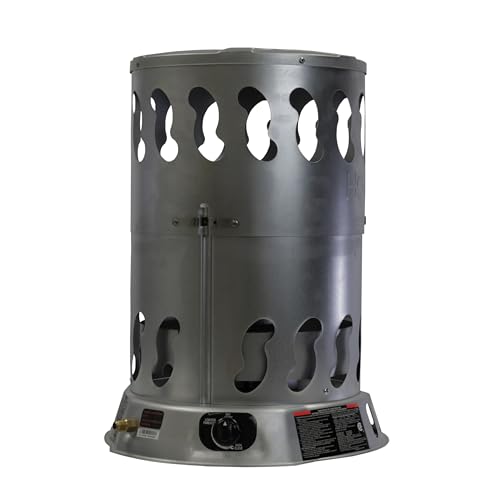
- Heat output and coverage: Our picks run from 17,000 to 30,000 BTU and claim coverage from 500 to 1,400 square feet. Concrete floors and thin garage doors pull heat away fast, so a little headroom over your actual floor area helps. The Mr. Heater 30,000 BTU Natural Gas Radiant Heater shows the balance well: it is rated for up to 1,000 square feet. That leaves margin in a drafty bay, and its built-in thermostat lets output drop once the space warms up.
- Indoor rating and oxygen sensor: Three of our picks are vent-free, and according to the U.S. Consumer Product Safety Commission, unvented gas heaters should have an oxygen depletion sensor that shuts the heater off if oxygen drops too low. The ProCom MN300TBA pairs that sensor with ANSI certification and a rating of up to 1,400 square feet, the widest coverage on our list. Its thermostat steps through 3 settings, High, Medium and Low, so you can dial it back once a large garage is warm.
- Ventilation and carbon monoxide: Only one of our 4 picks vents outdoors. The Comfort Glow 17,000 BTU Natural Gas Wall Heater uses a sealed burn system with its own air intake pipe and vent cap, and the included kit fits walls 4.5 to 10 inches thick. That makes it the closest match for a garage that stays shut all winter, with a rating of up to 500 square feet. Whatever you choose, the Centers for Disease Control and Prevention recommends a battery-operated carbon monoxide detector.
- Fuel type and run time: All 4 picks burn natural gas, so there is no tank to swap and run time depends on your gas supply rather than a cylinder. The CDC advises using only the fuel a heater is designed for, so confirm you have a natural gas line before you order. Three of our picks draw combustion air from the room, which is why the sensor and detector points above matter.
- Ignition and shut-offs: Two of our picks use push-button ignition with a pilot oxygen depletion sensor. One uses battery-operated electronic ignition, with the battery included, plus a low-oxygen shut-off. The last pairs electronic ignition with a safety pilot and a built-in pressure regulator that stops gas flow if the pilot goes out.
- Size and mounting: The heaviest of our picks weighs 43 pounds and measures 20 by 27.3 inches on the wall, with a depth of 6.5 inches. The lightest with a published weight comes in at 26.2 pounds. Two of our picks ship with both a wall mount and base feet, and the CPSC says a floor unit should sit on a level, hard, nonflammable surface at least three feet from anything that can burn.
We left out central furnaces and whole-house systems because they need professional installation and a much bigger budget. Water heaters and heated blankets do a different job entirely. Outdoor-only patio heaters were also cut, since they are not rated for enclosed spaces like a garage. A few other gas heaters came close, though.
Other Gas Heaters Worth Considering
These are other gas heaters we looked at but did not put on our main list.
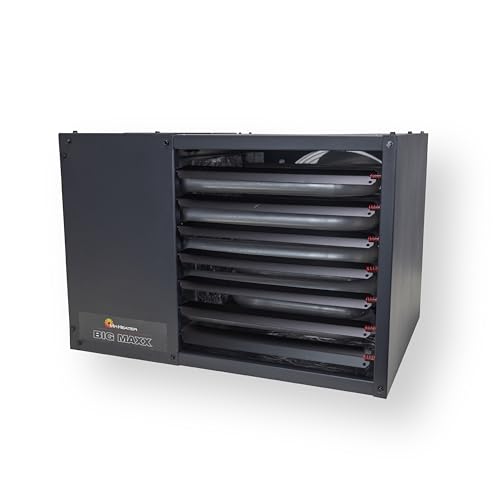
If you want more than the 17,000 BTU of our top pick in a slim blue flame body, the ProCom MN300TPA is rated for 30,000 BTU and up to 1,400 square feet. It keeps the adjustable thermostat and the oxygen depletion sensor. What it lacks is the through-wall vent that makes our top pick easier to trust in a closed garage.
Prefer a radiant unit that is easier to move around? The Mr. Heater 30,000 BTU Natural Gas Heater covers up to 1,000 square feet and weighs 24.7 pounds. That is about 18 pounds lighter than our 43-pound top pick, though it trades the outdoor venting for convenience.
And if raw output is the whole reason you are shopping, the Mr. Heater 50,000 BTU Propane Heater is rated for up to 1,667 square feet. It burns propane rather than natural gas, and at 60.3 pounds it is about 17 pounds heavier than our top pick.
Bigger still, the Mr. Heater 80,000 BTU Propane Heater claims up to 2,667 square feet at 78.2 pounds. That is more than 4 times the output of our top pick. It is a capable unit, but it runs on a different fuel and far exceeds what most home garages on a natural gas line need.
FAQs
Is it safe to run a vent-free natural gas heater in a closed garage?
Three of our picks are vent-free, and each has an oxygen depletion sensor, which the CPSC says unvented gas heaters should have. Pair any of them with a battery-operated carbon monoxide detector, as the CDC recommends. If the garage door stays down for hours, the one vented pick on our list is the safer choice.
How many BTU does a gas heater need for a garage?
Our picks range from 17,000 to 30,000 BTU, with rated coverage from 500 to 1,400 square feet. Measure your floor area, then size up if the garage is uninsulated or has a thin door. A thermostat keeps a larger unit from running flat out once the space is warm.
How far should a gas heater sit from tools and stored items?
The CPSC, the CDC and the U.S. Fire Administration all say to keep anything that can burn at least 3 feet away. The U.S. Fire Administration reports that portable heaters cause only 3 percent of home heating fires but 41 percent of the fatal ones. Keep gas cans, rags and cardboard well clear.
Will a thermostat-controlled gas heater work during a power outage?
Yes, none of our picks needs electricity to run or to hold its thermostat setting. One uses battery-operated ignition with the battery included, so keep a spare on hand. That makes all 4 useful as backup heat when the grid goes down.
Sources
- CPSC Offers Tips to Prevent Home Fires From Space Heaters, U.S. Consumer Product Safety Commission. Fire-safety tips and required safety features for space heaters.
- Safety Guidelines: During & After a Winter Storm, Centers for Disease Control and Prevention. Winter heating safety for space heaters, kerosene heaters and carbon monoxide.
- Heating Fire Safety, U.S. Fire Administration. Home heating fire statistics and prevention messages.



Write Your Review
No reviews yet. Be the first to share your experience!