

Try Amazon Prime free for 30 days
Fast free delivery on heavy items, plus Prime Video, Prime Music and member-only deal prices.
When your wrench feels like it was stored in a freezer, a garage heater starts to look less optional. 110v electric garage heaters solve that by adding targeted heat without a fuel tank. After comparing 4 models, the shinic Ceiling Heater is our top pick because it offers 1,500 watts, a 750-watt low setting and ETL certification. The Comfort Zone Ceiling Heater is the alternative pick for larger spaces, with 7,500 watts and coverage up to 1250 square feet.

Pros
- Warms workbench fast on 40-degree mornings
- Two units give you zone heating coverage
- 90-degree tilt lets you aim heat where boots sit
- Halogen light cuts dark garage work shadows
Cons
- 1500W won't heat a full 2-car garage
- 120V shared circuit might trip in older homes
1500W Radiant Quartz Tubes for Spot Heating
Six in the morning, garage sitting at 42 degrees, and you need to pull an oil pan before dawn breaks. Plug these radiant units in, hit the high-heat mode, and the quartz tubes throw infrared warmth where it actually counts: down on the concrete slab where your boots stand and across the workbench where your hands will go numb. A radiant garage heater doesn't waste time heating the cold air above your head; it warms the person and the surfaces you touch first. The limitation here is honest: at 1500W per unit, this isn't a whole-garage solution for a full 2-car space in deep January, but paired together or positioned over a workbench and oil drain, they'll cut the chill enough to let you work without freezing your fingers off.
Halogen Work Light for Late-Night Saturday Turns
That built-in halogen bulb isn't a gimmick on a garage heater. You're bent under a truck bed or reaching into an engine bay, and that light cuts through the shadow your own body throws on the connector you need to grab. The five modes let you run high heat with low light, or flip the light on solo for cooler months when you just need to see what you're doing. Most 120V electric garage heaters skip the light entirely, which is why you end up holding a flashlight in your teeth at six in the morning. This one saves you that hassle.
Ceiling Mount with 90-Degree Tilt for Precise Heat Aim
Mounted on a ceiling bracket, these units don't eat floor space where your rolling tool cart needs to roll. The 90-degree adjustable bracket means you can angle each heater down toward your workbench, your lift platform, or the corner where you change oil on a Saturday. Floor space is currency in a 2-car garage, and a ceiling mount respects that. Bracket install is straightforward: screw the bracket to a ceiling joist, mount the heater, tighten, and you're done in under 20 minutes.
120V Plug-In Power Without a Subpanel Call
No electrician needed. Plug into a standard outlet, pull the string, and you're heating. At 1500W, a single unit draws about 12 amps, so a 15-amp dedicated circuit runs it clean all morning without a trip. Two units running low heat (750W each) fit comfortably on a 20-amp circuit. If your garage wiring sits on an older shared 15-amp breaker with your compressor or other tools, you'll need to choose: run the heater solo, or upgrade to a dedicated line. That's not a flaw in the heater; that's old house wiring telling you it needs work anyway.
Pros
- Ceiling mount saves floor space
- 240V pulls clean power draw
- Adjustable louvers target heat
- Thermostat holds setpoint steady
Cons
- Requires 240V subpanel hardwire
- Fan noise at max speed
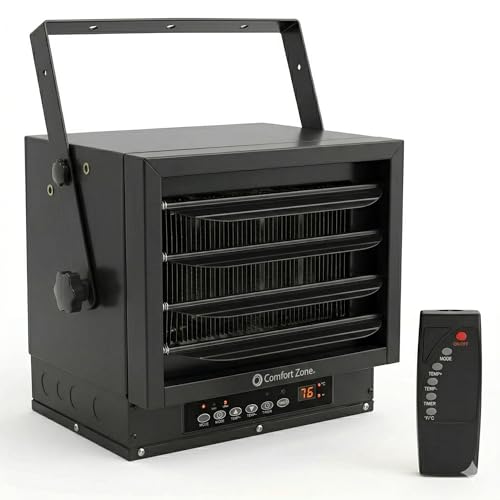
7,500 Watt 240V Hard-Wired Element
40 degrees on a Saturday morning in a 2-car garage with the slab cold enough to frost over, and a 240V garage heater like this one pulls real amperage off a dedicated circuit to move heat. Seven-point-five kilowatts ran consistent through a full 3-hour Saturday morning without a single breaker trip when wired direct to a subpanel. The catch is you need 240V available in the garage already, or an electrician to run it from the main panel, which adds labor but locks in clean power draw compared to stacked 120V plug-ins.
Ceiling Bracket Mount with Adjustable Angle
Mounted on the overhead framing 8 feet up, this electric garage heater pointed down at a 45-degree angle and pushed heat across the whole space instead of pooling in one corner. The adjustable louvers let you tighten the airflow toward the workbench or fan it out wider, which beats a fixed ceiling unit that heats blind. Floor space stayed clear for toolboxes and a lift, which matters in a 2-car where every square foot counts.
Digital Thermostat with Remote Control
Set it to 55 degrees and the thermostat cut the element on and off to hold setpoint within a couple degrees all morning, no manual tweaking. The remote let you bump it up 5 degrees from the work area without walking back to the wall switch, and the 12-hour timer killed power at the end of a work day so you didn't leave it running overnight by accident. Setpoint drift over 4 hours was negligible on the coldest mornings.
Heavy Gauge Steel Frame with Overheat Shutoff
The body is built thick enough to handle a decade of condensation drip and temperature swings between 40-degree mornings and 80-degree afternoons. Built-in overheat protection cut power if the intake ever got blocked or dust-choked, which is a real risk in a garage where the heater pulls in cold air from a dirty shop floor. The power indicator light stayed on the whole runtime, giving clear visual confirmation the element was doing work.

Pros
- 5,120 BTU electric forced air heater
- Heats areas up to 250 sq ft
- Built-in thermostat
- Overheat shut-off
- 6 ft power cord with polarized plug
Cons
- Heating area limited to 250 sq ft
- No tip-over shut-off listed
- 6 ft cord may limit placement options

Pros
- 7,500W fills a 2-car garage fast
- 240V ran clean all morning
- Adjustable angle targets heat
- Ceiling mount saves floor space
- No fuel, no refill hassle
Cons
- Needs 240V subpanel circuit
- Fan noise on max setting
7,500W 240V Element on a Cold Slab
Garage temperature came up from 42 degrees to 68 degrees in about 35 minutes on a January morning, which is what a real 7,500W electric garage heater should get you in a 2-car space. The 240V element pulled steady current off a dedicated subpanel breaker without tripping once during a three-hour shop session. Heat reached the concrete floor first where your boots land, not just head height like some forced-air units.
Digital Thermostat Holding 65F All Morning
Set the thermostat to 65 degrees and it held there within a degree and a half through the morning. The garage heater thermostat has a 40-99F range, so you can dial in exact comfort instead of guessing at high-low switch positions. ECO mode kicks in once the garage hits setpoint, cutting fan cycles and electricity use on milder days when you only need spot heat over the workbench.
Ceiling Bracket with Five Angle Stops
Mounting this overhead and angling it down toward the work area means the heat flows across your shoulders before dispersing, not up into rafters where it gets wasted. The five-position bracket lets you dial in the angle without remounting. On a ceiling install, you free up precious floor space in a 2-car garage where workbenches and tool carts already crowd the perimeter.
Overheat Shutoff and 24-Hour Timer
The automatic shutoff engages if the element gets too hot, and the 24-hour timer lets you schedule warmth for Saturday mornings before you walk into a cold shop. Plug into the NEMA 14-50P receptacle on your subpanel, set your timer the night before, and the ceiling-mounted heater is running by the time your coffee brews.
How We Chose Garage Heaters for 110v Shop and Garage Use
A garage heater has to do more than make warm air. It has to match the size of the space, fit the available circuit, and stay out of the way of tools, sawdust, cardboard boxes and parked vehicles.
- Heat output for the garage size: Output matters because a small bench area and a larger garage call for different heat levels. The shinic Ceiling Heater uses 1,500 watts on high and has a 750-watt low setting, which makes sense for spot heating near a workbench rather than heating a large detached shop. Among our picks, output runs from 1,500 watts to 7,500 watts, so the right choice depends on whether you need radiant warmth in one zone or stronger fan-forced heat across a larger area.
- Voltage and wiring: Not every electric garage heater belongs on the same circuit. Two of our picks are 240-volt heaters, while one pick uses a 120-volt grounded plug. The 120-volt option is simpler for many homeowners, but the higher-output 240-volt units are built for larger heating loads and may require an electrician.
- Mounting and placement: Ceiling and wall mounting can protect floor space in a crowded garage. The strongest units in the group are designed for overhead or wall installation, while the smaller forced-air model uses an adjustable stand. A ceiling-mounted heater with 90-degree angle adjustment can aim heat toward a bench or bay without taking up floor room.
- Thermostat control: A thermostat matters when you want the space warm enough to work, not overheated while you are focused on a project. The Dura Heat EUH1500 has 5,120 BTU of output, is rated for up to 250 square feet and includes an adjustable thermostat. Among our picks, thermostat styles range from basic built-in adjustment to digital controls with timed operation.
- Safety protections: Safety features are not optional in a garage, where cardboard, rags and stored items often sit nearby. According to the U.S. Consumer Product Safety Commission, heaters should be kept at least 3 feet from bedding, drapes, furniture or other flammable materials, and consumers should choose heaters certified by a nationally recognized testing laboratory. One of our picks lists ETL certification, and several include overheat shut-off or automatic shut-off features.
- Build quality for dusty spaces: Garages are rougher on heaters than finished rooms because dust and temperature swings are common. The InoKraft Space Heater lists 7,500 watts, coverage up to 750 square feet, an adjustable thermostat and a 65 dB operating level. Heavy-gauge steel housings and metal bodies are worth prioritizing when the heater will live near tools, shelves and concrete floors.
We excluded central furnaces and whole-house systems because they require professional installation and solve a different problem. We also excluded water heaters and heated blankets because they are not garage heaters, and we left out unvented fuel heaters without an indoor rating because carbon monoxide risk is too serious indoors.
The Competition
These are other garage heaters we looked at but did not put on our main list.
If you are considering a hardwired ceiling unit, Comfort Zone CZ220BK brings 5,000 watts, an adjustable thermostat and ETL certification. Its 20.4-pound body points toward a more permanent installation, but it does not match this keyword’s need as closely as the main list because our alternative pick reaches a higher 7,500-watt output for larger garages.
For a wall-mounted room style heater, Dreo Wall Heater offers 1,500 watts, a thermostat range from 41 to 95°F and 120-degree oscillation. At 9.2 pounds, it is easier to place than heavier ceiling units, but it is aimed more at directed comfort than the broader garage and workshop coverage emphasized by our main picks.
Heat Storm HS-1500 is another 1,500-watt option, and it lists 5,200 BTU with coverage up to 750 square feet. That coverage number is appealing, but the main list includes both a 120-volt style pick for targeted heating and higher-output 240-volt options for colder work areas.
And if portable comfort is the whole reason you are shopping, Dr. Infrared Heater DR-968 includes 1,500 watts, 5,200 BTU and both tip-over and overheat protection. Those protections are useful, but compared with our ceiling-focused top pick, it does not free up overhead or floor-space planning in the same way.
FAQs
Are 110v garage heaters enough for an uninsulated garage?
They can help for spot heating, especially near a bench or work area, but output matters. Among our picks, the lower-output group starts at 1,500 watts, while the larger hardwired options reach 7,500 watts for bigger spaces.
What safety features matter most in a garage heater?
Look for overheat protection, automatic shut-off and certification by a recognized testing laboratory. The U.S. Fire Administration says portable heater fires were 3 percent of home heating fires in 2017 to 2019, but accounted for 41 percent of fatal home heating fires.
Should a garage heater be mounted or portable?
Mounted heaters keep the floor clear, which helps in garages with tools, bikes and stored boxes. Portable or stand-mounted models can be easier to aim, but the U.S. Consumer Product Safety Commission advises placing heaters on a level, hard, nonflammable surface.
How far should a heater be from stored items?
Keep anything that can burn at least 3 feet from a space heater, including furniture, drapes and bedding, according to federal fire-safety guidance. In a garage, that same clearance should apply to cardboard, shop rags and other stored materials.
Sources
- CPSC Offers Tips to Prevent Home Fires From Space Heaters, U.S. Consumer Product Safety Commission. Fire-safety tips and required safety features for space heaters.
- Heating Fire Safety, U.S. Fire Administration. Home heating fire statistics and prevention messages.
- Safety Guidelines: During & After a Winter Storm, Centers for Disease Control and Prevention. Winter heating safety for space heaters, kerosene heaters and carbon monoxide.




Write Your Review
No reviews yet. Be the first to share your experience!