

Try Amazon Prime free for 30 days
Fast free delivery on heavy items, plus Prime Video, Prime Music and member-only deal prices.
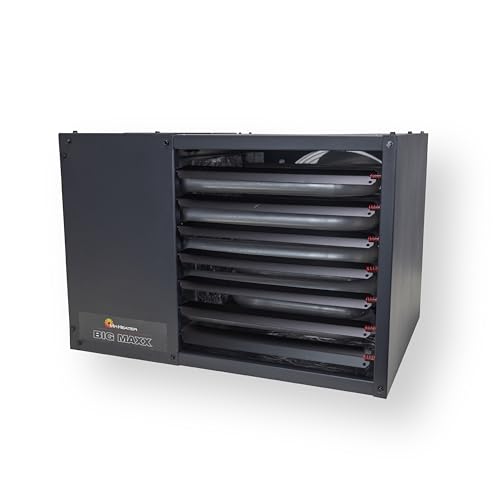
When a socket wrench feels like an ice cube and the garage floor seems to be winning, a thermostatic gas heater can make the space usable without babysitting the dial. Gas garage heaters with thermostat help match heat output to the room instead of running flat out. After comparing 6 models, the Mr. Heater 80,000 BTU Propane Heater stands out for 80,000 BTU, coverage up to 2667 square feet, and thermostat compatibility. The ProCom MN300TPA is the alternative pick, with 30,000 BTU for up to 1400 square feet.
Pros
- Heats 2-car garage fast on cold starts
- Flexible fuel option, propane or natural gas
- Ceiling mount saves valuable floor space
- Built-in safety shutoffs, flame sensor standard
- Thermostat-ready for temperature control
Cons
- Requires ceiling height and venting setup
- Hardwired installation, not a plug-and-play unit
80,000 BTU Output for Full 2-Car Coverage
Ceiling-mounted at 10 feet up, this propane garage heater pushes enough BTU to warm a full 2-car garage from a 40-degree start in a reasonable timeframe. The forced-air design means heat moves through the space instead of pooling near the ceiling, which matters when you're working on the floor and need warmth where your boots are, not where your head is.
Propane or Natural Gas, Your Choice
Mount it to a hardwired natural gas line running to your shop, or connect a standard propane tank outside and run fuel line to the unit. Unlike single-fuel heaters, this garage heater flexibility lets you pick based on what infrastructure you already have. Propane users get portable flexibility; natural gas users skip the tank swap routine.
24-Volt Thermostat Wiring for Steady Heat
Run a low-voltage thermostat wire from a wall-mounted stat to the heater and the unit holds setpoint through the morning without cycling on and off constantly. Standard 24-volt thermostats work fine, and newer Wi-Fi units are compatible if you want app control. Setpoint drift is rare when wiring is clean and the thermostat sensor isn't reading sunlight through a shop window.
High-Temperature Shutoff and Flame Sensor Safety
The flame sensor kills fuel flow if ignition fails, and an overheat cutoff trips if internal temperature climbs past safe limits. These aren't backup features; they're standard on a unit this size, and they work as designed on a real garage floor where your focus is on the engine, not the heater.

Pros
- 30,000 BTU heat output
- Heats up to 1,400 sq. ft.
- High, medium, low thermostat control
- No electricity required
- Wall mount hardware and base feet included
Cons
- Natural gas only, not an electric heater
- 34.35 lb weight may be harder to move
- Rated for up to 1,400 sq. ft., not larger spaces

Pros
- 30,000 BTU/hr output
- Heats up to 1,000 sq ft
- Built-in adjustable thermostat
- No electricity required
- Low oxygen safety shut-off
Cons
- For use with natural gas only
- Blower fan kit sold separately
- 24.67 lb weight may limit moving

Pros
- 17,000 BTU heats up to 500 sq. ft.
- Thermostatic heat control for adjustable warmth
- No electricity needed for power outage use
- Sealed burn system with safety pilot
- Includes vent kit for 4.5 to 10 inch walls
Cons
- Requires natural gas and direct wall venting
- Limited to spaces up to 500 sq. ft.
- 43 lb weight may need sturdy wall mounting

Pros
- 30,000 BTU/hr heat output
- Heats up to 1,000 sq ft
- Built-in adjustable thermostat
- No electricity required
- Low oxygen safety shut-off
Cons
- For use with natural gas only
- Blower fan kit sold separately
- Weighs 26.25 lb
Pros
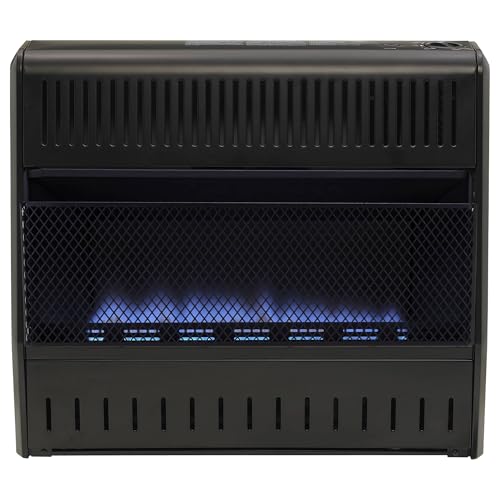
- 30,000 BTU output rated to heat spaces up to 1000 sq. ft.
- Dual fuel design operates on either natural gas or liquid propane
- Thermostatic control with variable settings for adjustable heat output
- Push button piezo ignition for simple startup
- Cool touch cabinet and included wall mount hardware
Cons
- No wattage, oscillation, remote, or timer features listed for this heater
- No tip-over or overheat protection mentioned in the product data
- Requires wall mounting and a connected fuel line, not a plug in portable unit
How We Chose Gas Heaters With Thermostat Control
A garage heater has to do more than make warm air. It has to produce enough BTU for the space, manage combustion safely, and fit the way the garage is actually used.
- Heat output and coverage: BTU output matters first because a small heater can run constantly in a drafty garage and still leave cold corners. Among our picks, output runs from 17,000 BTU to 80,000 BTU, with stated coverage from 500 square feet to 2667 square feet. The Mr. Heater 80,000 BTU Propane Heater is the high-output pick, rated for up to 2667 square feet and compatible with an adjustable thermostat. Its 78.2-pound weight also makes it a more permanent garage or workshop choice than the smaller wall heaters.
- Indoor rating and oxygen depletion protection: An enclosed garage raises different safety questions than an open patio, so indoor-safe language and low-oxygen protection matter. Several of our picks list low oxygen shut-off or an oxygen depletion sensor, which is important for unvented gas heat. The U.S. Consumer Product Safety Commission says unvented gas heaters should have an oxygen depletion sensor that shuts the heater off if oxygen drops too low. It also advises choosing a heater certified by a nationally recognized testing laboratory.
- Ventilation and carbon monoxide precautions: Vent-free and direct-vent heaters handle combustion differently, so the safer fit depends on the garage, wall access, and local rules. The Comfort Glow 17,000 BTU Natural Gas Wall Heater uses a direct-vent design, produces 17,000 BTU, and is rated for up to 500 square feet. Its 43-pound wall-mounted setup includes a vent kit, which suits buyers who want combustion gases routed through an exterior wall. The CDC advises installing a battery-operated carbon monoxide detector and using only the fuel type the heater is designed to use.
- Fuel type, tank size and run time: The main list includes natural gas, propane, and dual-fuel approaches, but none of the listed models provides a tank size or run-time figure. That absence matters because a propane setup may depend on tank capacity, while natural gas usually depends on a fixed line. For this guide, we treated fuel compatibility as a hard requirement and did not infer run time where no number was provided. The CDC also says to use only the type of fuel a heater is designed to use.
- Ignition and safety shut-offs: A garage heater should start predictably and shut down when something is wrong. Across the list, ignition systems include battery-operated electronic ignition and push-button piezo ignition, while safety features include pilot shut-off, low oxygen shut-off, and high-temperature shut-off. The Mr. Heater 30,000 BTU Natural Gas Heater combines 30,000 BTU, coverage up to 1000 square feet, and an adjustable thermostat. At 24.7 pounds, it is also much lighter than our top pick.
- Size and portability: Weight and mounting style affect whether a heater belongs on a wall, on the floor, or near the ceiling. The listed weights we could compare run from 24.7 pounds to 78.2 pounds, so installation expectations vary sharply. A ceiling-mounted unit is suited to a dedicated heated workspace, while a lighter wall heater may fit a smaller garage or cabin room. The U.S. Fire Administration says anything that can burn should be kept at least 3 feet from space heaters.
We excluded central furnaces and whole-house systems because they require professional installation and solve a different problem. We also left out water heaters, heated blankets, and outdoor-only patio heaters because they do not match the job of heating an enclosed garage, cabin, or workshop.
Other Gas Heaters Worth Considering
These are other gas heaters we looked at but did not put on our main list.
If you want a lower-output wall-style option, ProCom ML250TPA offers 25,000 BTU and is rated for up to 1150 square feet. It also lists an adjustable thermostat and an oxygen depletion sensor, but its 25,000 BTU output is well below the 80,000 BTU output of our top pick.
For shoppers who want more heat than a compact wall heater but less than the largest unit here, Mr. Heater 50,000 BTU Propane Heater sits in the middle with 50,000 BTU. It is rated for up to 1667 square feet and weighs 60.3 pounds, so it is still a serious garage heater rather than a small room appliance. Compared with our top pick, it gives up 30,000 BTU and about 1000 square feet of stated coverage.
A more installation-minded buyer might consider Modine 45,000 BTU Natural Gas Heater, which brings 45,000 BTU and a 60-pound body. It is a capable unit on paper, but it does not match this search as closely because the available facts do not include thermostat details. The main list stayed focused on heaters where thermostat control is part of the decision.
At the small-space end, ProCom MN100TPA provides 10,000 BTU and is rated for up to 500 square feet. It includes an adjustable thermostat and an oxygen depletion sensor, which are useful features for this category. Still, its 10,000 BTU output is only one-eighth of our top pick’s output, so it is better matched to a small zone than a full garage or workshop.
FAQs
How many BTU do I need for a garage heater with a thermostat?
Our picks range from 17,000 BTU to 80,000 BTU, and the stated coverage ranges from 500 square feet to 2667 square feet. A thermostat helps reduce constant manual adjustment, but it cannot make an undersized heater cover a larger space than its rating.
Are ventless gas heaters safe in a garage?
Ventless gas heaters require careful attention to oxygen depletion protection and carbon monoxide risk. The CPSC says unvented gas heaters should have an oxygen depletion sensor, and the CDC recommends a battery-operated carbon monoxide detector.
Do I still need ventilation if the heater has a thermostat?
Yes, thermostat control manages heat output, not combustion byproducts. The CDC says proper ventilation is necessary when using kerosene heat, and it also advises using only the fuel type the heater is designed to use.
How much clearance should I leave around a garage heater?
The CPSC and U.S. Fire Administration both recommend keeping anything that can burn at least 3 feet from space heaters. That includes bedding, drapes, furniture, and other flammable materials stored in a garage.
Sources
- CPSC Offers Tips to Prevent Home Fires From Space Heaters, U.S. Consumer Product Safety Commission. Fire-safety tips and required safety features for space heaters.
- Safety Guidelines: During & After a Winter Storm, Centers for Disease Control and Prevention. Winter heating safety for space heaters, kerosene heaters and carbon monoxide.
- Heating Fire Safety, U.S. Fire Administration. Home heating fire statistics and prevention messages.




Write Your Review
No reviews yet. Be the first to share your experience!