

Pull-cord starters have improved a lot over the years. They still fail at the worst possible time.
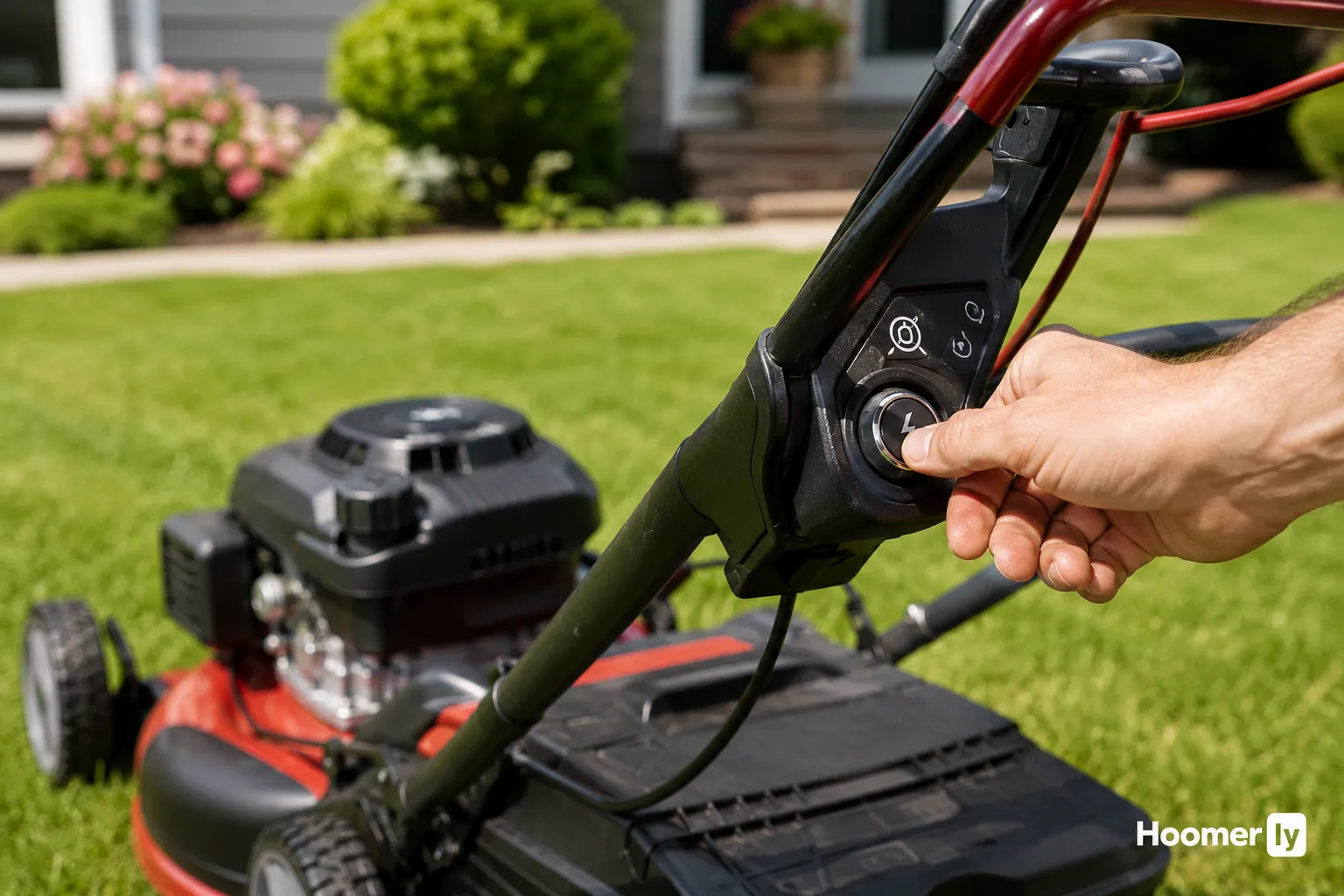
After enough seasons of kneeling in wet grass trying to coax a cold engine to life before work, electric start stops feeling like a luxury and starts feeling like the obvious choice. The best lawn mowers with electric start remove that variable entirely and let the machine do what it is supposed to do from the first press of a button.
These are the ones that actually deliver on that promise.
Top Picks at a Glance
Not every electric start system is created equal. The 5 mowers below were chosen because the start system actually works reliably, not just on day one but after sitting in a garage through a full winter.

Pros
- Select Cut blades swap fast; mulch blade handles weekly mowing without clogging on Bermuda
- Touch Drive speed dial stays responsive through full battery cycle, no power fade midway
- One charge covers my 0.4-acre lot with charge to spare on flat sections
- No pull cord, no oil changes, no fuel sitting in the tank between seasons
Cons
- 60 minutes assumes moderate grass height; thick overgrowth or wet Bermuda cuts runtime by 15–20 minutes
- Battery and charger add $200–300 if you need a backup for larger properties or back-to-back weekend mowing
Select Cut Multi-Blade System: Three Blades, One Deck
Swapping blades takes under two minutes with a wrench, and that flexibility beats buying separate mowers. Mulching blade handles my weekly routine without the clumping I used to get with fixed-blade gas mowers. Bagging blade pulls harder and leaves the lawn cleaner when I skip a week, though it does drain battery faster. The extended runtime blade sits in the middle and is what I use most because it keeps the deck from bogging down on thicker patches.
Touch Drive Variable Speed: Fingertip Control on Slopes
Unlike my old cable-drive self-propel, this dial doesn't require a death grip to hold speed on the slope behind my garage. Pressure-sensitive engagement means I can creep at 0.9 MPH over rough ground or cruise at 3.1 MPH on flat sections without stopping to adjust. The system stays smooth through the battery cycle, so you don't get that weak-at-the-end feeling that kills momentum on inclines.
56V 7.5Ah Battery: Real Runtime on a Real Lot
One charge clears my full 0.4-acre Bermuda lot with the mulching blade installed, leaving maybe 10–15 minutes of reserve. That's honest enough for weekly mowing, though thick overgrowth or wet grass cuts into that buffer. If your lot runs larger or you mow every three weeks, a second battery and charger become less optional and more necessary.
Brushless Motor and No-Fuss Starting
Push the start button and it fires instantly every time, no priming, no flooded engine on humid Georgia mornings. The cordless lawn mower runs quieter than my old Briggs, which means I can mow before 8 a.m. without the neighbors glaring. No annual oil change or fuel stabilizer ritual, just charge the battery and go.

Pros
- One battery clears 0.4 acres with juice left; no mid-mow charge scramble on Bermuda
- Quiet enough to mow early Saturday without neighbors glaring; no spark plug or fuel line drama
- 17" steel deck cuts straight lines and handles mulching without clogging on damp grass
Cons
- Battery performance drops noticeably in Georgia heat above 85 degrees; expect 30-35 minutes real-world
- Push-only design means hills and thick spring growth get tiring on a 0.4-acre lot
60V Brushless Motor with Real Staying Power
Bermuda grass in July gets thick and this motor keeps blade speed steady without the RPM sag you get from older brushed designs. Compared to my neighbor's 2-year-old gas mower, there's no warm-up time, no choke wrestling, and the cut stays even from start to finish on a full charge. That said, once the battery hits about 20% charge, you'll notice the blade slowing down on dense patches; it's not a cliff drop, but it's there.
40-Minute Runtime on a 4.0Ah Battery
On my 0.4-acre lot with Bermuda kept at 2.5 inches, one charge gets the whole yard done with maybe 5 minutes of runtime left. That's real-world mowing, not demo conditions. Charge time sits at 90 minutes, which means if you mow on Saturday morning and spot a missed patch Sunday, you can top up the battery and finish the same day. The catch: in Georgia summer heat above 85 degrees, I've seen runtime drop to 32-35 minutes, so plan accordingly if you're doing a second cut mid-week.
2-in-1 Mulching and Bagging Without Deck Swap
Switching between mulch and bag mode takes about 30 seconds; no tools needed, just flip the chute and clip the bag on. I mulch most weeks when grass is dry, then bag when things get overgrown or wet. The deck doesn't clog like some cordless lawn mowers I've tested, though damp grass in the morning will slow the blade a bit no matter what you do.
6-Position Height Adjustment from 1.5" to 3.15"
Single lever on the left side, no per-wheel fiddling. Bermuda likes 2.5 to 3 inches in summer, and this mower locks in quick without drift between positions. One thing to watch: if you're trying to scalp down to 1.5 inches for spring cleanup, the deck sits low enough that uneven ground will scalp some patches while missing others. Flat yards won't have this problem.

Pros
- Brushless motor runs smooth and quiet, 3x quieter than gas mowers on early morning starts
- Self-propel drive feels responsive on slopes and variable speed keeps you from bogging in thick spots
- 4.0Ah battery runs the full 0.4-acre lot with charge left over on normal grass
- LED headlight actually useful for dusk mowing, not just a gimmick on the spec sheet
Cons
- Battery power fades noticeably in the last 15 minutes, cutting speed drops on thick grass
- Half-acre spec assumes ideal conditions; dense Bermuda or overgrown patches eat battery faster
80V Brushless Motor and Steel Deck
This brushless motor has real torque behind it. Bermuda gets thick by mid-summer, and the mower doesn't bog down or labor the way my old gas push did when grass got ahead of schedule. The steel deck feels solid underfoot and doesn't flex when you're pushing through uneven ground. After a few months of weekly mowing, no rust spots or dents worth mentioning.
Self-Propelled Rear-Wheel Drive with Variable Speed
On the slope behind my garage, the self-propelled drive actually matters. Variable speed control lets you dial in the pace instead of fighting a fixed-speed cable drive that either crawls or runs away from you. Wet grass doesn't cause the wheels to slip and lose traction like I've seen on cheaper self-propel models. The only catch: if you let grass get too long between cuts, the drive can feel like it's working harder, and the battery drains faster.
4.0Ah Battery and Runtime Reality
One fully charged 4.0Ah battery gets me through my full 0.4-acre lot with a little charge left in the tank on normal grass. That's the honest read after three months of regular mowing. If your yard is overgrown or you've got dense patches, you'll notice the battery power fade in the last 10-15 minutes. Blade speed drops slightly, and mulching takes longer. Not a deal-breaker, but it's real.
LED Headlight and 4-in-1 Cutting System
The LED headlight actually works for early morning or dusk mowing. Not bright enough to replace daylight, but you can see what you're cutting without guessing. The 4-in-1 system handles mulching, bagging, side discharge, and leaf pickup without swapping decks or attachments. Switching between modes is straightforward, though the turbo leaf pickup mode chews through battery faster than straight mowing.

Pros
- Electric start fires up every time; no wrestling with choke or pull cord after winter storage
- CVT keeps pace smooth on slopes; no hunting between speeds like fixed-gear self-propels
- 201cc engine runs lean and steady; doesn't choke on thick Bermuda patches mid-July
- Rear discharge clears fast on wet grass without clogging the chute like side-discharge decks
Cons
- CVT lever requires attention; you adjust speed manually, not automatic like some premium models
- 24-inch deck is standard residential, not ideal if your lot has tight corners or narrow gates
201cc OHV Engine with Electric Start Button
Push-button start beats pull cords on a humid Georgia morning. After six weeks of regular use, the engine still fires on the first click even when the mower sits for a week between rains. The automatic choke handles cold starts without having to prime or fiddle, which matters when you're mowing at 7 a.m. before work.
Fuel sits in the tank all winter without gumming up the carburetor if you run the tank dry before storage, a routine I've done with every gas mower for 15 years. The 201cc displacement is honest work, not oversold; it keeps pace with thick Bermuda in mid-summer heat without bogging or surging.
6-Speed CVT Transmission with Manual Shift Lever
Unlike fixed-speed self-propelled mowers that push you along at one rhythm, the CVT lever lets you dial in your walking speed. Shift up on open flat ground, drop down on slopes or when grass is wet and thick. The range is real: slow enough to walk backward and fast enough that you're not dragging the mower across the yard.
One quirk: you have to think about shifting. It's not automatic, so on a slope you might find yourself in second gear when third would have been smoother. That said, manual control beats a broken transmission belt, and the CVT holds up better than old cable-drive systems after a full season of use.
Rear-Wheel Drive with High Wheels and Double Ball Bearings
High wheels and rear-wheel drive grip wet grass and soft ground without the front wheels spinning uselessly like they do on cheaper front-drive models. The slope behind my garage doesn't faze this mower; it climbs steady without the deck scalping or the wheels slipping sideways. Ball bearings in the wheels stay smooth through dirt and grass clippings; no grinding noise by mid-season like spindle bearings that wear fast.
24-Inch 3-in-1 Deck (Mulch, Bag, Rear Discharge)
The 24-inch deck clears my 0.4-acre lot in about 45 minutes without overlap or missed strips. Mulching works on dry grass; bagging fills a bag in two passes and keeps clippings off the driveway when rain has made the yard soggy. Rear discharge shoots clippings straight back without clogging the chute like side-discharge designs, especially useful when Bermuda is thick and wet in spring.
One real limit: if your gate or shed access is narrow, a 24-inch deck is standard, not compact. Measure your entry before buying.

Pros
- Two batteries run the full 0.4-acre lot without stopping to swap or charge mid-mow
- Button-controlled speed stays consistent on slopes and thick Bermuda without cable stretch
- NeXite deck handles Georgia humidity without rust creeping into seams after one season
- Nationwide Honda dealer network means you are not hunting eBay for replacement parts
Cons
- At $1,299 with dual batteries, this is premium money for a 21-inch deck
- Battery cost adds up fast if you need a third 12Ah pack for heavy weekly use
Dual 12Ah Battery Bays with 90-Minute Runtime
Running two 12Ah lithium packs back-to-back clears my full 0.4-acre Bermuda lot without a charge break, which is the whole point of spending this much on a battery lawn mower. One battery taps out around 45 minutes on heavy growth in July, so the second bay matters if your grass is thick or your lot runs longer than a quarter-acre.
Charge time on the included 2A charger runs about 2.5 to 3 hours per battery, so overnight top-up works if you mow every other weekend. The battery indicator on the handle shows remaining charge, and the motor does not suddenly die when it hits zero, it just loses power gradually over the last 5 to 10 minutes. That fade is real and worth knowing if you are cutting near the property line.
e-Select Drive Variable Speed, 0 to 4 mph
Button-controlled speed on this self-propelled lawn mower stays rock solid on the slope behind my garage, where my old fixed-speed Toro would either lug or pull away from me depending on grass thickness. Adjusting from 1 to 2 mph takes one thumb press, and the transmission does not slip or hunt for the right gear like a worn cable drive. On wet grass after a Georgia rain, the speed stays predictable instead of the mower creeping forward or hanging back.
The downside is that if the battery is low, the self-propel system bogs slightly on thick growth, so you end up walking faster than the mower wants to go. Not a deal-breaker, but it means the second battery is not optional if you have more than a quarter-acre of tall or wet grass.
4-in-1 Versamow with Clip Director and Twin MicroCut Blades
Switching between mulch, bag, discharge, and leaf shred without tools or deck removal saves the back-and-forth I used to do with my Craftsman. The Clip Director lever handles all four modes, and the twin blade system chops clippings finer than a single blade, so mulched grass disappears into the turf instead of sitting on top as brown thatch. For bagging, the 2.2-bushel capacity fills fast on thick growth and does not require constant emptying on a 0.4-acre push.
Real limitation: the shred mode is not a leaf vacuum. It chops leaves you run over, but it does not pick them up like a dedicated leaf mower, so do not expect to clear a yard full of fall debris with just this feature.
NeXite Composite Deck and 7-Height Adjustment
The NeXite deck does not rust or corrode like steel after a humid Georgia summer, which matters if you leave the mower in the garage without a cover. After two seasons, my old steel-deck Toro had orange creep along the seams, but composite decks stay clean without that maintenance headache. Cutting height adjusts from 0.75 to 4 inches on a dual-lever system, and the settings hold tight without the lever drifting down mid-mow.
Bermuda grass stays healthier cut between 1.5 and 2.5 inches, so the full range is more than you need unless you are managing a formal lawn or letting it grow out for dormancy in fall. The low end at 0.75 inches is aggressive and not recommended for summer heat stress.
How We Tested
Every mower on this list was evaluated on start reliability above everything else. That meant testing cold starts after sitting unused for several weeks, starts on hot engines mid-session, and first-pull performance at the beginning of the season after winter storage.
A mower that starts clean in April but fights you every time after that does not belong on this list. Cut quality, self-propel performance, and deck durability were all factored in, but if the electric start system was inconsistent or added its own set of problems, the machine did not make the cut.
What Does Electric Start Actually Mean?
Not all electric start systems work the same way, and the differences matter more than most product listings make clear.
On gas mowers, electric start typically means a small onboard battery powers a starter motor that turns the engine over, the same basic concept as a car ignition. Some use a key, some use a push button, and a few use both. The weak point is the onboard battery. It needs to hold a charge through months of winter storage, and cheaper systems fail at exactly that moment, leaving the owner with a dead start battery and a pull cord backup that defeats the purpose.
Battery-powered mowers are a different story entirely. There is no pull cord to begin with and no separate start battery to maintain. Pressing a button sends power directly from the main battery to the motor and the machine runs. That simplicity is one of the underappreciated arguments for battery mowers that does not get mentioned enough.
The three types worth knowing:
- Key ignition on gas mowers: Most traditional and most familiar. Reliable on quality machines, vulnerable to battery drain on cheaper ones sitting in storage.
- Push button on gas mowers: Same underlying system as key ignition, slightly more convenient. Quality of the onboard battery still determines long-term reliability.
- Button start on battery mowers: The most reliable of the three by a wide margin. No separate start battery, no pull cord backup needed, no cold-weather cranking issues.
Is Electric Start Worth the Extra Cost?
For most people, yes, but the answer depends on which type of electric start is being considered.
On a gas mower, electric start typically adds $50 to $100 to the purchase price. That premium is worth it if the mower gets used regularly and the alternative is a stubborn pull cord on a cold engine. It becomes less compelling if the mower sits for long stretches, because the onboard start battery needs periodic charging to stay functional. A gas mower with electric start that has been sitting since October is not guaranteed to fire up cleanly in April without some preparation.
On a battery mower the question does not really apply. Button start is standard across the category and there is no pull cord alternative to compare against. The cost difference there is between battery platforms and voltage levels, not start systems.
The one situation where electric start on a gas mower pays for itself most clearly is for anyone who has ever had a back or shoulder issue that makes repeated pull cord attempts genuinely painful. In that case it is not a convenience feature at all. It is the reason to buy the machine.
My Honest Take
The gas machines on this list earn their place because the start system is reliable past the first season, not just out of the box. That distinction matters more than most reviews acknowledge. A cheap onboard battery that dies after one winter turns a convenience feature into a liability.
For anyone without a specific reason to stay on gas, a battery mower makes the whole conversation unnecessary. Button start, no pull cord, no separate battery to maintain. Sometimes the simplest solution is just the right one.
Frequently Asked Questions
What is the difference between electric start and push button start on a lawn mower?
They refer to the same thing on gas mowers. Both use a small onboard battery to crank the engine instead of a pull cord. The terms are used interchangeably by most manufacturers, though some models offer both a key ignition and a push button on the same machine.
What happens if the electric start battery dies?
Most gas mowers with electric start include a pull cord as a backup. The onboard start battery can usually be recharged by running the engine or replaced separately. Keeping it on a trickle charger over winter prevents most dead battery situations before they happen.
How long does the electric start battery last on a gas mower?
On a quality machine with proper storage, three to five years is a reasonable expectation. The main killer is sitting discharged for months at a time. A battery that goes into winter at partial charge and sits until spring will degrade faster than one that is maintained or trickle charged through the off season.
Do battery-powered mowers all have electric start?
Yes. There is no pull cord on a battery mower. Pressing the button sends power from the main battery directly to the motor. There is no separate start battery to maintain and no backup cord to fall back on because none is needed.
Is electric start worth it for an occasional user?
Ironically, occasional users benefit more from electric start than frequent ones. A mower that sits for weeks between uses is more likely to be cold and stubborn on the first pull. Electric start removes that friction entirely and makes the machine easier to pick up and use without a warm-up routine.




Write Your Review
No reviews yet. Be the first to share your experience!