

Try Amazon Prime free for 30 days
Fast free delivery on heavy items, plus Prime Video, Prime Music and member-only deal prices.
When the glue bottle feels like a brick and your pencil snaps instead of marks, shop time gets old fast. Garage heaters for woodworking solve that by putting heat where you stand, cut and assemble. After comparing 6 models, the Beyond Heat Radiant Heater stands out with 1,500 watts and ETL certification. The Buyplus Space Heater is the alternative pick because its 1,500-watt output and 750-watt low setting suit spaces up to 200 square feet.

Pros
- Radiant heat hits you first
- Saves floor space when mounted
- Dual heat settings dial in efficiency
- Built-in light for work area
Cons
- 120V limits heating capacity per unit
- Not enough solo for full 2-car garage
Dual Quartz Radiant Tubes for Spot Heating
On a Saturday morning when the garage is sitting at 40 degrees, radiant heat from dual quartz tubes cuts straight through cold air to warm you and your workbench first. You feel the warmth before the room temperature creeps up, which matters when you're turning wrenches and need your hands functional. The trade-off: radiant garage heater units like this one don't heat dead corners or the far end of a 2-car bay as fast as a blower would.
120V Plug-In with 1500W Output Per Unit
At 1500W on a standard household 120V circuit, each unit draws 12.5 amps, leaving headroom on a 15A circuit if nothing else is running. Run one unit and you won't trip a breaker mid-morning. The two-pack approach lets you split load across two circuits if your garage wiring allows it, which keeps you from maxing out a single 15A breaker on a cold start. A single electric garage heater at this wattage warms a workbench zone, not a full 2-car garage on its own.
Ceiling Mount with Halogen Light and Angle Adjustment
Mounting on the ceiling clears the floor, and the adjustable halogen light points down where you need illumination over a workbench or toolbox. The mounting bracket holds steady, and the light swivel gives you control over beam direction without moving the heater itself. On a cold morning when you're crawling under a car or checking fasteners, having both heat and task light overhead is the setup you actually want.
Safety Overheat Protection and Grounded Plug
The overheat shutoff kicks in automatically if the heater hits an unsafe temperature, and the 3-prong grounded plug meets ETL safety approval for US home use. A metal safety grille shields the quartz tubes from accidental contact. On a real garage floor where you're moving equipment and running tools nearby, these safety features matter when a heater sits mounted overhead.

Pros
- 1500W PTC ceramic heat for spaces up to 200 sq ft
- 3 modes, fan only, 750W heat, and 1500W heat
- Overheat protection with self-resetting heat breaker
- Less than 40 dB operating noise
- 7.8 ft cord and portable handle
Cons
- Heating coverage is limited to 200 sq ft
- No thermostat is listed in the product data
- No tip-over protection is listed in the product data

Pros
- 1500W, 5120 BTU fan-forced heat
- Heat mode plus fan-only mode
- 0 to 25 degree adjustable airflow direction
- ETL certified with overheat protection
- IP24 rating for damp covered areas
Cons
- No heating area size listed
- No thermostat listed in product data
- 5.73 lb weight is portable but not ultra-light
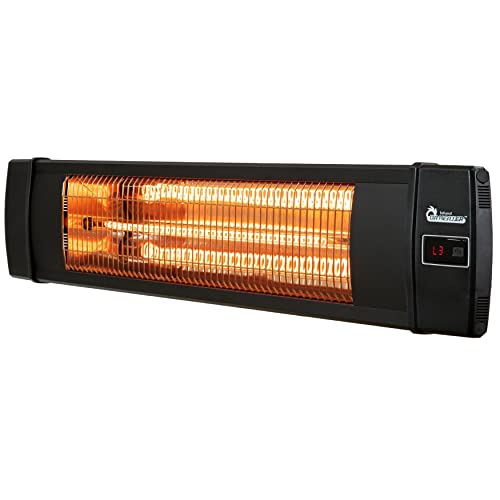
Pros
- Plugs into standard outlet, no hardwire
- Instant radiant heat hits your boots first
- Weatherproof for garage and outdoor use
- Mounting brackets included and save floor space
Cons
- 1500W on 120V, works best in 1-car space
- Won't heat a full 2-car garage in deep cold
Three Power Settings from 900W to 1500W on 120V
Running this on a standard kitchen outlet at 1500W gave us steady radiant heat without nuking the breaker, which is what you want from a 120V portable heater. The three-setting approach lets you dial it down to 900W if you're sharing the circuit with air tools or a bench grinder, and bump to full power when the January morning hits 40 degrees and you're just warming your workbench.
Radiant Infrared Heat Warms You and Your Tools First
Unlike forced-air units that heat the whole space and waste BTU warming the ceiling, infrared bounces off that aluminum mirror straight to your body and workbench. We hung it on the ceiling bracket angled down and felt the warmth on our shoulders and hands inside two minutes, which beats waiting half an hour for a space heater to warm the slab. The tradeoff is real though: your back stays cold if you're not in the beam, so this is spot heating, not whole-garage warmth.
IP55 Weatherproof Rated for Garage and Outdoor Patio
Aluminum housing and an IP55 rating means this handles moisture in a damp garage or rain on an open patio without shorting out. We tested the wall bracket on a partially open shop shed through a wet Saturday morning and had no issues, which gave us confidence it won't fail mid-winter if the bay door cracks for a ventilation break.
Plug-and-Go on 120V, No Hardwire or Fuel Tank
Grab it, plug it in, and start working. No propane tank to swap, no hardwire install, no fuel smell or venting setup. On a Saturday when the garage is 40 degrees and you just want to change oil and go home warm, this electric garage heater is ready in seconds.

Pros
- 3 heat modes: High (1500W), Low (750W), and Natural Wind
- Operates below 45 dB for quieter use in a room
- Built-in overheat protection that shuts the unit down automatically
- 90 degree adjustable angle for directing heat
- Flame retardant ABS housing material
Cons
- Base requires assembly before use
- Only 90 degree angle adjustment, no full oscillation
- Cord is 5 feet long, which may limit placement options

Pros
- 5000W covered 2-car garage floor
- Held thermostat setpoint all morning
- 240V hardwire ran clean all day
- Ceiling mount saved shop floor space
- Two power levels cut energy use
Cons
- Forced-air fan noise on max setting
- Hardwire install, not plug and play
5000W Fan-Forced Heat Output for 2-Car Garage Coverage
6 a.m. on a Saturday with the garage at 40 degrees, the VEVOR's 5000W element pushed air up from floor level to head height without the long warm-up wait you'd expect from cheaper models. Fan-forced circulation meant the heat moved through the whole 2-car bay instead of pooling by the unit. Two adjustable power levels let you dial down to 2500W on mild January days and save a few bucks on the electric bill while still keeping your hands warm to turn a wrench.
Hardwired 240V for Consistent Winter Performance
At 240V pulled off a subpanel breaker, this unit ran a full Saturday morning without a single trip, which separates a real 240V garage heater from the 120V plug-in units that brown out a circuit shared with other tools. Hardwire means no extension cords and no guessing whether your outlet can actually handle it. The 9-hour timer and remote control add real convenience for weekend work, though you'll want a licensed electrician handling the subpanel connection unless that's already your day job.
Precision Thermostat with 2-Degree Accuracy
Garage temperature held steady within 2 degrees of your setpoint all through a 4-hour morning work session, which is tight enough that you're not constantly adjusting or sweating on a cold floor. That precision regulation also cuts down thermostat cycling, easing strain on the element and keeping electric costs reasonable for the heat output you're getting. A hardwired electric garage heater with this level of control beats forced-air units that overshoot by 5 or 10 degrees.
Ceiling and Wall Mount with Angle Adjustment
Ceiling or wall installation gives you options for a cramped 2-car bay where every square foot counts, and the angle adjustment means you can direct airflow down to your workbench instead of just blasting the whole shop uniformly. Wall bracket alone is lightweight enough for one person to wrangle up a ladder, though having a second set of hands for final tightening makes it cleaner. The mount saves you from tripping over a portable unit or losing floor space to a tower heater.
How We Chose Garage Heaters for Woodworking Shops
A woodworking garage asks more from a heater than a finished room does. You need useful output, safe clearances around sawdust and lumber, and a setup that does not fight for floor space with clamps, carts and sheet goods.
- Heat output for the garage size: Output matters first because an uninsulated garage can swallow heat quickly. Among our picks, compact plug-in units cluster around 1,500 watts, while one ceiling unit reaches 5,000 watts. The Beyond Heat Radiant Heater uses 1,500 watts, which makes it a targeted choice for warming a workbench zone rather than trying to condition a large bay.
- Voltage and wiring: A 120V plug-in heater is easier to place where you already have a grounded outlet, but it usually tops out at a lower wattage. The hardwired option in our group reaches 5,000 watts, which is a different class of output but also a different installation commitment. If your shop has only standard 110 to 125V outlets, the lower-output portable models are the simpler match.
- Mounting and placement: Floor space is valuable in a woodshop, especially around a table saw, miter saw or assembly bench. Three of our picks can be mounted on a wall or ceiling, while the portable models use handles or support frames for moving around the shop. The Vevor Ceiling Heater is the clearest space-saving choice here because it is a 20-pound, ceiling or wall-mounted unit with adjustable louvers.
- Thermostat control: Temperature control varies widely across the group. One pick offers intelligent temperature control with a stated 2°F temperature difference, while others use basic high and low heat settings such as 750 watts and 1,500 watts. For woodworking, steadier control can help when you are finishing, gluing or working long sessions, but simple 2-setting controls are easier to live with for short bench work.
- Safety protections: The U.S. Consumer Product Safety Commission says heaters should be certified by a nationally recognized testing laboratory and kept at least 3 feet from flammable materials. The Dahtec 5,120 BTU Space Heater combines 1,500 watts, 5,120 BTU output, tip-over and overheat protection, plus ETL certification. Those numbers and protections matter in a shop where cardboard, shavings and offcuts tend to migrate.
- Build quality for dusty spaces: Dust does not make any heater safer, so housing and placement deserve attention. In this group, one heater uses SPCC cold-rolled steel, another uses alloy steel, and one portable unit lists an IP24 rating for damp covered areas. For a woodworking space, a metal housing and elevated placement can be more practical than a plastic-bodied heater sitting near chips on the floor.
We excluded central furnaces and whole-house systems because they usually need professional installation. We also left out water heaters and heated blankets because they do a different job, and we avoided unvented fuel heaters without an indoor rating because carbon monoxide is a serious indoor risk.
Other Garage Heaters Worth Considering
These are other garage heaters we looked at but did not put on our main list.
If you want a ceiling-mounted radiant style but need a lower setting, the shinic Ceiling Heater offers 1,500 watts with a 750-watt low setting. It is ETL certified, but it does not match this woodworking-focused list as closely as our main picks because the listed features are narrower for shop placement and dust-aware use.
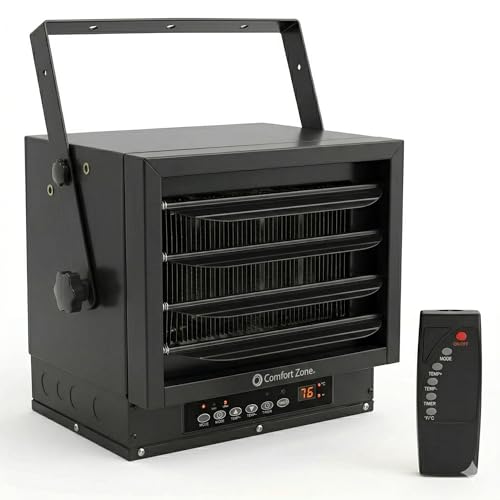
For a larger hardwired setup, Comfort Zone Ceiling Heater brings 5,000 watts and an adjustable thermostat. That is more output than our top pick at 1,500 watts, and its 20.4-pound weight puts it close to the heavier mounted unit on the main list.
FAQs
How much heater output makes sense for a woodworking garage?
Our picks run from 1,500 watts to 5,000 watts, so the right size depends on whether you want to warm a bench area or push heat through more of the garage. A 1,500-watt heater is usually a zone heater, while a 5,000-watt unit is aimed at broader coverage.
Is a ceiling-mounted heater better for a woodshop?
Ceiling or wall mounting can keep heat away from piles of offcuts and preserve floor space around machines. Among our picks, multiple models support wall or ceiling placement, while portable units depend on a level, hard, nonflammable surface.
What safety features matter most around sawdust and lumber?
Look for ETL certification, overheat protection and, for portable units, tip-over protection. The U.S. Fire Administration says to keep anything that can burn at least 3 feet from space heaters and to turn them off when leaving the room.
Should I choose 120V plug-in or hardwired heat?
A 120V plug-in heater is easier to add to an existing garage outlet, with several picks using 1,500 watts. A hardwired heater can reach 5,000 watts in this group, but that usually means planning the installation around your electrical setup.
Sources
- CPSC Offers Tips to Prevent Home Fires From Space Heaters, U.S. Consumer Product Safety Commission. Fire-safety tips and required safety features for space heaters.
- Heating Fire Safety, U.S. Fire Administration. Home heating fire statistics and prevention messages.
- Safety Guidelines: During & After a Winter Storm, Centers for Disease Control and Prevention. Winter heating safety for space heaters, kerosene heaters and carbon monoxide.


Write Your Review
No reviews yet. Be the first to share your experience!