

Try Amazon Prime free for 30 days
Fast free delivery on heavy items, plus Prime Video, Prime Music and member-only deal prices.
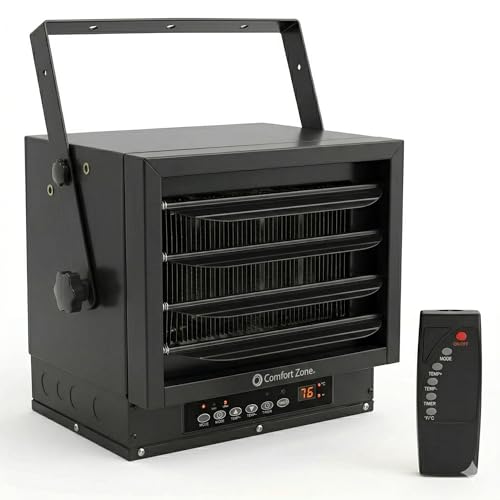
When your socket wrench feels like it came out of the freezer, garage ceiling heaters start to make sense. A ceiling-mounted unit can warm a work area while keeping the floor clear for cars, benches and half-finished projects. After comparing 2 models, the Mr. Heater 50,000 BTU Propane Heater stands out for 50,000 BTU output, coverage up to 1667 square feet and thermostat compatibility. The Comfort Zone CZ230ER is the alternative pick, with 7,500 watts and coverage up to 1250 square feet.

Pros
- 50,000 BTU covers large garage
- Thermostat setpoint stays true
- Ceiling mount saves floor space
- Dual fuel, propane or natural gas
Cons
- Needs 10 ft minimum ceiling height
- Forced air fan noise on high
50,000 BTU Forced-Air Coverage for a Full 3-Car Garage
On a 40-degree January morning, mounting this unit overhead and firing it up gets the whole garage warm instead of just the corner where you're standing. The forced-air propane heater pushes warm air across the full floor plan, and because it's ceiling-mounted, you're not losing heat to floor drafts like you do with a portable unit sitting on the slab. Real-world heat moves fast enough that you can have both bay doors cracked for air flow and still stay comfortable, though the fan noise on high does carry if you're trying to hear a customer on the phone.
Thermostat Control Holds Your Setpoint All Morning
Wire this to a 24-volt thermostat (or the newer Wi-Fi models, sold separate) and the unit cycles on and off to keep your garage at exactly 65 degrees while you're turning wrenches. Unlike a simple on-off toggle, a garage heater with thermostat control means you're not walking back to the unit every hour to bump the heat up or down. The flame sensor cuts gas immediately if the pilot dies, so you don't end up with unburned fuel pooling in a cold shop.
Dual Fuel Flexibility: Propane Tank or Natural Gas Line
Run it off a standard 20-lb propane tank for portable seasonal heat, or hardwire it to an existing natural gas line if your shop is already plumbed. This flexibility means you can set it up however your garage is already configured without ripping walls apart or running new utility lines. Propane gives you the option to move the heat between the garage and a shed if you're seasonal, while natural gas locks in lower per-BTU cost if you're running it all winter.
High-Temperature Shutoff and Flame Safety Sensor
The built-in overheat shutoff kills the flame if internal temps spike, and the gas shutoff sensor ensures no raw fuel escapes into a closed garage if the pilot goes out. On a poorly ventilated shop or a morning when you've got the bay doors shut tight, these two features work together to keep CO and unburned fumes from creeping up on you. Real garages don't always have perfect ventilation, so having the heater cut itself off rather than push bad air at your chest is worth the hardware cost alone.

Pros
- 240V hardwired, no plug limits
- Covers full 2-car space
- Ceiling mount saves floor room
- Adjustable louvers for aimed heat
Cons
- Hardwire install required
- Fan noise on high setting
7,500 Watt 240V Hardwired Element
On a 40-degree January morning, a 240V garage heater pulling straight off a subpanel breaker gives you real thermal output. This unit hit 65 degrees in a 2-car garage within 45 minutes from cold slab, which is what 7,500 watts should deliver. The draw stays clean off the breaker without nuisance trips, so you can run it all morning while changing oil without worrying about the power cutting out mid-job.
Ceiling Mount with Adjustable Louvers
Mounting this on the ceiling bracket at a 45-degree angle puts the warm air exactly where you stand at the workbench instead of heating empty space above your head. The adjustable louvers let you aim the fan-forced airflow down and forward, so heat reaches the cold slab where you're working rather than pooling near the rafters. The downside is that the fan gets audible on max speed when the thermostat is calling for heat, so expect some noise from your workshop heater during the coldest part of the morning.
Digital Thermostat with Remote Control
Set the thermostat once and the electric garage heater holds temperature through the morning without cycling on and off every few minutes. The remote lets you bump the setpoint up from your workbench if the slab is still cold, so you don't walk back to the unit every 20 minutes. One quirk: the thermostat responds slower than you might expect on a sudden temperature drop, so if you open the garage door on a windy day, it takes a couple minutes to kick back on.
Heavy Gauge Steel Build for Durability
The steel construction resists vibration and temperature swings in a garage that sits at 40 degrees one morning and 72 degrees the next. Long-term reliability depends on keeping dust off the heating element, so vacuum the intake grill every few weeks if you run power tools or create sawdust in the shop. That maintenance habit keeps your heater running clean through multiple winters instead of burning out the element after year one.
How We Chose Garage Heaters for Ceiling Mounting
A garage heater has to do more than take the edge off a chilly room. It needs enough output for a large, often underinsulated space, and it has to mount safely above work zones, stored materials and vehicles.
- Heat output for the garage size: Output came first because a garage or shop can lose heat quickly through doors, concrete and thin walls. The Mr. Heater 50,000 BTU Propane Heater is rated at 50,000 BTU and up to 1667 square feet, which fits the needs of a large workspace better than lower-output units. Its 60.3-pound weight also signals that buyers should plan the mounting location before installation.
- Voltage and wiring: Among our picks, one model is a gas forced-air unit that works with a 24-volt thermostat, while the electric alternative is a 240-volt hardwired heater. That difference matters because a plug-in 120-volt outlet is not the same job as a 240-volt circuit or a fuel-fired installation. If the garage does not already have the right service, the wiring or fuel setup may decide the purchase before the heat rating does.
- Mounting and placement: Both main picks are designed for ceiling installation, which keeps the floor open for vehicles and tools. One pick requires a minimum 10-foot ceiling height and 8 feet of clearance from the heater base to the floor. That clearance number is important in garages with low rafters, openers, storage racks or tall vehicles.
- Thermostat control: A thermostat matters because a workshop may need steady heat for several hours, not a short blast of warm air. Across the main picks, thermostat control includes compatibility with standard 24-volt thermostats on one model and a digital thermostat on the other. The electric alternative also includes a 12-hour timer, which is useful when heat is needed for a defined work session.
- Safety protections: Safety features were weighted heavily because heaters operate near sawdust, cardboard, solvents and parked vehicles. The main picks include high-temperature shutoff or overheat shutoff, and the gas unit adds a flame sensor shutoff. According to the U.S. Fire Administration, portable heater fires accounted for 41 percent of fatal home heating fires during a 3-year period, so clearance and shutoff features are not optional details.
- Build quality for dusty spaces: Garages are rougher than living rooms, so cabinet material and enclosure design matter. One main pick uses heavy gauge steel, while the gas unit has a low-profile ceiling-mounted design. For a dusty shop, a mounted heater also keeps the unit away from floor grit, wet tires and routine clutter.
We excluded central furnaces and whole-house systems because they are a different installation project and typically require professional design. We also left out water heaters and heated blankets because they solve different problems. Unvented fuel heaters without an indoor rating were excluded because carbon monoxide risk is too serious for a garage or workshop.
Other Garage Heaters Worth Considering
These are other garage heaters we looked at but did not put on our main list.
If you want an electric ceiling unit with familiar controls, Comfort Zone Ceiling Heater offers 7,500 watts and coverage up to 1250 square feet. At 23.5 pounds, it is much lighter than our top pick at 60.3 pounds, but it does not match the larger coverage number of our top pick.
For smaller workshops, Comfort Zone CZ220BK brings 5,000 watts, an adjustable thermostat and ETL certification. Its 20.4-pound weight makes it about one-third the weight of our top pick, though the lower wattage points to a smaller heating role.
When a lower-output unit is enough, shinic Ceiling Heater has 1,500 watts and a 750-watt low setting. It is ETL certified, but that output is far below the 7,500-watt alternative pick and does not fit the needs of a larger garage as closely as the main list.
Radiant heat can be appealing near a bench, and Beyond Heat Radiant Heater offers 1,500 watts with ETL certification. That may suit a focused area, but it is not as closely matched to whole-garage heating as our alternative pick, which is rated up to 1250 square feet.
FAQs
How much heater output do I need for a garage?
Start with the size and insulation level of the space. Our picks range from 7,500 watts to 50,000 BTU, with stated coverage from 1250 to 1667 square feet.
Is a ceiling-mounted heater safer than a floor heater in a workshop?
A ceiling-mounted heater can help keep heat equipment away from floor clutter, but it still needs proper clearance. The U.S. Consumer Product Safety Commission says heaters should be kept at least 3 feet from bedding, drapes, furniture or other flammable materials.
Do garage heaters need special wiring?
Some do, and that can be a deciding factor. Among our picks, one electric model is 240-volt hardwired, while the gas forced-air unit works with a 24-volt thermostat.
What safety features matter most for an uninsulated garage?
Look for automatic shutoff features and proper certification, especially in spaces with dust or stored materials. The CDC recommends electric space heaters with automatic shut-off switches and non-glowing elements, and it also recommends a battery-operated carbon monoxide detector when combustion heat is part of the situation.
Sources
- CPSC Offers Tips to Prevent Home Fires From Space Heaters, U.S. Consumer Product Safety Commission. Fire-safety tips and required safety features for space heaters.
- Heating Fire Safety, U.S. Fire Administration. Home heating fire statistics and prevention messages.
- Safety Guidelines: During & After a Winter Storm, Centers for Disease Control and Prevention. Winter heating safety for space heaters, kerosene heaters and carbon monoxide.




Write Your Review
No reviews yet. Be the first to share your experience!