

Try Amazon Prime free for 30 days
Fast free delivery on heavy items, plus Prime Video, Prime Music and member-only deal prices.
When a cold socket wrench feels like it has been stored in a freezer, the right electric infrared heaters for garage use can make a workbench bearable without heating the whole house. After comparing 2 models, the Dr. Infrared Heater DR-975 is our top pick for its 7,500 watts, 4700-watt low setting and UL certification. The Dr. Infrared Heater DR218 is our alternative pick because its 3,000 watts come in a 13-pound portable design.

Pros
- 7,500W element heats fast on cold mornings
- 240V subpanel draw runs clean all day
- Adjustable louvers angle heat precisely
- Remote thermostat holds setpoint steady
- Hardwired install eliminates cord hazards
Cons
- Hardwire install requires licensed electrician
- Needs 8 AWG copper wire and subpanel breaker
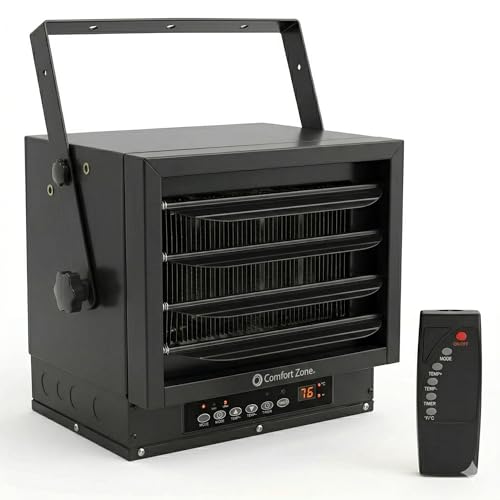
7,500 Watt 240V Hardwired Element
Six a.m. on a January Saturday, garage sitting at 40 degrees. Full power from a 240V subpanel breaker hits an element rated for serious heat output. Garage temperature climbed 25-30 degrees in the first 45 minutes, which is real performance from a 240V electric garage heater without any compromise on draw stability. Thermostat setpoint accuracy stayed tight through a full morning of work without drift or cycling noise.
Five Adjustable Louvers for Targeted Airflow
Five louvers on the front face angle to push warm air where you actually stand instead of straight up into rafters. Ceiling mount lets you tilt coverage downward over a workbench or tool wall, which cuts heating waste compared to units locked in a single direction. Fan noise stays moderate at operational settings, though max fan speed does carry enough sound that close work on a quiet bench gets noticeable.
Remote Controlled Thermostat, 50-85 Degree Range
Remote thermostat sits in your hand instead of locked to the unit, so you set temperature from the bench or across the garage without climbing a ladder. Setpoint range covers real garage winter work, 50 degrees for light shop time up to 85 if you need rapid warm-up on a brutal morning. Temperature holds steady once dialed in, cycling the element on and off to maintain your setpoint through a work session.
Hardwired Installation with 8 AWG Copper Wire
Direct wiring to a dedicated 240V subpanel breaker means no extension cords, no plug overheating, no shared circuits pulling other tools offline. Installation requires 8 AWG copper wire and a licensed electrician if you're not running your own panel work, so factor that labor into your budget. Once hardwired, the garage heater runs stable and reliable without any breaker trips on cold-start draws, which is critical for a real shop setup.

Pros
- 3000W output with separate high and low heat settings
- IPX4 rated, protected against water splashing
- Weighs just 13 pounds for easy portability
- Enclosed heating element and heating system for low maintenance
Cons
- Requires a 240V, 20A outlet rather than a standard household plug
- No thermostat, timer or remote control mentioned in the listing
- Compact 10 x 10 x 15 inch size may limit coverage in larger spaces
What Matters in Infrared Heaters for Garage Work
A garage or workshop asks more from a heater than a bedroom or office does. The space may be drafty, dusty or uninsulated, and the heater also has to stay out of the way of tools, lumber, vehicles and extension cords.
- Heat output for the space: Wattage is the first number to check because garages lose heat quickly through concrete floors, overhead doors and unfinished walls. The Dr. Infrared Heater DR-975 has a 7,500-watt high setting and a 4700-watt low setting, which gives it the strongest output among our picks. At 26 pounds, it is also the heavier of the two picks, which fits its role as a mounted shop heater rather than a small portable unit.
- Voltage and wiring: Both of our picks require 240V power, so these are not casual 120V plug-in heaters for a standard wall outlet. Our top pick is hardwired and calls for 8 AWG copper wire, with no power cord included. Our alternative pick uses a 240V, 20A outlet, which still requires the right circuit but avoids the same hardwired setup.
- Mounting and placement: A mounted heater can keep heat and hardware away from the floor, which matters when a garage has sawdust, gas cans, cardboard boxes or tires nearby. Our top pick is designed for wall or ceiling mounting, while our alternative pick is listed as lightweight and portable. According to the U.S. Consumer Product Safety Commission, heaters should be kept at least 3 feet from bedding, drapes, furniture or other flammable materials, and that same clearance thinking applies to garage clutter.
- Thermostat control: A garage heater should not force you to choose only between too cold and too hot. The top pick has a remote controlled thermostat with a 50 to 85 degree range, which is useful when the unit is mounted above head height. Among our picks, thermostat control is strongest on the hardwired model, while the alternative pick emphasizes 3000W output with high and low operation.
- Safety protections: Certification and automatic shutoff features matter because heaters are often used near stored materials. Our top pick is UL and CUL listed, and the U.S. Consumer Product Safety Commission advises choosing a heater certified by a nationally recognized testing laboratory. The Centers for Disease Control and Prevention also advises using electric space heaters with automatic shut-off switches and keeping them at least 3 feet from drapes, furniture or bedding.
- Build quality for dusty spaces: Garages create dust, and dust is hard on motors and exposed heating parts. Among our picks, one model has a heavy duty fully enclosed motor, while the other has an enclosed heating element and heating system. The alternative pick also has an IPX4 structure, which means it is protected against water splashing.
We excluded central furnaces and whole-house systems because they require professional installation, and we excluded water heaters and heated blankets because they do a different job. We also left out unvented fuel heaters without an indoor rating because carbon monoxide is a serious indoor risk.
The Competition
These are other infrared heaters we looked at but did not put on our main list.
If you are shopping for a lighter unit, the Trebixa Infrared Heater lists 1,500 watts and weighs 7 pounds. That makes it easier to move than our top pick, but the lower wattage does not line up as well with garage and workshop heating needs.
For a room-style infrared heater, Dr. Infrared Heater DR-968 brings 1,500 watts and 5,200 BTU of output. It also includes tip-over and overheat protection, but its output is far below the 7,500-watt ceiling of our top pick.
A larger coverage claim is the appeal of the Heat Storm HS-1500, which lists 1,500 watts and is rated for up to 750 square feet. Even with that square-foot figure, it still sits at the same 1,500-watt level as several household-style options, while our main picks are built around 240V garage use.
And if a compact cabinet-style heater is what you had in mind, Dr. Infrared Heater Infrared Heater offers 1,500 watts with a 900-watt low setting. Its 8-pound weight is convenient, but the lower setting is meant more for trimming heat than bringing up a cold garage quickly.
FAQs
How much wattage should I look for in a garage infrared heater?
Our picks range from 3,000 watts to 7,500 watts, and that spread matters because garages vary widely in insulation and air leakage. If the space has an overhead door, bare concrete and unfinished walls, the higher-output end is usually the more appropriate place to start.
Do garage infrared heaters need 240V power?
Both of our picks use 240V power, which is common for higher-output shop heaters. One is hardwired, while the other uses a 240V, 20A outlet, so the circuit and wiring should be confirmed before purchase.
Where should an infrared heater go in a garage?
Placement should keep the heater away from anything that can burn by at least 3 feet, according to the U.S. Fire Administration. A wall or ceiling location can help preserve floor space, but the heater still needs clear air around it and should be turned off when leaving the room.
Are portable infrared heaters safe for garage use?
Portable heaters can be used more safely when they sit on a level, hard, nonflammable surface and have the right shutoff features. The Centers for Disease Control and Prevention says to never cover a space heater and to use electric space heaters with automatic shut-off switches.
Sources
- CPSC Offers Tips to Prevent Home Fires From Space Heaters, U.S. Consumer Product Safety Commission. Fire-safety tips and required safety features for space heaters.
- Heating Fire Safety, U.S. Fire Administration. Home heating fire statistics and prevention messages.
- Safety Guidelines: During & After a Winter Storm, Centers for Disease Control and Prevention. Winter heating safety for space heaters, kerosene heaters and carbon monoxide.




Write Your Review
No reviews yet. Be the first to share your experience!