

Free Delivery. Exclusive Deals. All Prime.
Prime members save on shipping and get first access to deals, plus Prime Video included. 30 days free.
Stepping onto cold tile after a shower can make a bath mat feel like a prank. Bathroom heater lights add overhead warmth and light without stealing floor space. After comparing 6 models, the Runcasa E26 is the best fit, with 720 watts, a 400-watt low setting and a 4-hour timer. The Broan-NuTone Infrared Heater is the alternative pick for gentler 250-watt infrared heat and an adjustable thermostat.
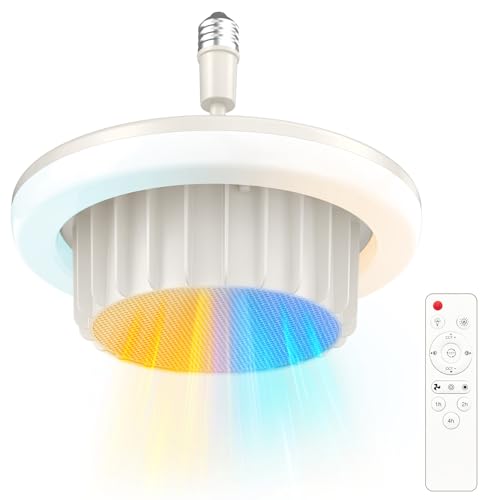
Pros
- 720W max heat mode with Fan (4W) and Warm Air (400W) options
- 2500lm LED light with stepless dimming (10%-100%) and 3000K-6500K color
- 300° oscillation for wider air and light coverage
- 4 hour timer and remote control for both heat and light
- Overheat protection and memory function for last-used settings
Cons
- Requires an E26 lamp holder and bracket mount, not a standalone unit
- 720W max output suits small spaces only, not larger rooms
- No stated thermostat range for precise temperature control

Broan-Nutone 164 Bulb Heater and Fan, Energy-Saving 2-Bulb Infrared Type IC Ceiling Heater, White, 250-Watt, 4.0 Sones, 70 CFM
Pros
- Uses two 250-Watt R40 or BR40 infrared bulbs
- 70 CFM ventilation fan
- Type IC ceiling installation
- 4-inch round duct connector
- 8.56 lb steel housing
Cons
- Bulbs are not included
- Ceiling installation and duct connection required
- Not a portable room heater

Pros
- 1500W heater with remote control
- 80, 90, or 110 CFM airflow for 129 to 161 ft² spaces
- 1.5 sones, rated at 60 dB or less
- LED light has 3000K, 4000K, and 5000K settings
- ETLus certified damp-resistant housing
Cons
- Ceiling install needs a 4-inch duct connection
- Fits a 7.68 x 7.60 in ceiling opening
- Not a portable space heater

Pros
- 1800W PTC ceramic heater for fast bathroom warming
- 230 CFM airflow for ventilation and dehumidification
- Quiet 1.0 sone operation listed by the brand
- 3 color light settings, 3000K, 4000K, 5000K
- Bluetooth speaker with password 6666 included
Cons
- Heating coverage area is not listed
- Requires 11.5 x 11.5 inch ceiling compatibility
- No thermostat or timer is specified
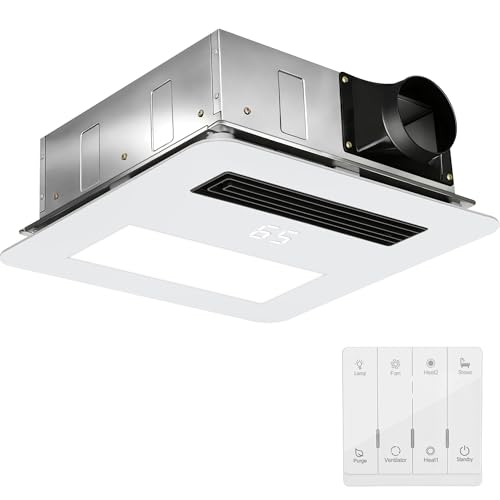
Pros
- 1800W rapid heater built into a 4-in-1 ceiling unit
- 190 CFM ventilation rated at just 1.0 sone for quiet operation
- 1500lm LED lighting for bright, even illumination
- Wall remote control lets you switch between heat, fan, and light modes
- UL-listed with flame-retardant materials and overload protection
Cons
- Requires an 11.22 x 11.22-inch ceiling cutout and wiring, not a plug-in portable heater
- Heater function is tied to the ceiling fan unit, so it cannot be moved room to room
- No stated thermostat range or tip-over protection details for the heat setting

Pros
- 1134W PTC ceramic heating element for rapid warmth
- Built-in overheat protection disconnects circuit if needed
- Quick 5 minute installation with built-in mounting hook
- Durable aluminum grille shell for quiet operation
- Backed by a 5-year warranty
Cons
- Intended only as a supplemental heat source, not for long-term primary heating
- No mention of adjustable thermostat or multiple heat settings
- Limited to small spaces like bathrooms, kitchens, or bedrooms
What We Looked For in Bathroom Heaters for Quick, Safer Warmth
A bathroom heater has a harder job than a bedroom heater. It has to warm a small, damp space, stay out of the way and avoid adding a cord where water and bare feet are already part of the room.
- A safer design for bathroom use: Ceiling or socket-mounted designs matter because they keep the heat source off a crowded floor. Among our picks, three are ceiling exhaust or ceiling heater designs, and one is built around an E26 lamp holder. According to the U.S. Consumer Product Safety Commission, portable or fixed local heaters were associated with about 10,900 residential fires in a recent year, so placement and certification language deserve more attention than style.
- Wattage for a small room: The Vevor Ceiling Heater gives you 1,500 watts and a listed sound level of 60 dB, with a 7.9-pound unit that belongs overhead rather than on the floor. That wattage is more than double our top pick, so it makes more sense for a bathroom where you want stronger ceiling heat and ventilation together. Among the main picks, heat output runs from 250 watts to 1,800 watts, which is a wide enough spread to separate gentle spot warmth from fast room warming.
- Tip-over and overheat protection: The CPSC says an automatic cut-off is required to turn off electric or kerosene heaters if they tip over. That is less relevant for hardwired ceiling units, but it is still important for any heater that could sit within reach of towels or rugs. Among our picks, two listings specifically mention overheat or overload protection, and one includes flame-retardant materials.
- Thermostat and timer: The Runcasa E26 pairs 720 watts with a 400-watt low setting, 300-degree oscillation and a 4-hour timer. That timer is useful in a bathroom because the heat is often needed for a short routine, not an entire evening. Timers on our main picks run up to 4 hours, while the alternative pick uses an adjustable thermostat instead.
- Size and outlet placement: The Oahfui Space Heater uses 1,800 watts and weighs 7 pounds, which points to a more involved ceiling-style installation than a simple plug-in heater. Several main picks use ceiling cutouts, including one with an 11.5 by 11.5-inch ceiling size and another with an 11.22 by 11.22-inch opening. That matters because a bathroom outlet may be poorly placed, switched by a GFCI or too close to splashing for a floor unit to make sense.
We excluded central furnaces and whole-house systems because they need professional installation. We also left out water heaters and heated blankets because they solve a different problem, and we avoided unvented fuel heaters without an indoor rating because carbon monoxide is too serious a risk indoors.
Other Bathroom Heaters Worth Considering
These are other bathroom heaters we looked at but did not put on our main list.
If you want much more heat output than our top pick, Oeukas Space Heater is rated at 1,800 watts and is listed as UL certified. It also weighs 9.5 pounds, so it is better suited to a stable placement than to frequent moving. The tradeoff is that 1,800 watts is far above the 720 watts of our top pick, which may be more heat than a very small bathroom needs.
Prefer another high-output ceramic option? Vivohome Ceramic Heater also reaches 1,800 watts, and its listed weight is 8.9 pounds. That puts it close to the Oeukas model, but both are heavier and more powerful than our top pick, so outlet location and clearance become more important than with a ceiling or socket-based solution.
FAQs
Are bathroom heater lights safer than floor space heaters?
They can be easier to place safely because many mount overhead or in a ceiling opening, keeping the heat source away from bath mats and foot traffic. The U.S. Fire Administration says anything that can burn should stay at least 3 feet from space heaters, which is difficult in some small bathrooms.
How much wattage do you need for a small bathroom?
Our picks range from 250 watts to 1,800 watts, and that spread changes how the heater behaves. Lower wattage is better for gentle localized warmth, while 1,500 watts or 1,800 watts is aimed at faster room warming.
Should a bathroom heater have a timer or automatic shut-off?
Yes, a shut-off feature is especially useful because bathroom heat is usually needed for a short period. The CDC recommends electric space heaters with automatic shut-off switches and non-glowing elements, and the CPSC requires an automatic cut-off for electric or kerosene heaters if they tip over.
What installation details matter most in a bathroom?
Start with the opening size, duct size and whether the heater uses a ceiling box, duct connection or E26 socket. Among our picks, ceiling openings include 11.5 by 11.5-inch and 11.22 by 11.22-inch requirements, so measuring before purchase matters more than the look of the grille.
Sources
- CPSC Offers Tips to Prevent Home Fires From Space Heaters, U.S. Consumer Product Safety Commission. Fire-safety tips and required safety features for space heaters.
- Heating Fire Safety, U.S. Fire Administration. Home heating fire statistics and prevention messages.
- Safety Guidelines: During & After a Winter Storm, Centers for Disease Control and Prevention. Winter heating safety for space heaters, kerosene heaters and carbon monoxide.


Write Your Review
No reviews yet. Be the first to share your experience!