

Free Delivery. Exclusive Deals. All Prime.
Prime members save on shipping and get first access to deals, plus Prime Video included. 30 days free.
Nothing makes brushing your teeth feel longer than bare feet on cold tile while the shower warms up. Rated bathroom heaters solve that problem by adding focused heat where moisture and limited floor space complicate ordinary heater use. After comparing 4 models, the Stelpro ASOA1501W stands out for its 1,500 watts, adjustable thermostat, and 7.9-pound build. The Dreo Space Heater is the alternative pick, with 1,500 watts and a 900-watt low setting.

Pros
- 1500W fan-forced heat at 120V
- Built-in thermostat adjusts from 41°F to 86°F
- Boost Mode for rapid heating
- Recessed or surface mounting options
- 5-year heater warranty, 3 years on controls
Cons
- Requires hardwired wall installation
- Not a portable plug-in space heater
- Thermostat range tops out at 86°F
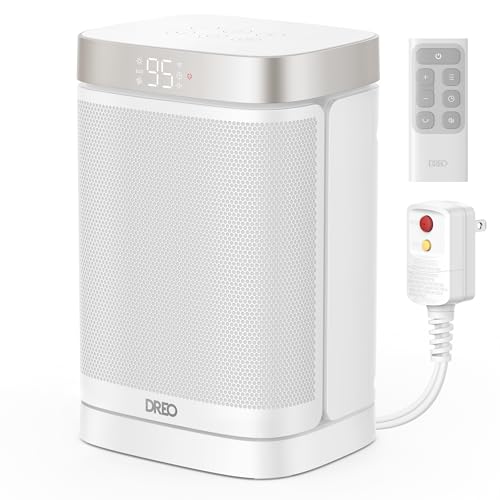
Pros
- ALCI safety plug designed for bathroom use near water
- 5 heat modes: 900W, 1300W, 1500W, Eco and Fan Only
- Noise level as low as 36.5 dB for quiet operation
- 70 degree oscillation with 1 to 12 hour timer
- Tip-over and overheat protection with V-0 flame-retardant housing
Cons
- No stated square footage coverage, best suited for smaller rooms
- Compact 10.3 inch size and 3.85 pound weight limit it to desk or floor use in one spot
- No remote control mentioned, controls are on the unit itself

Pros
- Two heat settings: High 1500W and Low 900W for flexible warmth
- ALCI safety plug cuts power automatically on water contact
- Automatic tip-over switch and overheat protection for added safety
- ETL certified for tested electrical safety standards
- Programmable timer up to 12 hours and ECO energy-saving mode
Cons
- No remote control or oscillation feature mentioned for room coverage
- Compact 3.26 pound design may suit small spaces rather than large rooms
- No stated square footage or BTU rating to gauge heating capacity

Pros
- 1250W rapid heating output for quick warmth
- Compatible replacement for Broan-NuTone 157 ceiling heater
- Built-in overheat protection system disconnects circuit if needed
- PTC ceramic heating technology with low-noise design
- Fits standard 3-1/2 inch or 4-inch ceiling electrical boxes
Cons
- Not recommended as a main heat source for long-term use
- Thin-shell design may limit durability compared to bulkier units
- Requires ceiling electrical box installation, not a plug-in portable option
How We Chose Rated Bathroom Heaters for Quick, Safer Warmth
A bathroom heater has a harder job than a bedroom heater. It has to warm a small room quickly while accounting for steam, splash risk, tight outlets, and the need to shut down safely if something goes wrong.
- A safe design for bathroom use: Bathroom use changes the safety conversation because water and electricity are often close together. The Stelpro ASOA1501W is a hardwired 120-volt heater, so it avoids a floor cord in a wet room and delivers 1,500 watts from a fixed installation. At 7.9 pounds, it is also meant for a more permanent setup rather than being moved around after each shower. According to the U.S. Consumer Product Safety Commission, heaters should be certified by a nationally recognized testing laboratory and kept at least 3 feet from flammable materials.
- Wattage for a small room: Among our picks, heat output runs from 1,250 watts to 1,500 watts. That range is appropriate for taking the edge off a bathroom rather than replacing a central heating system. The noblequest Ceiling Heater uses 1,250 watts, which makes sense for a ceiling location that frees the floor and keeps heat out of the splash zone. A lower output can still be useful when the heater sits close to where warmth is needed.
- Tip-over and overheat protection: Portable bathroom heaters need extra attention because they can be bumped in a small room. The Reaks Ceramic Heater lists tip-over protection, ETL certification, and a 1,500-watt high setting with a 900-watt low setting. It also includes overheat protection, which matters if towels, rugs, or tight corners reduce airflow. The U.S. Fire Administration says portable heater fires were 3 percent of home heating fires in one period but accounted for 41 percent of fatal home heating fires.
- Thermostat and timer: Bathrooms often need heat for a short routine, not all-day operation. Across our picks, timer settings reach up to 12 hours, and temperature controls range as low as 41°F on models with digital thermostats. A thermostat helps avoid leaving a heater running at full output once the room is comfortable. The CDC recommends electric space heaters with automatic shut-off switches and non-glowing elements, which supports prioritizing controls that reduce unattended risk.
- Size and outlet placement: A bathroom heater should fit the room before it fits the wish list. Among our picks, one model is hardwired at 120 volts, one mounts to a ceiling electrical box, and two are portable units that use standard outlet placement. That spread matters because a heater that forces a cord across the floor is a poor fit for a damp room. The safest placement still follows the same rule from federal fire guidance: keep anything that can burn at least 3 feet away.
We excluded central furnaces and whole-house systems because they need professional installation and solve a broader heating problem. We also left out water heaters and heated blankets because they do different jobs, and we avoided unvented fuel heaters without an indoor rating because carbon monoxide risk is too high indoors.
Other Bathroom Heaters Worth Considering
These are other bathroom heaters we looked at but did not put on our main list.
If lower weight matters more than permanent installation, Lasko CD08200 is worth a look. It delivers 1,500 watts and weighs 3.4 pounds, which is much lighter than the 7.9-pound build of our top pick. It is also ETL certified, but it does not offer the same hardwired wall setup that keeps cords out of the way.
For a different feature mix, Ambiora Ceramic Heater pairs 1,500 watts with coverage rated for up to 200 square feet. Its thermostat range runs from 59 to 95°F, and it lists tip-over protection, so it overlaps with the portable safety priorities in our main list. Compared with our alternative pick, it takes a different approach to controls while staying in the same heat-output class.
FAQs
What makes a bathroom heater safer than an ordinary space heater?
A bathroom heater should be designed for the conditions where it will be used, especially moisture and limited clearance. For portable electric heaters, automatic shut-off features matter, and federal safety guidance says heaters should stay at least 3 feet from anything that can burn.
How much wattage is useful for quick bathroom heat?
Our picks range from 1,250 watts to 1,500 watts, which is the range represented by the models compared here. In a bathroom, that output is usually about fast supplemental warmth, not heating an entire home.
Should I choose a wall, ceiling, or portable bathroom heater?
Wall and ceiling models can help keep the floor clear, which is useful in a room where towels, rugs, and water are common. Portable models are easier to move, but outlet placement and the 3-foot clearance rule become more important.
Can I leave a bathroom heater on while I sleep or leave the room?
The U.S. Fire Administration says to turn space heaters off when leaving the room or going to bed. Timers and thermostats can help manage short heating sessions, but they do not replace basic shutoff habits.
Sources
- CPSC Offers Tips to Prevent Home Fires From Space Heaters, U.S. Consumer Product Safety Commission. Fire-safety tips and required safety features for space heaters.
- Heating Fire Safety, U.S. Fire Administration. Home heating fire statistics and prevention messages.
- Safety Guidelines: During & After a Winter Storm, Centers for Disease Control and Prevention. Winter heating safety for space heaters, kerosene heaters and carbon monoxide.


Write Your Review
No reviews yet. Be the first to share your experience!