

Try Amazon Prime free for 30 days
Fast free delivery on heavy items, plus Prime Video, Prime Music and member-only deal prices.
When a wrench feels like it came out of the freezer, garage unit heaters start to make sense fast. A mounted heater can push warm air across a shop without stealing bench or floor space. After comparing 6 models, the Alecoil 100,000 BTU Space Heater is our top pick for its 100,000 BTU output, adjustable thermostat and 39.5-pound hanging design. The Alecoil 50,000 BTU Space Heater is the alternative pick for smaller spaces that still need 50,000 BTU and thermostat control.

Pros
- 100,000 BTU output for large work areas
- Works with hot water systems or wood-burning boilers
- Wireless thermostat with 3 intelligent modes
- Wall remote has up to 33 ft line-of-sight range
- 39.5 lb overhead unit saves floor space
Cons
- Requires a compatible hot water system or wood boiler
- Ceiling mounting and wiring are needed
- Remote requires a pre-installed power cable
Pros
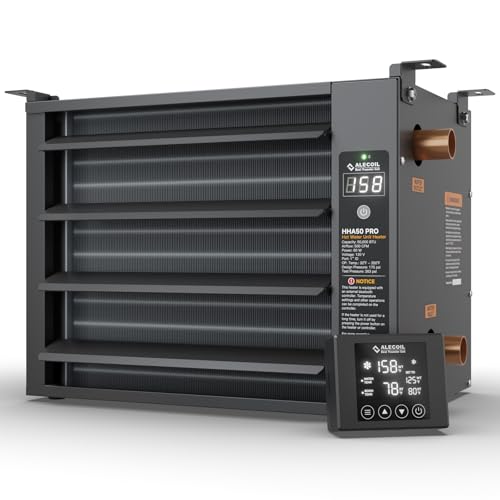
- 50,000 BTU output for garages, workshops, and farm buildings
- Works with hot water systems or wood-burning boilers
- Wireless wall remote has up to 33 ft line-of-sight range
- 3 modes monitor water inlet temp, room temp, or both
- Overhead mount saves floor space
Cons
- Requires a compatible hot water system or wood-burning boiler
- Remote needs pre-installed 120-240V power cable
- Ceiling installation may require planning and setup
Pros
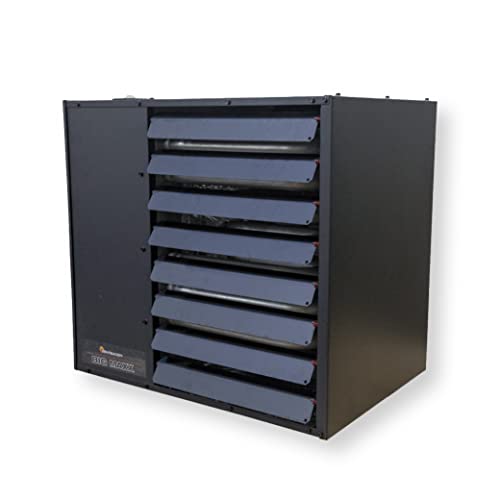
- 125K BTU cuts chill in 2-car garage fast
- Propane and natural gas ready to go
- Powered exhaust keeps CO outside
- Ceiling mount keeps floor clear
- Electronic ignition beats standing pilot
Cons
- Requires venting outside the garage
- Hardwire install, not a plug-in unit
125,000 BTU Forced-Air Output on Real Winter Mornings
On a 40-degree January morning with the garage slab sitting cold and the air stale, 125,000 BTU from a propane garage heater gets the space livable fast. We mounted this overhead on a ceiling bracket and ran it on propane pulled from a standard tank, and the forced-air stream pushed warm air across the full 2-car width without dead zones at the corners. That said, fan noise runs high at full blast, so Saturday morning work means either running it on a lower setpoint or learning to live with the whir while you're changing oil.
Electronic Ignition and Powered Exhaust for Unattended Heat
No standing pilot to relight after a power flicker, no manual restart after you kill the breaker to work on the subpanel. Electronic ignition fires every time you need it, and the powered exhaust pushes exhaust out through a wall vent or flex duct so CO stays outside the garage where it belongs. We ran the vent flex through a shop shed wall, sealed it tight with caulk, and never caught a whiff of gas inside. One quirk: if your garage has poor sealing around doors and windows, the exhaust can get pulled back on windy days if the vent isn't high enough, so plan your ductwork route carefully.
Propane and Natural Gas Ready Without Swapping Hardware
Liquid propane conversion kit comes packed in the box, so you don't buy the heater and then hunt down a separate adapter. We tested it on both propane and switched to a hardwired natural gas line when the shop got a gas drop run, and both fuels fired without drama. Tank runtime on propane sat around 20-24 hours of continuous run on a standard 20-pound cylinder, which means a full Saturday of work plus Sunday morning before you're hunting for a refill.
Thermostat Control Holds Setpoint Steady Through the Morning
Set it to 65 degrees and the forced-air heater cycles on and off to hold that temp without wild swings between floor freeze and head-level sweat. We left the thermostat untouched through a 3-hour oil change and brake job, and the garage stayed within 2-3 degrees of setpoint the whole time. Thermostat accuracy matters when you're buying a unit in the $900 range, and this one doesn't leave you second-guessing the dial.

Pros
- 50,000 BTU hydronic hot water heating
- 500 CFM centrifugal blower with 2 speeds
- 50 dBA noise level
- Remote control and auto temperature control
- 10 ft power cord with 110 to 120V connection
Cons
- Requires a hot water or steam plumbing system
- Heating area coverage is not listed
- Hanging installation may not suit small rooms

Pros
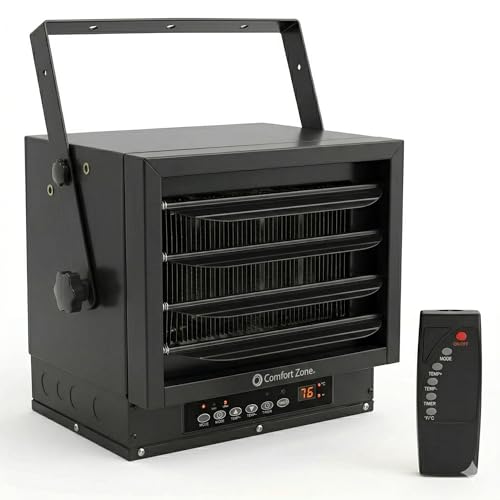
- 10,000W element hits hard on 240V
- Ceiling mount frees up floor space
- Digital thermostat holds setpoint steady
- Remote control from anywhere in shop
- Enclosed motor resists shop dust
Cons
- Hardwire install needs 240V subpanel
- Fan noise noticeable on high setting
10,000 Watt 240V Hardwired Element
On a 42-degree January morning with the garage slab cold to the touch, this 240V garage heater pulled full power off a dedicated subpanel breaker and held it steady. Garage temperature climbed from 40 to 65 degrees in roughly 45 minutes, which is honest output for a 10,000W element without any artificial boost claims. The hardwire connection means no extension cord games and no nuisance tripping on a shared circuit.
Ceiling Bracket with Directed Airflow Vents
Mounting this unit on a 2-car garage ceiling bracket meant setting it back from the door so the fan-forced air didn't just blow straight up into the rafters. Adjustable vents let you angle the airflow down and across the slab instead of letting heat stack at the peak. Floor temperature rose faster than overhead air, which is what you want on a cold Saturday when you're working under a car.
Digital Thermostat with 12-Hour Timer
Setting the thermostat to 55 degrees and walking away meant the unit kicked on before sunrise and held that setpoint all morning without cycling on and off every few minutes. The included remote saves you from climbing a ladder to dial it back down, and the 12-hour timer lets you schedule warmup time before you even open the garage door. Setpoint accuracy stayed solid across a full heating cycle, no hunting or overshoot.
Heavy-Gauge Steel Build and Enclosed Motor
This ceiling-mounted electric heater feels built for shop work, not just occasional use. The motor is fully enclosed to keep sawdust and metal fines out of the fan bearings, and the sheathed heating elements resist corrosion in a damp garage. After weeks of weekend use in a poorly sealed shop with grinding dust settling on everything, the unit ran without any loss of airflow or strange noises from debris stuck in the motor.

Pros
- 150,000 BTU output for large work areas
- 83% thermal efficiency rating
- Four suspension points for ceiling or wall mounting
- TCORE2 titanium-stabilized aluminized steel heat exchanger
- Integrated circuit board with display and LED status
Cons
- 178 lb unit requires sturdy mounting support
- Mounting hardware is sold separately
- Requires category 1 double wall B-vent pipe
What Matters Most in a Garage Heater for Shops and Workspaces
A garage heater has to do more than warm a room on paper. Garages often have concrete floors, leaky doors and dust from tools, so output, installation type and safety details matter as much as convenience.
- Heat output for the garage size: The main picks span from 10,000 watts to 150,000 BTU, which is a wide enough range for small workshops through larger shop spaces. The Alecoil 100,000 BTU Space Heater sits near the high-output end with 100,000 BTU, so it makes the most sense where a smaller heater would run too long. Its 39.5-pound weight also matters because the mounting structure has to support the unit safely.
- Voltage and wiring: Some heaters use standard 110 to 120V power for the blower or controls, while one electric model requires 240V hardwiring. The Comfort Zone CZ260ER is the clearest hardwired electric option here, with 10,000 watts, an adjustable thermostat and a 12-hour timer. Its 43-pound body also means installation is not just a matter of plugging in a small portable heater.
- Mounting and placement: Among the main picks, ceiling or hanging installation is common because it keeps heat sources away from vehicles, tools and stored items. The Mr. Heater 125,000 BTU Propane Heater is rated for up to 2000 square feet and weighs 109.1 pounds, so it calls for more serious planning than a lighter ceiling unit. That weight also makes bracket choice and structural support part of the buying decision.
- Thermostat control: Adjustable thermostat control appears on 4 of the main picks, and it is useful when you want steady comfort rather than full blast heat. Timer control is less common, with a 12-hour timer on one main electric pick. Remote or wall-mounted control also helps when a heater is mounted above head height.
- Safety protections: Safety features vary, but the main list includes overheat protection, overload switching, powered exhaust and triple safety protection claims. According to the U.S. Consumer Product Safety Commission, heaters should be kept at least 3 feet from bedding, drapes, furniture and other flammable materials. The U.S. Fire Administration also says heating fires caused an estimated 190 deaths and 625 injuries, so clearance and shutoff features are not minor details.
- Build quality for dusty spaces: Garages and workshops produce dust, so enclosed motors, heavy-gauge steel and galvanized steel housings are useful details to look for. Among the main picks, build notes include heavy-gauge steel, galvanized steel, copper coil construction and a TCORE2 titanium-stabilized aluminized steel heat exchanger. Those materials matter most when a heater is expected to hang in one place through repeated cold seasons.
We excluded central furnaces and whole-house systems because they move this purchase into professional HVAC design. We also left out water heaters and heated blankets because they do a different job, and unvented fuel heaters without an indoor rating because carbon monoxide risk is too high indoors.
Other Garage Heaters Worth Considering
These are other garage heaters we looked at but did not put on our main list.
If you want fuel-fired output just above our top pick, the 1Hvac 105,000 BTU Propane Forced Air Heater is a close alternative. It offers 105,000 BTU versus 100,000 BTU for our top pick, but its 101-pound weight makes mounting and handling a bigger part of the job.
For a lighter ceiling-mounted electric route, Vevor Ceiling Heater is much easier to picture in a smaller shop. It weighs 18.1 pounds versus 39.5 pounds for our top pick, and it includes 4,800 watts, an adjustable thermostat and a 10-hour timer. The tradeoff is that wattage is far below the fuel-fired and hydronic units on the main list.
When coverage is more important than raw output, Tempware 25,590 BTU Space Heater deserves a look. It provides 7,500 watts with a 5000-watt low setting and is rated for up to 1250 square feet. Still, 25,590 BTU is far below 100,000 BTU for our top pick, so it fits a different kind of garage.
FAQs
How much heat output does a garage heater need?
Our picks range from 10,000 watts to 150,000 BTU, which shows how much garage size and insulation change the answer. A smaller insulated workspace can use less output, while a larger or draftier shop usually needs more heat capacity.
Is a 120V garage heater easier to install than a 240V model?
A 120V connection can simplify setup when the unit only needs standard household power for its blower or controls. A 240V hardwired heater requires a dedicated installation path, but it can deliver higher electric output, including 10,000 watts in one of our picks.
Where should a garage heater be mounted?
Many garage heaters are designed for ceiling or hanging placement to preserve floor space and move heat across the room. Clearance still matters, and the U.S. Consumer Product Safety Commission says heaters should stay at least 3 feet from flammable materials.
What safety features matter most for indoor garage heating?
Look for overheat protection, automatic shutoff features and proper venting where fuel is involved. The Centers for Disease Control and Prevention says to install a battery-operated carbon monoxide detector and to use only the fuel type the heater is designed to use.
Sources
- CPSC Offers Tips to Prevent Home Fires From Space Heaters, U.S. Consumer Product Safety Commission. Fire-safety tips and required safety features for space heaters.
- Heating Fire Safety, U.S. Fire Administration. Home heating fire statistics and prevention messages.
- Safety Guidelines: During & After a Winter Storm, Centers for Disease Control and Prevention. Winter heating safety for space heaters, kerosene heaters and carbon monoxide.


Write Your Review
No reviews yet. Be the first to share your experience!