

Try Amazon Prime free for 30 days
Fast free delivery on heavy items, plus Prime Video, Prime Music and member-only deal prices.
When the home office feels like a walk-in freezer but the dog is somehow sunbathing, a room heater can fix one cold zone without cranking the whole house. Quality heaters solve that by putting controlled heat where people actually sit. After comparing 3 models, the ENVI Wall Heater stands out for its 1,000 watts, 12.3-pound build and wall-mounted design. The Dreo Space Heater is the alternative pick for 1,500 watts with a 900-watt low setting.

Pros
- 1000W wall mounted electric convection heater
- Rated for rooms up to 350 sq ft
- Wi-Fi app control with timer, scheduling and geofencing
- Works with Alexa and Google Home
- 3-year warranty
Cons
- 350 sq ft coverage may not suit larger open areas
- Voice control requires separate Alexa or Google hardware
- Wall mounted design is less portable than plug-in heaters
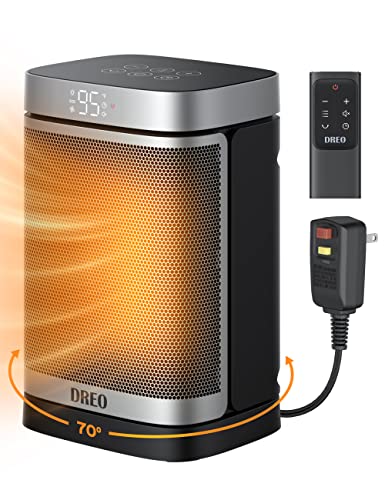
Pros
- ALCI safety plug allows safer use in bathrooms with water nearby
- 1500W PTC ceramic heating with 5 modes (900W, 1300W, 1500W, Eco, Fan Only)
- Quiet operation rated down to 36.5 dB for bedrooms or offices
- Tip-over and overheat protection with 24h auto shut off
- 70 degree oscillation and 1-12h timer for flexible heating
Cons
- Compact 10.3-inch size may not suit heating large open rooms
- No remote control mentioned, so settings must be adjusted by hand
- Cord length is not specified, which may limit placement options

Pros
- 750W/1500W dual heat settings for flexible warmth
- Tip-over switch automatically shuts off the heater if it falls
- Automatic overheat protection for added safety
- UL 1278 tested and certified construction
- Top air intake lets it sit against walls or on carpet
Cons
- No thermostat mentioned, so temperature cannot be set precisely
- 6 foot cord may limit placement options in larger spaces
- Compact 12 x 10 x 6 inch size suits small areas, not whole rooms
How We Chose These Heaters for Quality Heat
A good room heater is not just about getting hot. It needs enough output for the space, safety features that matter when it runs near people and furniture, and controls that help avoid constant fiddling.
- Heat output for the room size: Among our picks, output runs from 1,000 watts to 1,500 watts. The ENVI Wall Heater uses 1,000 watts, which suits shoppers who want steady room heat from a wall-mounted unit rather than a small floor heater. That output is paired with a 12.3-pound body, so it is better treated as a placed heater rather than a carry-around appliance.
- Tip-over and overheat protection: Safety matters because room heaters often run near beds, desks and seating areas. The Xtreme Heaters Space Heater has 1,500 watts of output plus tip-over protection, overheat protection and UL certification. According to the U.S. Consumer Product Safety Commission, electric or kerosene heaters need an automatic cut-off if they tip over, and shoppers should choose a heater certified by a nationally recognized testing laboratory.
- Thermostat range and controls: One of our picks allows temperature adjustment from 41 to 95 degrees in 1-degree increments. That same model also has a 1 to 12 hour timer, which is useful when you want heat during a work block or evening routine without leaving it on indefinitely. Another pick uses app control, scheduling, geofencing and voice-control compatibility with separate hardware, so the control style differs sharply across the group.
- Noise level: Only one of our picks gives a published sound number, and it is listed at 36.5 dB. That matters for bedrooms, offices and small rooms where fan noise can become more annoying than the cold. The other picks describe quiet operation, but without a comparable decibel number, that claim carries less weight for direct comparison.
- Oscillation and heat spread: One pick offers 70-degree oscillation, which helps move warm air across a wider seating area. The wall-mounted pick relies on convection rather than oscillation, while the portable cabin-style pick uses top air intake to allow placement against walls. Those are different approaches, so the better fit depends on whether you want moving fan heat or steadier heat from a fixed location.
- Size, weight and portability: Among our picks, one portable model is listed at 10.3 inches tall and includes a built-in handle. The wall-mounted pick weighs 12.3 pounds, so its advantage is fixed placement rather than quick movement from room to room. The cabin-style pick has a 6-foot power cord, which gives more placement flexibility than a shorter cord would.
We excluded central furnaces and whole-house systems because they need professional installation. We also excluded water heaters and heated blankets because they do different jobs, and we avoided unvented fuel heaters without an indoor rating because carbon monoxide is a serious indoor risk.
Other Heaters Worth Considering
These are other heaters we looked at but did not put on our main list.
If you want a familiar ceramic tower-style option, Amazon Basics Ceramic Heater offers 1,500 watts with a 900-watt low setting. That gives it more maximum wattage than our top pick, but it is a simpler plug-in choice rather than a wall-mounted smart heater. Its listing also cites 43 dB noise, adjustable thermostat control, tip-over protection and overheat protection.
For a very light portable heater, Lasko Ceramic Heater lists 1,500 watts and a 2.5-pound body. That makes it much easier to move than our 12.3-pound top pick, though it does not offer the same fixed wall placement. It also has ETL certification and a 7-hour timer, which are useful numbers for shoppers focused on safety certification and timed operation.
Prefer wider fan-driven coverage from a compact room heater? Dreo Atom One provides 1,500 watts and 70-degree oscillation, matching the oscillation angle of our alternative pick. It also includes an adjustable thermostat plus tip-over and overheat protection, but it did not displace the main list because our alternative pick adds bathroom-focused protection with an ALCI safety plug.
FAQs
How many watts should a quality room heater have?
Our picks range from 1,000 watts to 1,500 watts, which covers the common room-heater range in this comparison. A 1,500-watt heater gives more peak output, while a 900-watt low setting can be useful when you only need mild heat.
What safety features matter most in a quality heater?
Tip-over shutoff and overheat protection are the key features to look for in an electric room heater. The U.S. Consumer Product Safety Commission says an automatic cut-off is required to shut off electric or kerosene heaters if they tip over, and it recommends choosing a heater certified by a nationally recognized testing laboratory.
How far should a heater be from furniture or bedding?
The U.S. Fire Administration says to keep anything that can burn at least 3 feet from a space heater. The Centers for Disease Control and Prevention gives the same 3-foot distance for drapes, furniture and bedding, and also says never to cover a space heater.
Are quieter heaters always less powerful?
Not necessarily, based on this group. One pick lists 1,500 watts and a 36.5 dB noise level, so a higher wattage number does not automatically mean a louder heater. The better comparison is published noise level, because descriptions like quiet are not as useful without a number.
Sources
- CPSC Offers Tips to Prevent Home Fires From Space Heaters, U.S. Consumer Product Safety Commission. Fire-safety tips and required safety features for space heaters.
- Heating Fire Safety, U.S. Fire Administration. Home heating fire statistics and prevention messages.
- Safety Guidelines: During & After a Winter Storm, Centers for Disease Control and Prevention. Winter heating safety for space heaters, kerosene heaters and carbon monoxide.


Write Your Review
No reviews yet. Be the first to share your experience!