

Try Amazon Prime free for 30 days
Fast free delivery on heavy items, plus Prime Video, Prime Music and member-only deal prices.
You settle in at your desk with a fresh coffee, and before it cools your toes have gone numb while the rest of the house feels fine. Low voltage space heaters fix that by warming the small pocket of air around you instead of every room. After comparing 4 models, the Asnug Ceramic Heater is the best fit: it draws 500 watts, warms up in 2 seconds and shuts off on its own if it tips or overheats. On a tighter budget, the Amazon Basics Ceramic Heater weighs 1.4 pounds and still cuts power if it gets knocked over.

Pros
- 500W PTC ceramic heating element for quick warmth
- Heats up in about 2 seconds for fast comfort
- Tip-over and overheat protection for added safety
- Compact size at 6.1 x 5.75 x 2.87 inches for easy placement
- One-touch operation with LED on/off indicator
Cons
- 500W output suits only small spaces like a desk or bathroom, not larger rooms
- No thermostat or multiple heat settings are listed for temperature control
- No oscillation feature mentioned, so heat stays directed in one area

Pros
- 500W ceramic heating element warms small spaces quickly
- Compact 5.9 x 3.2 x 6 inch size fits on desks or tables
- Lightweight at just 1.4 lbs for easy portability
- Tip-over protection automatically shuts off the unit if knocked over
- Rated at 48dB for relatively quiet operation
Cons
- 500W output is best for small desk or office areas, not whole rooms
- No thermostat or multiple heat settings are listed for this model
- Very lightweight build may feel less substantial than larger heaters

Pros
- 500W ceramic heater for small indoor spaces
- Heats up to 43 sq ft within 3 seconds
- Tip-over and overheat shutoff protection
- Quiet operation below 45 dB
- 2 pack for two small areas or backup use
Cons
- 43 sq ft coverage is limited to small areas
- Only one power switch, no thermostat listed
- Not suited for heating a full room
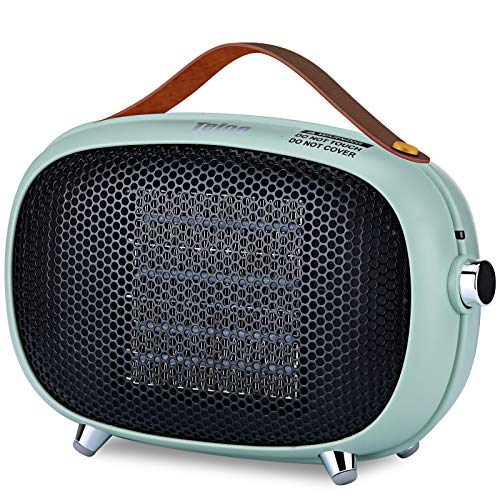
Pros
- 800W high heat and 400W low heat settings
- Heats to 70°F in 3 seconds
- Tip-over and overheat protection
- 8-hour auto power-off
- 1.6 lb weight with handle
Cons
- 800W max is best for personal spot heating
- No thermostat range listed
- No oscillation or remote listed
What We Looked For in a Low Voltage Space Heater
A small heater sits a few feet from your legs, your papers and sometimes your bed, so the numbers that matter are wattage, safety cutoffs and noise rather than raw power. We weighed each model against the points below, in this order.
- Heat output for the room size: Among our picks, power runs from 500 to 800 watts, which suits a desk, a dorm corner or a small bedroom rather than an open living area. Three of the 4 models run at a single 500-watt level. The Teioe Ceramic Heater is the one with a choice: 800 watts on high, 400 watts on low and a fan-only mode, so you can cut the draw once the space feels warm.
- Tip-over, overheat and certification: All 4 of our picks shut off if knocked over, which the U.S. Consumer Product Safety Commission lists as a required feature for electric heaters. Three of them add overheat protection, and one adds an ETL-certified plug, in line with the CPSC advice to choose a heater certified by a nationally recognized testing laboratory. The Asnug Ceramic Heater covers both cutoffs at 500 watts: a flip switch on the base kills power if it tips, and an automatic overheat cutoff works inside a flame-retardant shell.
- Thermostat range and controls: None of our 4 picks lists an adjustable thermostat, which is the main trade-off at this size. Two use a single power switch, and one adds a rotary dial with 3 modes plus an 8-hour auto power-off. If you want a set temperature held for you, the 1,500-watt models in the next section are the better route.
- Noise level: Three of our picks publish a noise figure, ranging from under 45 dB to 48 dB. The fourth describes a silent mode without giving a number. The two lowest figures sit at or below 45 dB, which matters most if the heater runs beside your bed or during calls.
- Oscillation and heat spread: None of our 4 picks oscillates, so each one pushes heat in a single direction. That works for a heater aimed at your feet, and one listing claims it warms about 43 square feet, roughly a desk area or a small reading nook. If you need heat swept across a wider room, the oscillating 1,500-watt option below fits better.
- Size, weight and portability: Among the three picks that list a weight, figures run from 1.1 to 1.6 pounds, light enough to carry from office to bedroom in one hand. The shinic Space Heater is the lightest at 1.1 pounds and measures 3.46 by 4.33 by 6.22 inches, small enough for a crowded desk. It also comes as a 2-pack, so you can warm two small spots at once at 500 watts each.
We left out central furnaces and whole-house systems because they need professional installation. Water heaters and heated blankets do a different job, and unvented fuel heaters without an indoor rating bring a carbon monoxide risk indoors. If you want more power than 500 to 800 watts, the models below are worth a look.
Other Space Heaters Worth Considering
These are other space heaters we looked at but did not put on our main list.
If quiet matters more than size, the Dreo Space Heater lists 34 dB, the lowest noise figure of any heater here. It also adds an adjustable thermostat along with tip-over and overheat protection. The catch is its 1,500-watt draw, three times the 500 watts of our top pick, which is more than a desk or small office usually needs.
Thermostat control is also the draw of the Aubkn Space Heater, which pairs it with a 12-hour timer and ETL certification. Its low setting runs at 700 watts, and the high setting reaches 1,500 watts, triple our top pick. That range suits a bedroom you heat for long stretches more than a cubicle.
Need to heat an actual room rather than a desk? The GiveBest Space Heater is rated for up to 200 square feet, compared with the roughly 43 square feet one of our picks claims. It runs at 1,500 watts with a 750-watt low setting and includes an adjustable thermostat plus tip-over and overheat protection.
And if spreading warmth across the room is the whole reason you are shopping, the Jibufi Space Heater oscillates through 70 degrees, something none of our 4 picks does. It is also rated for up to 200 square feet at 1,500 watts. It lists only tip-over protection, though, while three of our picks also guard against overheating.
FAQs
Is a 500-watt low voltage space heater enough for a small room?
For a desk, dorm corner or reading nook, usually yes: one of our 500-watt picks claims about 43 square feet of coverage. For a full bedroom or living room, the 1,500-watt models rated for up to 200 square feet are the better match.
What safety features should a low voltage space heater have?
At minimum, look for an automatic shut-off that cuts power if the heater tips over, which the CPSC lists as required for electric heaters. The CDC also recommends electric heaters with automatic shut-off switches and non-glowing elements. The CPSC adds that a heater certified by a nationally recognized testing laboratory is the safer buy.
Can I leave a low voltage space heater running overnight?
The U.S. Fire Administration advises turning space heaters off when you leave the room or go to bed. According to the agency, portable heaters account for just 3 percent of home heating fires but 41 percent of the fatal ones.
Where should a low voltage space heater sit?
Keep it at least 3 feet from bedding, drapes, furniture and anything else that can burn, as the CPSC, the CDC and the U.S. Fire Administration all advise. Set it on a level, hard, nonflammable surface rather than a rug or carpet, and never cover it.
Sources
- CPSC Offers Tips to Prevent Home Fires From Space Heaters, U.S. Consumer Product Safety Commission. Fire-safety tips and required safety features for space heaters.
- Heating Fire Safety, U.S. Fire Administration. Home heating fire statistics and prevention messages.
- Safety Guidelines: During & After a Winter Storm, Centers for Disease Control and Prevention. Winter heating safety for space heaters, kerosene heaters and carbon monoxide.


Write Your Review
No reviews yet. Be the first to share your experience!