

Try Amazon Prime free for 30 days
Fast free delivery on heavy items, plus Prime Video, Prime Music and member-only deal prices.
When the workshop feels like a walk-in freezer and the coffee mug is doing more warming than the room, natural gas heaters for home can add steady heat without relying on a wall outlet. After comparing 6 models, the ProCom MN300HPA is the best fit because it delivers 30,000 BTU, covers up to 1200 square feet, and includes an oxygen depletion sensor. The ProCom MN300HBA is the alternative pick for 30,000 BTU and coverage up to 1400 square feet.

Pros
- 30,000 maximum BTU output
- Heats up to 1,200 sq. ft.
- 3 heat settings, low, medium, high
- No electricity required
- ODS automatic shut-off included
Cons
- Uses natural gas only
- Blower sold separately
- Manual control, no thermostat listed

Pros
- 30,000 maximum BTU output
- Heats up to 1,400 sq. ft.
- 3 manual heat settings, Low, Medium, High
- No electricity required
- Base feet and wall mounting bracket included
Cons
- Natural gas only
- Blower sold separately
- Manual control, no thermostat listed

Pros
- 10,000 maximum BTU output
- Heats up to 500 sq. ft.
- Natural gas only, no electricity required
- Manual Low and High heat settings
- ODS with automatic shutoff
Cons
- Requires natural gas fuel only
- Blower is sold separately
- Manual control has only 2 heat settings

Pros
- 12,000 BTU natural gas heater
- Heats up to 500 sq. ft.
- No electricity required
- Manual adjustable heat settings
- Built-in oxygen depletion sensor
Cons
- Natural gas model, not for other fuels
- Floor stand and blower are optional accessories
- Manual control, no thermostat listed
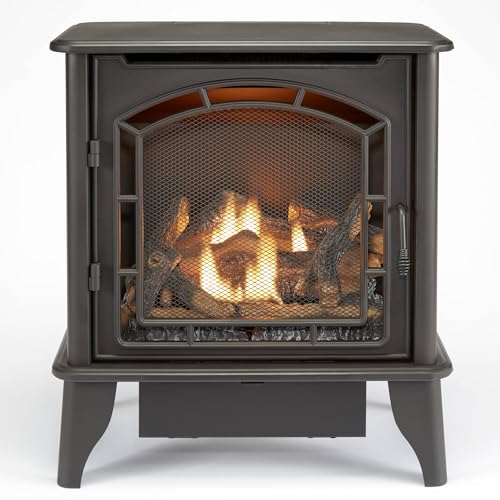
Pros
- 23,000 BTUs heats up to 1,100 sq. ft.
- Dual fuel for natural gas or liquid propane
- Thermostat remote with LCD screen included
- 99.9% efficient, no chimney or outside duct
- Oxygen Depletion Sensor with auto shut-off
Cons
- Not sized for spaces over 1,100 sq. ft.
- Requires natural gas or liquid propane fuel
- 66 lb weight may limit easy repositioning
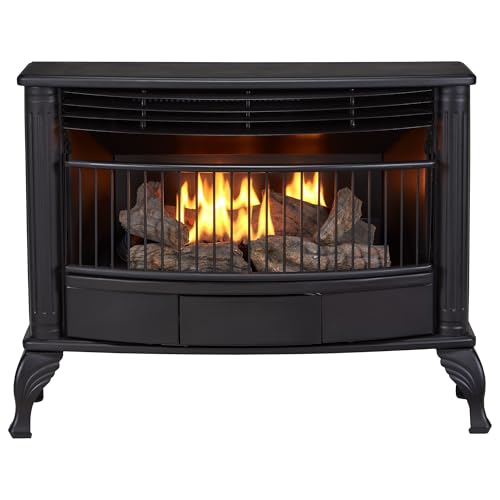
Pros
- 25,000 BTUs heats up to 1,100 sq ft
- Thermostat control cycles heat on and off
- 99.9% efficient vent-free design
- Oxygen Depletion Sensor with auto shut-off
- 33.5 x 13 x 25 inches, 56 lb
Cons
- Operates on natural gas only
- Heating coverage limited to 1,100 sq ft
- 56 lb weight may make placement harder
How We Chose These Gas Heaters for Home Backup Heat
A gas heater for a house, cabin, garage or workshop has to do more than feel warm on paper. The important tradeoff is heat output versus the safety details that matter in enclosed spaces, especially ventilation and carbon monoxide precautions.
- Heat output and coverage: BTU output sets the ceiling for how much heat a unit can provide, while the square-foot rating helps you avoid oversizing a small room or undersizing a larger space. The ProCom MN300HPA leads our main list on output with 30,000 BTU and is rated for up to 1200 square feet. That combination makes the most sense for readers trying to warm a larger workshop, cabin room or backup zone rather than a compact office.
- Indoor rating and oxygen depletion protection: For enclosed rooms, an oxygen depletion sensor is a key safety feature because it is designed to shut the heater off if oxygen drops too low. The Duluth Forge QSN250T pairs 25,000 BTU with coverage up to 1100 square feet and includes an oxygen depletion sensor. Its adjustable thermostat also matters because the heater can cycle to hold a selected room temperature instead of relying only on a fixed manual setting.
- Ventilation and carbon monoxide precautions: Vent-free gas heaters still require careful room use, because combustion appliances can create carbon monoxide if something goes wrong. According to the Centers for Disease Control and Prevention, a battery-operated carbon monoxide detector should be installed, and only the fuel type a heater is designed to use should be used. The U.S. Consumer Product Safety Commission also says unvented gas heaters should have an oxygen depletion sensor, a feature included across the main gas-heater picks we prioritized.
- Fuel type, tank size and run time: The main list focuses on natural gas models, with one dual-fuel pick that can operate on either natural gas or liquid propane. Natural gas-only models avoid propane tank sizing and refill planning, but they require the right gas supply at the installation location. Because no tank capacity or hour-by-hour run-time figure is specified for these picks, we did not rank them by claimed run time.
- Ignition and safety shut-offs: Push-button Piezo ignition appears on several of our picks, which matters during a power outage because no electricity is required for those models. The Comfort Glow KWN211 is a smaller example, with 12,000 BTU, coverage up to 500 square feet, and an oxygen depletion sensor. At 16.4 pounds, it is also easier to place than larger cabinet-style stoves while still offering vent-free infrared heat.
- Size and portability: Weight affects whether a heater is a set-it-once appliance or something a careful adult can reposition before installation. Among the featured criteria picks, weights run from 16.4 pounds to 26 pounds where specified. Larger stove-style models trade that easier handling for flame presentation and higher listed heating capacity, so placement should be planned before connecting the gas supply.
We excluded central furnaces and whole-house systems because they call for professional installation and a different buying process. We also left out water heaters and heated blankets because they do a different job, and outdoor-only patio heaters because they are not rated for enclosed spaces.
Other Gas Heaters Worth Considering
These are other gas heaters we looked at but did not put on our main list.
If maximum output is the first requirement, Mr. Heater 30,000 BTU Natural Gas Heater has the same 30,000 BTU headline number as our top pick. It is rated for up to 1000 square feet and weighs 24.7 pounds, but it does not match this keyword’s need as closely as the main list because its coverage rating is lower than the leading main picks.
For shoppers who want thermostat control in a higher-output wall heater, ProCom MN300TPA is a closer alternative. It provides 30,000 BTU, is rated for up to 1400 square feet, and includes an oxygen depletion sensor. The tradeoff is weight: 34.4 pounds versus 26 pounds for our top pick.
Smaller rooms change the math, and ProCom MN100TPA is built around that narrower need. It delivers 10,000 BTU and is rated for up to 500 square feet, with an adjustable thermostat and an oxygen depletion sensor. That is one third of the BTU output of our top pick, so it fits a smaller heated zone rather than a broad workshop or cabin space.
Prefer blue-flame style heat in the same compact class? ProCom MN100TBA also lists 10,000 BTU and coverage up to 500 square feet, with an adjustable thermostat and an oxygen depletion sensor. Compared with our top pick, the lower output is the main limitation, but for one modest room it may be the more measured approach.
FAQs
How many BTU do I need for home backup heat?
Among our main picks, output ranges from 10,000 BTU to 30,000 BTU. The listed coverage range runs from up to 500 square feet to up to 1400 square feet, so the room size should drive the choice more than the biggest number alone.
Are vent-free gas heaters safe indoors?
Vent-free models need the right safety features and careful use in the room where they are installed. The U.S. Consumer Product Safety Commission says unvented gas heaters should have an oxygen depletion sensor, and the CDC recommends a battery-operated carbon monoxide detector.
What clearance should I leave around a gas heater?
The U.S. Fire Administration says anything that can burn should be kept at least 3 feet from space heaters. The U.S. Consumer Product Safety Commission gives the same 3-foot guidance for bedding, drapes, furniture and other flammable materials.
Can I use a gas heater during a power outage?
Several main-list models state that no electricity is required and use Piezo ignition, which can be useful when the power is out. The CDC still advises using only the fuel type the heater is designed to use, and a carbon monoxide detector should be part of the setup.
Sources
- CPSC Offers Tips to Prevent Home Fires From Space Heaters, U.S. Consumer Product Safety Commission. Fire-safety tips and required safety features for space heaters.
- Safety Guidelines: During & After a Winter Storm, Centers for Disease Control and Prevention. Winter heating safety for space heaters, kerosene heaters and carbon monoxide.
- Heating Fire Safety, U.S. Fire Administration. Home heating fire statistics and prevention messages.


Write Your Review
No reviews yet. Be the first to share your experience!