

Try Amazon Prime free for 30 days
Fast free delivery on heavy items, plus Prime Video, Prime Music and member-only deal prices.
You head out to the garage for a project, and twenty minutes later your fingers are too numb to hold a screwdriver. Gas space heaters fix that by burning fuel for steady heat without leaning on an outlet or the power grid. After comparing 6 models, the ProCom MN180HPA is our top pick for its 18,000 BTU output, a rating for up to 900 square feet and a built-in oxygen depletion sensor. For portable heat, the Benass 30,000 BTU Propane Radiant Heater puts out 30,000 BTU on high and shuts itself off if it tips over.

Pros
- 18,000 maximum BTU output
- Heats up to 900 sq. ft.
- 3 manual heat settings, low, medium, high
- No electricity required
- Oxygen Depletion Sensor with automatic shut-off
Cons
- Operates on natural gas only
- Manual control, no thermostat listed
- Blower sold separately
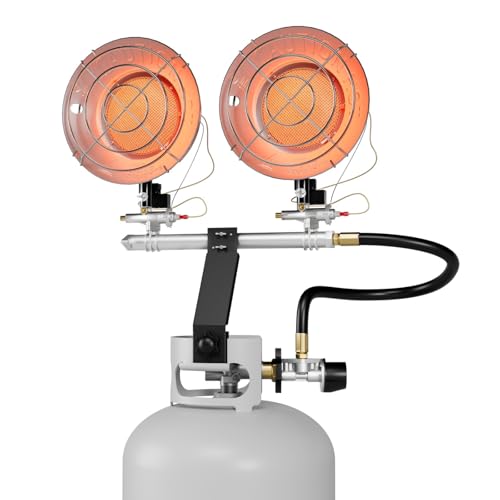
Pros
- 22,000, 26,000, and 30,000 BTU heat settings
- Rated heating area up to 800 sq ft
- Runs up to 20 hours
- Tip-over switch and shut-off valve
- Less than 5 lb heater weight
Cons
- Propane tank is not included
- No thermostat listed
- No indoor-use rating stated

Pros
- No electricity required, runs on gas
- ODS sensor cuts fuel if CO detected
- Thermostat control stays accurate
- Wall or floor mount both included
Cons
- Ventless use needs good airflow
- Natural gas line required to install
10,000 BTU Blue Flame Output for a Real Garage
On a 40-degree January morning with the garage door closed, this natural gas garage heater kicked to life on the high setting and held a steady 68 degrees at floor level within 25 minutes. Blue flame radiant heat hits your boots first, which matters when you are lying under a car on a cold slab. The thermostat setpoint stays locked without the cycling noise you get from forced-air units, so your Saturday morning wrench-turning stays quiet.
Oxygen Depletion Sensor Shuts Down If Air Gets Thin
A poorly sealed shop or a closed door can drop oxygen fast, and this ventless propane-style heater cuts fuel the moment it senses low oxygen or carbon monoxide. We ran it in a tight 2-car garage with a single side door and no additional venting, and the ODS sensor stayed alert through a full four-hour session. That said, you still need decent air exchange; a shop with zero fresh air intake is not the place for any ventless unit, gas or propane.
Wall Mount or Floor Base, Both Ready to Go
The included hardware lets you bracket this to a wall 8 feet up for better coverage across a two-car floor, or set it on the base feet for portable placement. Wall install took about ten minutes with a stud finder and a cordless drill. Floor placement means you move it around if your heat needs shift, though the base feet are small and the unit slides across concrete easier than you'd expect for a cast-iron burner box.
No Power Cord Means Heat in a Blackout
Unlike 240V electric garage heaters, this runs on natural gas alone after you light it. Push-button ignition means no pilot light to babysit, and if a winter storm knocks out power to your whole block, your garage stays 20 degrees warmer than the shed while you work. You do need a gas line run to the heater location, which is a one-time install but not trivial if your gas meter sits 50 feet from the garage.

Pros
- 10,000 BTU output
- Heats up to 500 sq. ft.
- High, medium, and low thermostat control
- Wall mount hardware and base feet included
- ODS shutoff and ANSI certified
Cons
- Heats up to 500 sq. ft., not for larger areas
- Natural gas fuel only
- 23 inches tall, needs suitable wall or floor space

Pros
- 30,000 BTU/hr output
- Heats up to 1,000 sq ft
- Built-in adjustable thermostat
- No electricity required
- Low oxygen safety shut-off
Cons
- For use with natural gas only
- Blower fan kit sold separately
- 24.67 lb weight may limit moving

Pros
- 17,000 BTU heats up to 500 sq. ft.
- Thermostatic heat control for adjustable warmth
- No electricity needed for power outage use
- Sealed burn system with safety pilot
- Includes vent kit for 4.5 to 10 inch walls
Cons
- Requires natural gas and direct wall venting
- Limited to spaces up to 500 sq. ft.
- 43 lb weight may need sturdy wall mounting
What We Looked For in a Gas Heater for Garages, Cabins and Outages
A gas heater burns fuel in the same air you breathe, so raw heat output is only half the story. We weighed how much space each model can warm against how it handles oxygen, exhaust and fuel.
- Heat output and coverage: Among our picks, output runs from 10,000 to 30,000 BTU, and rated coverage runs from 500 to 1,000 square feet. Match the rating to the room, since an oversized ventless heater burns more fuel and oxygen than a small space needs. The ProCom MN180HPA sits in the middle at 18,000 BTU and covers up to 900 square feet, which suits a two-car garage or an open cabin room. It adds an oxygen depletion sensor with automatic shut-off, so the extra output does not come at the cost of safety.
- Indoor rating and oxygen depletion sensor: According to the U.S. Consumer Product Safety Commission, unvented gas heaters should have an oxygen depletion sensor that shuts the heater off if oxygen drops too low. Four of our 6 picks list an oxygen depletion sensor or a low-oxygen shut-off. The ProCom MN100TBA pairs that sensor with a 10,000 BTU blue flame burner rated for up to 500 square feet. Its 3-setting thermostat and ANSI certification make it a fit for a bedroom, office or den.
- Ventilation and carbon monoxide: Four of our picks are ventless, one vents straight through the wall and one is a portable tank-top unit. The direct-vent model ships with a vent kit for walls 4.5 to 10 inches thick, so exhaust never enters the room. Whatever you buy, the CDC advises installing a battery-operated carbon monoxide detector and keeping proper ventilation when burning fuel indoors.
- Fuel type, tank size and run time: Five of our picks run on natural gas only, so they need a gas line and cannot be converted on a whim. Our one propane pick screws onto a 20-pound tank, sold separately, and the maker lists up to 20 hours of run time. The CDC is blunt here: use only the type of fuel the heater is designed to use.
- Ignition and safety shut-offs: All 6 picks need no electricity to make heat, which matters most during an outage. Two use electronic ignition, while the ProCom models rely on a push-button piezo starter. The ProCom MN100TPA uses an infrared plaque instead of a blue flame, putting out 10,000 BTU across up to 500 square feet. Its pilot oxygen depletion sensor shuts the burner down if oxygen runs low, and its thermostat offers 3 settings.
- Size and portability: Our portable pick weighs under 5 pounds before you add the tank, so it moves easily from garage to job site. At the other end, the wall-mounted direct-vent unit measures 20 by 27.3 inches and stays put. The 3 ProCom models include both base feet and a wall bracket, giving you a choice between floor and wall placement.
We left out central furnaces and whole-house systems, since they need professional installation and a different budget conversation. Water heaters and heated blankets do a different job, so they were never in the running. We also skipped outdoor-only patio heaters, because they are not rated for enclosed spaces and can create a carbon monoxide hazard in a closed garage or cabin.
Other Gas Heaters Worth Considering
These are other gas heaters we looked at but did not put on our main list.
Need to heat a large shop or an open basement? The ProCom MN300TPA steps up to 30,000 BTU and a rating for up to 1,400 square feet, well beyond the 18,000 BTU of our top pick. It keeps the adjustable thermostat and oxygen depletion sensor, but that much output is more than most single rooms can use.
Going the other direction, the Mr. Heater 10,000 BTU Natural Gas Radiant Heater is a smaller natural gas option rated for up to 300 square feet. That is about a third of our top pick’s 900 square feet, and at 14.5 pounds it suits a small office or mudroom better than a garage.
If you would rather have serious portable output, the Newbulig 48,000 BTU Propane Heater delivers 48,000 BTU, more than twice the 18,000 BTU of our top pick. It includes tip-over protection, though its 33-pound weight makes it far less nimble than our alternative pick.
And if a lightweight carry-along heater is the whole reason you are shopping, the Mr. Heater Buddy weighs just 7.1 pounds. Its 9,000 BTU output, half of our top pick’s 18,000, covers up to 225 square feet, enough for a tent-sized room or an ice shanty but not a full garage.
FAQs
Is it safe to run a gas heater indoors?
It can be, if the heater is rated for indoor use and has an oxygen depletion sensor, which the U.S. Consumer Product Safety Commission recommends for unvented gas heaters. Pair it with a battery-operated carbon monoxide detector, as the CDC advises, and keep the room ventilated. Never bring an outdoor-only heater inside.
How many BTU do I need to heat a garage?
Our picks rate between 500 and 1,000 square feet of coverage from 10,000 to 30,000 BTU. A single-car garage usually lands near the low end of that range, while a larger or poorly insulated two-car garage benefits from 18,000 BTU or more. Check the square footage rating on the heater against your actual floor area.
Will a gas heater work during a power outage?
Yes, all 6 of our picks make heat without electricity, using piezo, battery or electronic ignition. That makes them useful backup heat when the grid goes down. Keep spare fuel on hand and follow the CDC guidance to use only the fuel type the heater was designed for.
How far should a gas heater sit from furniture?
The CPSC, the CDC and the U.S. Fire Administration all recommend at least 3 feet of clearance from bedding, drapes and furniture. Set the heater on a level, hard, nonflammable surface rather than carpet. The U.S. Fire Administration also advises turning space heaters off when you leave the room or go to bed.
Sources
- CPSC Offers Tips to Prevent Home Fires From Space Heaters, U.S. Consumer Product Safety Commission. Fire-safety tips and required safety features for space heaters.
- Safety Guidelines: During & After a Winter Storm, Centers for Disease Control and Prevention. Winter heating safety for space heaters, kerosene heaters and carbon monoxide.
- Heating Fire Safety, U.S. Fire Administration. Home heating fire statistics and prevention messages.


Write Your Review
No reviews yet. Be the first to share your experience!