

Try Amazon Prime free for 30 days
Fast free delivery on heavy items, plus Prime Video, Prime Music and member-only deal prices.
A dead battery and a low tire at the same gas station air pump is the kind of roadside comedy nobody enjoys. Jump starter power packs with compressor solve that by pairing 12V starting power with built-in tire inflation. After comparing 6 models, the Nicholaus 2800A Jump Starter (8,000 mAh) is the best fit, with a 2,800-amp peak, coverage up to 6L gas and 3L diesel, and a 150 PSI inflator. The DEWALT DXAEJ14 is the alternative pick, with a 1,600-amp peak and 120 PSI inflator.


Pros
- 1600 peak amps for most 4, 6 and 8-cylinder vehicles
- 120 PSI digital inflator with automatic shutoff
- 25W USB-C and 15W USB-A charging ports
- Reverse-polarity protection warns of bad clamp connection
- Built-in LED area light for low-light roadside work
Cons
- 17.3 pounds is bulky for small storage spaces
- Extension cord for recharging is not included
- Inflator auto shutoff is limited to a 10-minute timer

Pros
- 1000 peak amps and 500 instant starting amps
- 120 PSI air compressor for low tires
- Reverse polarity alarm for improper connections
- USB port and 12V DC outlet for device power
- 270 degree rotating LED light
Cons
- 17.2 pounds, heavier than pocket jump starters
- Needs charging every 30 days when not in use
- Household extension cord is sold separately

Pros
- 4000A peak for 12V vehicles up to all gas or 10.0L diesel
- 160 PSI air compressor with auto stop and 5 inflation modes
- 20,000mAh rated capacity supports up to 50 starts per charge
- Works from -4°F to 140°F for jump starting
- Built in 45W USB-C output cable for device charging
Cons
- 3.2 lb weight is bulkier than pocket size jump starters
- Recharge at least once every 3 months during storage
- USB-C cable is output only, not listed for recharging the unit

Pros
- Starts all gas engines and diesel engines up to 12L
- 160PSI air compressor with 45L/min turbo pump
- Inflates car tires from 0 to 36PSI in 1 minute
- 12 safety protections, including reverse polarity
- 3 LED modes, steady, strobe and SOS
Cons
- Peak amp rating is not listed in the product data
- Battery capacity and starts per charge are not listed
- 9.84 x 6.10 x 3.35 in, larger than pocket size

What We Looked For in Jump Starters With Built-In Compressors
A roadside unit has to do two different jobs well: deliver a strong burst of current and move enough air to bring a tire back to a safe pressure. Cold weather also matters, because AAA Oregon/Idaho says a car battery loses about 35 percent of its strength at 32°F.
- Air compressor rating: We gave the most weight to inflators with clear PSI ratings and automatic shutoff, because guessing at tire pressure is not useful on the shoulder of a road. Among our picks, compressor ratings run from 120 PSI to 160 PSI. The Nicholaus 2800A Jump Starter (8,000 mAh) lands in the middle with a 150 PSI inflator, and it also lists 5 inflation modes for car, motorcycle, bike, ball, and custom use. Auto-stop matters because it cuts inflation at the preset pressure instead of relying on the driver to watch the gauge the whole time.
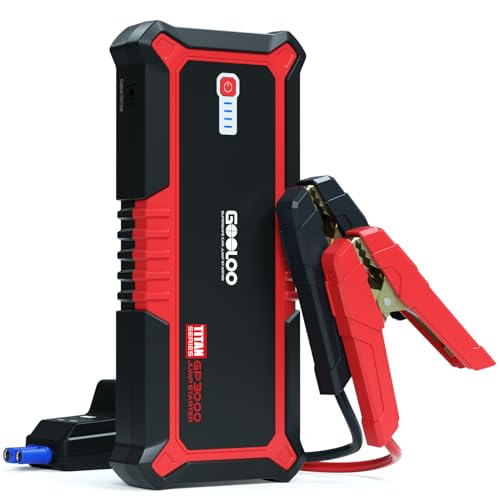
- Jump-starting coverage: Peak current is only part of the story, so we also looked for stated gas and diesel engine limits. The strongest listed coverage in the main group reaches all gas engines and diesel engines up to 12L, while the lowest named peak output is 1,000 amps. The GOOLOO A5 has a 4,000-amp peak and covers all gas engines plus diesel engines up to 10L, which gives it a wide margin for larger pickups and SUVs. AAA Oregon/Idaho notes that an engine may need up to twice the normal current to start in the cold, so extra starting headroom is useful.
- Battery capacity for both jobs: A combo unit has to save enough charge for starting, inflating, lighting, and phone power. Among our picks, stated battery capacity ranges from 8,000 mAh to 20,000 mAh where capacity is provided. Our top pick is rated for up to 25 starts per charge, while one larger-capacity pick lists up to 50 starts. That difference matters if the unit will live in a family vehicle, work truck, or road-trip kit rather than being charged after every use.
- Size and weight: A power pack that is too bulky often stays in the garage, which defeats the point of a roadside tool. The lightest option in our comparison is 1.66 pounds, while the heaviest named model is 17.2 pounds. The STANLEY 1000A Jump Starter with Air Compressor has a 1,000-amp peak, a 120 PSI inflator, and a 17.2-pound body, so it is better suited to trunk storage than glove-box storage. Smaller lithium-style units are easier to carry, but larger garage-style packs may be easier to spot, grip, and keep upright.
- Safety protections: We looked for reverse-polarity warnings, spark protection, automatic circuit protection, and overtemperature safeguards. One of our picks lists 12 protection technologies, while several others call out reverse-polarity protection specifically. The U.S. Consumer Product Safety Commission has reported a lithium jump starter recall involving about 10,400 units after overheating and melting reports, including 18 reports of fire. That is why clamp protection and heat management are not minor details.
- Display and controls: Clear controls matter when the hood is up, traffic is passing, or the tire is already half flat. Among the main picks, displays include digital tire-pressure readouts, LCD status screens, and color LED displays. Several models offer 3 light modes, typically steady, SOS, and strobe, which helps when a start or inflation job happens after dark. We favored controls that show pressure, battery status, and connection warnings without requiring a phone app.
We excluded jumper cables because they need a second running vehicle, which is not always available in a parking lot or trailhead. We also left out trickle chargers and maintainers because they take hours, not seconds, and 24V semi truck boosters because they are built for commercial trucks and are much heavier than most drivers need.
Other Jump Starters Worth Considering
These are other jump starters we looked at but did not put on our main list.
If maximum cranking output is the priority, the NACKEO 8000A Jump Starter with Air Compressor lists an 8,000-amp peak and covers all gas engines plus diesel engines up to 12L. Its 160 PSI inflator is higher than our top pick’s 150 PSI rating, but its 2.15-pound weight is above the 1.66-pound weight of our top pick.
For a slightly higher peak rating than our top pick without moving into the largest packs, the GOOLOO A3 lists a 3,000-amp peak and a 150 PSI inflator. It is also rated for operation from -4°F to 140°F, which is a useful published range for drivers who keep a unit in the vehicle year-round.
Stepping up again, the Joltekon 4500A Jump Starter with Air Compressor lists a 4,500-amp peak and covers engines up to 9L gas and 8L diesel. It also has a 150 PSI inflator, but at 2.65 pounds it weighs more than our top pick’s 1.66 pounds.
And if high peak output in a relatively light body is the reason you are shopping, the VANXIPOW M1 lists a 7,000-amp peak and weighs 1.76 pounds. It covers engines up to 9L gas and 8L diesel, while our top pick uses a lower 2,800-amp peak in a slightly lighter body.
FAQs
How much PSI should a jump starter with compressor have?
Our picks range from 120 PSI to 160 PSI, which covers typical car, SUV, motorcycle, bicycle, and sports-equipment inflation tasks listed by the makers. A higher maximum PSI does not automatically mean faster inflation, so also look for stated airflow or time-to-inflate figures when available.
How many peak amps are enough for cold-weather starting?
Our picks range from 1,000 peak amps to 4,000 peak amps, and other considered models go higher. AAA Oregon/Idaho says a battery loses about 60 percent of its power at 0°F, and an engine may need up to twice the normal current to start in the cold, so extra peak output is helpful in winter climates.
Should I choose a small lithium pack or a larger jump starter?
The main group spans from compact units around 1.66 pounds to larger packs listed at 17.2 pounds. A lighter unit is easier to carry and store in a small vehicle, while a larger unit may suit drivers who prefer a more garage-style form factor and do not need to move it often.
How often should a jump starter power pack be recharged?
One listed model says it should be charged every 30 days when not in use, while another recommends recharging at least once every 3 months during storage. The safest habit is to check the battery display on a schedule, especially before long drives or freezing weather.
Sources
- Winter Battery Preparation, AAA Oregon/Idaho. How cold weather drains car batteries and when to replace them.
- Whistler Recalls Jump&Go Portable Jumpstart and Power Supply Units, U.S. Consumer Product Safety Commission. Recall of a lithium jump starter that could overheat.




Write Your Review
No reviews yet. Be the first to share your experience!