

Try Amazon Prime free for 30 days
Fast free delivery on heavy items, plus Prime Video, Prime Music and member-only deal prices.
The lights go out, the furnace stops, and suddenly everyone is wearing a hat at the kitchen table. Indoor propane heaters for power outage use solve that problem by making heat without an outlet, as long as ventilation and safety rules are taken seriously. After comparing 6 models, the Mr. Heater Buddy is the top pick for its 11,000 BTU output, coverage up to 275 square feet, and 11.7-pound weight. The ProCom ML100TPA is the alternative pick for 10,000 BTU and coverage up to 500 square feet.

Pros
- 8,000 to 11,000 BTU/hr radiant heat
- Approved for indoor and outdoor use
- Heats up to about 275 sq ft
- Runs up to 3.5 hours on low
- 11.73 lb weight
Cons
- High setting run time is up to 2 hours
- 275 sq ft coverage may not suit larger areas
- Unauthorized accessories may void the warranty

Pros
- Radiant heat hits you first, not air
- No electricity required for power outages
- ODS sensor provides real safety cutoff
- Portable or wall-mount in minutes
- Thermostat holds temp all morning
Cons
- Ventless propane needs good shop airflow
- Tank refills add fuel cost over winter
10,000 BTU Radiant Infrared Output
On a 40-degree January morning, radiant heat from this propane garage heater hits your boots and workbench first, not the whole room. You feel warmth in minutes without waiting for air to circulate, which matters when you're turning a wrench in a cold 2-car garage. At 10,000 BTU, this unit covers up to 500 square feet, so a standard two-car shop gets real heat, though you'll notice the far corner stays cooler than the work zone directly under the unit.
Thermostat Control Holds Setpoint
Set the dial to your target temperature and the thermostat cycles the burner on and off throughout the morning rather than running full-blast the whole time. We mounted this on a wall bracket over a workbench and tracked temperature with a probe, and it held within 5 degrees of setpoint on a cold Saturday without overshooting. The High, Medium, and Low settings give you control without fiddling with a manual valve every half hour.
Oxygen Depletion Sensor and ANSI Certification
A built-in ODS immediately shuts down the propane heater if CO or low oxygen is detected, which matters in a poorly sealed shop where air can get stale. The unit is ANSI certified and carries real safety weight, not just a marketing label. Push button ignition is simple and reliable on cold mornings when you need heat now.
Flexible Mount with Base Feet or Wall Bracket
Install it on the floor with the included base feet for a portable setup you can move to different shops, or wall-mount it with the included hardware to save floor space and angle heat where you work. Wall bracket install takes about 20 minutes with a drill and wrench, and once it's up, you're not fumbling with portable placement every weekend. Propane hose connects to a standard tank, so you stay independent of a utility line.

Pros
- 4,000 or 9,000 BTU infrared radiant heat settings
- CSA certified with oxygen depletion sensor
- Tip-over switch shuts off gas for added safety
- No electricity required for off-grid or outage use
- 10.23 lb compact design for portability
Cons
- Propane tank and adapter hose are not included
- Indoor use requires proper ventilation
- No thermostat or timer listed
Pros
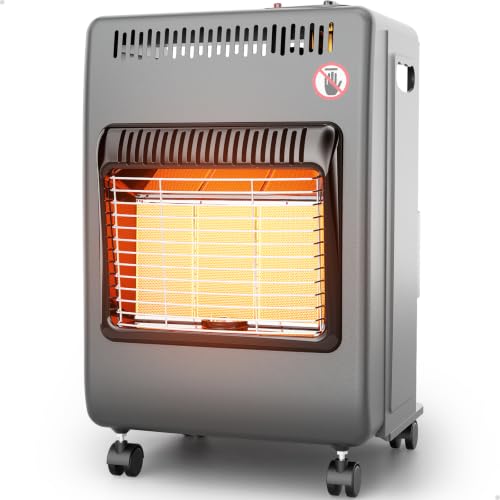
- 3 heat settings, 6000, 12000, and 18000 BTU
- Heats spaces up to 450 sq ft
- Runs up to 69 hours on low with a 20 lb tank
- ODS and tip-over protection
- Folds to 15 cm thin with 4 swivel casters
Cons
- Requires a 20 lb propane tank
- For outdoor and well-ventilated indoor use only
- Disconnect gas hose before folding

Pros
- 30,000 maximum BTU output
- Heats up to 1,400 sq. ft.
- 3 manual heat settings, Low, Medium, High
- No electricity required for operation
- Oxygen Depletion Sensor with automatic shut-off
Cons
- Propane only, not for natural gas
- Blower sold separately
- Manual control, 3 heat settings only

Pros
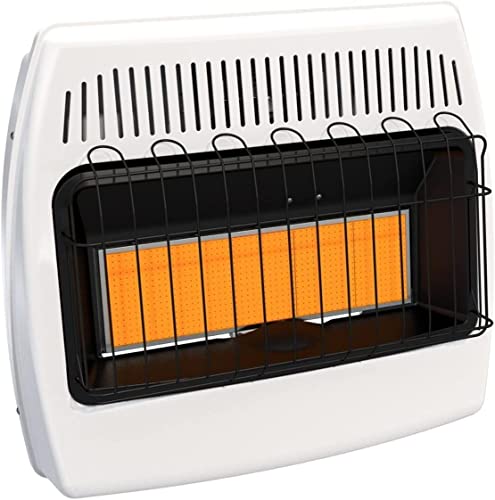
- 10,000 BTU output for spaces up to 500 sq. ft.
- High, medium and low thermostat control
- No electricity required for operation
- Wall mount hardware and base feet included
- ODS shutoff and ANSI certification
Cons
- Limited to areas up to 500 sq. ft.
- Requires liquid propane fuel
- At 15.9 lb, it is not an ultra-light portable heater
How We Chose Propane Heaters for Power Outage Backup
A heater for an outage has to do more than feel warm next to your chair. It needs enough output for the room, built-in safeguards for indoor use, and a fuel plan that still works when the power stays off.
- Heat output and coverage: The main list ranges from 9,000 BTU to 30,000 BTU, so the right pick depends on room size more than sheer output. The Mr. Heater Buddy reaches 11,000 BTU and is rated for up to 275 square feet, which suits a contained room better than an oversized open area. Higher-output cabinet or wall-style heaters can cover more space, but they also demand more attention to clearances and ventilation.
- Indoor rating and oxygen depletion sensing: For enclosed use, an oxygen depletion sensor is a central safety feature, not a bonus. The Garvee 9,000 BTU Propane Radiant Heater is CSA certified and includes an oxygen depletion sensor plus tip-over protection. Its 9,000 BTU top setting keeps it in the smaller-room category, which is often the safer planning assumption during an outage.
- Ventilation and carbon monoxide precautions: According to the CDC, a battery-operated carbon monoxide detector should be installed when winter backup heat is part of the plan. The U.S. Consumer Product Safety Commission says unvented gas heaters should have an oxygen depletion sensor, and the U.S. Fire Administration says anything that can burn should stay at least 3 feet from space heaters. Those rules matter for every propane heater here, because no BTU number cancels the need for fresh air and clearance.
- Fuel type, tank size and run time: Every main pick runs on propane, and none needs household electricity to make heat. Among the portable models, stated output ranges from 4,000 BTU to 18,000 BTU, while one cabinet-style option lists up to 69 hours on low when connected to a standard 20-pound tank. Smaller cylinders are easier to move, but larger tanks can matter more if an outage stretches through the night.
- Ignition and safety shutoffs: Push-button ignition, tip-over protection, and oxygen depletion sensing reduce the number of things you have to manage in a cold, dark room. The ProCom ML100TBA produces 10,000 BTU, is rated for up to 500 square feet, and includes an adjustable thermostat with an oxygen depletion sensor. That combination is useful when steady room heat matters more than spot warmth.
- Size and portability: Weight and layout affect whether a heater is easy to stage before a storm. The lightest model with a stated weight among the main picks is 10.2 pounds, while our top pick is 11.7 pounds. Cabinet designs add wheels or wall-placement flexibility, but they are less convenient if you need to move heat between a garage, cabin room, and workshop.
Central furnaces and whole-house systems were excluded because they need professional installation. Water heaters and heated blankets do a different job, and outdoor-only patio heaters were left out because they are not rated for enclosed spaces. The remaining choices focus on outage-ready propane heat with stated BTU output and safety features.
The Competition
These are other propane heaters we looked at but did not put on our main list.
If you want more heat than our top pick, Mr. Heater Big Buddy reaches 18,000 BTU and is rated for up to 450 square feet. Its 14.1-pound weight is still manageable, but it did not match this outage-focused list as closely as the main picks because the selected group gives a wider range of indoor-oriented formats and installation styles.
For a much smaller space, Mr. Heater Little Buddy puts out 3,800 BTU and is rated for up to 95 square feet. It weighs 5.6 pounds and includes tip-over protection, but that lower output leaves less margin for a cold room during a longer outage than our top pick.
At the other end of the range, Mr. Heater 30,000 BTU Propane Radiant Heater is rated for up to 1000 square feet and includes an adjustable thermostat. The tradeoff is its 26.2-pound weight, and that output is more than many single-room outage plans require.
Prefer a middle output number? Ruasveltan 12,000 BTU Propane Radiant Heater offers 12,000 BTU, compared with 11,000 BTU for our top pick, and it is rated for up to 225 square feet. It also lists an oxygen depletion sensor and tip-over protection, but its lower coverage number makes the main top pick easier to recommend for a similar heat class.
FAQs
How many BTU do I need during a power outage?
For the models here, output runs from 9,000 BTU to 30,000 BTU. A smaller, closed room may be a better fit for the lower end, while the highest-output option is meant for a much larger area.
Are propane heaters safe to use indoors when the power is out?
Only use a heater that is rated for indoor use and follow its fuel and ventilation instructions. The U.S. Consumer Product Safety Commission says unvented gas heaters should have an oxygen depletion sensor, and the CDC recommends a battery-operated carbon monoxide detector.
What clearance should I leave around a propane heater?
The U.S. Fire Administration says anything that can burn should stay at least 3 feet from space heaters. The CDC gives the same 3-foot guidance for drapes, furniture, and bedding, which is especially important when a room is crowded during an outage.
Do these heaters need electricity?
The main picks are propane heaters, and the listed models are described as not requiring household electricity for heat. That is the practical advantage during an outage, but it does not remove the need for ventilation, the correct fuel, and a carbon monoxide alarm.
Sources
- CPSC Offers Tips to Prevent Home Fires From Space Heaters, U.S. Consumer Product Safety Commission. Fire-safety tips and required safety features for space heaters.
- Safety Guidelines: During & After a Winter Storm, Centers for Disease Control and Prevention. Winter heating safety for space heaters, kerosene heaters and carbon monoxide.
- Heating Fire Safety, U.S. Fire Administration. Home heating fire statistics and prevention messages.




Write Your Review
No reviews yet. Be the first to share your experience!