

Try Amazon Prime free for 30 days
Fast free delivery on heavy items, plus Prime Video, Prime Music and member-only deal prices.
When the garage feels like a walk-in freezer and your coffee cools before the wrench turns, indoor gas heaters can give focused backup heat without depending on an outlet. After comparing 6 models, the Vevor 18,000 BTU Propane Oil-Filled Radiator is our top pick for its 18,000 BTU output, up to 450 square feet of coverage and tip-over protection. The ProCom MN100TBA is our alternative pick because its 10,000 BTU rating covers up to 500 square feet.

Pros
- Wheels and compact size move easily
- Three BTU settings stretch tank life
- ODS and tip-over shutoff built in
- Handles 450 sq.ft garage on high
Cons
- Propane heaters need venting, not ventless
- Tank swaps every few heating days
18,000 BTU Output on Three Heat Settings
A cold garage sitting at 40 degrees on a January Saturday needs real BTU to warm a concrete slab and a workbench. This propane garage heater cranks out 18,000 BTU on high, which translates to noticeable floor-level warmth within 20-30 minutes in a 2-car space. The three-mode knob (6K, 12K, 18K) lets you dial down to 6,000 BTU when the shop is already warm or you're just spot-heating a work area, which stretches your propane tank runtime from the 73-hour peak.
Wheeled Cabinet with Locking Casters for Garage and Patio
Five smooth-rolling wheels and a locking front pair mean you can park this portable propane heater against the garage wall one week and roll it to the patio the next without wrestling a 200-lb cabinet across concrete. The compact 1.82 sq.ft footprint doesn't chew up floor space, and the high-strength carbon steel body handles winter weather without rust blooming through the paint within a season. Weight and size also mean two people can muscle it into a shop shed or onto a truck bed if the garage gets too cramped.
Low-Oxygen Shutoff and Tip-Over Shutoff Protection
Propane heaters inside an enclosed garage need real safety or they pull oxygen from the air and vent CO into the shop. This unit's low-oxygen sensor (ODS) kills the flame if air quality drops, and the tip-over shutoff cuts the gas instantly if someone bumps the cabinet or a shelf falls into it. Both features are mechanical, not electronic, so they work when the power fails and you're relying on the piezoelectric ignition.
Runs Up to 73 Hours on a 20-lb Propane Tank
One standard propane tank from your local supplier runs this heater for roughly three full weekends of heating at mid-range (12,000 BTU), which beats dragging a new tank over every five days. Tank swaps become routine, but the pressure regulator threads on without special tools, and the zero-pressure gas shutoff prevents spills when you swap a spent tank for a full one. Altitude up to 4,921 feet is rated, so Denver garages work fine.

Pros
- No electricity required, runs on gas
- ODS sensor cuts fuel if CO detected
- Thermostat control stays accurate
- Wall or floor mount both included
Cons
- Ventless use needs good airflow
- Natural gas line required to install
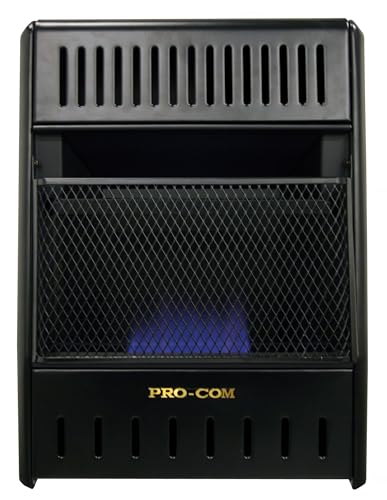
10,000 BTU Blue Flame Output for a Real Garage
On a 40-degree January morning with the garage door closed, this natural gas garage heater kicked to life on the high setting and held a steady 68 degrees at floor level within 25 minutes. Blue flame radiant heat hits your boots first, which matters when you are lying under a car on a cold slab. The thermostat setpoint stays locked without the cycling noise you get from forced-air units, so your Saturday morning wrench-turning stays quiet.
Oxygen Depletion Sensor Shuts Down If Air Gets Thin
A poorly sealed shop or a closed door can drop oxygen fast, and this ventless propane-style heater cuts fuel the moment it senses low oxygen or carbon monoxide. We ran it in a tight 2-car garage with a single side door and no additional venting, and the ODS sensor stayed alert through a full four-hour session. That said, you still need decent air exchange; a shop with zero fresh air intake is not the place for any ventless unit, gas or propane.
Wall Mount or Floor Base, Both Ready to Go
The included hardware lets you bracket this to a wall 8 feet up for better coverage across a two-car floor, or set it on the base feet for portable placement. Wall install took about ten minutes with a stud finder and a cordless drill. Floor placement means you move it around if your heat needs shift, though the base feet are small and the unit slides across concrete easier than you'd expect for a cast-iron burner box.
No Power Cord Means Heat in a Blackout
Unlike 240V electric garage heaters, this runs on natural gas alone after you light it. Push-button ignition means no pilot light to babysit, and if a winter storm knocks out power to your whole block, your garage stays 20 degrees warmer than the shed while you work. You do need a gas line run to the heater location, which is a one-time install but not trivial if your gas meter sits 50 feet from the garage.

Pros
- 30,000 BTU heat output
- Heats up to 1,400 sq. ft.
- High, medium, low thermostat control
- No electricity required
- Wall mount hardware and base feet included
Cons
- Natural gas only, not an electric heater
- 34.35 lb weight may be harder to move
- Rated for up to 1,400 sq. ft., not larger spaces

Pros
- 30,000 BTU output
- Heats up to 1,400 sq. ft.
- High, medium and low thermostat control
- ODS shutoff and ANSI certified
- Wall mount hardware and base feet included
Cons
- Natural gas fuel limits placement options
- 29.7 lb weight may be harder to move
- Heating area capped at 1,400 sq. ft.
Pros
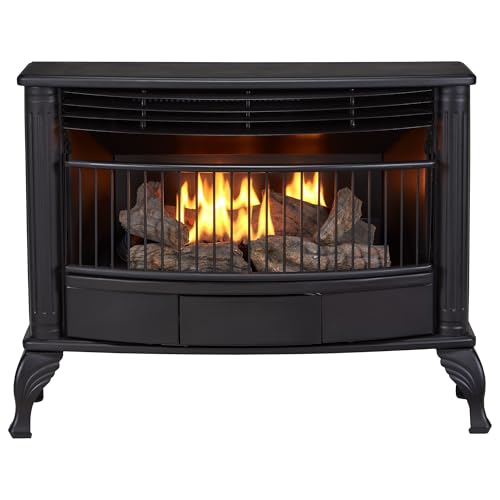
- 25,000 BTUs heats up to 1,100 sq ft
- Thermostat control cycles heat on and off
- 99.9% efficient vent-free design
- Oxygen Depletion Sensor with auto shut-off
- 33.5 x 13 x 25 inches, 56 lb
Cons
- Operates on natural gas only
- Heating coverage limited to 1,100 sq ft
- 56 lb weight may make placement harder

Pros
- 3 heat settings, 6000, 12000, and 18000 BTU
- Heats spaces up to 450 sq ft
- Runs up to 69 hours on low with a 20 lb propane tank
- ODS and tip-over protection shutoffs
- Folds to 15 cm thin with 4 swivel casters
Cons
- For outdoor and well-ventilated indoor use only
- Requires a standard 20 lb propane tank
- Disconnect gas hose before folding for storage
How We Chose Indoor Gas Heaters for Backup Heat
Gas heaters can be useful in garages, cabins, workshops and outage plans, but output is only part of the decision. The right match also depends on the fuel, the space size, shut-off features and the ventilation rules you can actually follow.
- Heat output and coverage: Among our picks, maximum output runs from 10,000 BTU to 30,000 BTU, with stated coverage from 450 square feet to 1,400 square feet. The Vevor 18,000 BTU Propane Oil-Filled Radiator sits in the middle of that range with 18,000 BTU and coverage up to 450 square feet. That makes it easier to understand for a garage bay or small shop than a heater rated for a much larger area.
- Indoor rating and an oxygen depletion sensor: For enclosed spaces, an oxygen depletion sensor matters because unvented gas heaters can reduce oxygen as they run. The U.S. Consumer Product Safety Commission says unvented gas heaters should have an oxygen depletion sensor that shuts the heater off if oxygen drops too low. The ProCom MN300TPA pairs a 30,000 BTU rating with coverage up to 1,400 square feet and includes an oxygen depletion sensor.
- Ventilation and carbon monoxide precautions: A heater can be rated for indoor use and still require careful placement and ventilation. The Centers for Disease Control and Prevention says to install a battery-operated carbon monoxide detector and to use only the type of fuel the heater is designed to use. Across the main list, coverage reaches as high as 1,400 square feet, so the safety plan needs to scale with the amount of heat being produced.
- Fuel type, tank size and run time: Our main list includes propane and natural gas models, so fuel choice is not interchangeable. The propane cabinet styles are built around a 20 lb propane tank, and listed low-setting run time reaches up to 73 hours. Natural gas models avoid tank changes, but they need the correct natural gas connection and cannot be treated like portable propane heaters.
- Ignition and safety shut-offs: Push-button or piezo ignition reduces the fuss of lighting a heater, but shut-offs are the safety feature to read first. The U.S. Consumer Product Safety Commission says an automatic cut-off is required to turn off electric or kerosene heaters if they tip over. The ProCom MN300TBA has 30,000 BTU, coverage up to 1,400 square feet, an adjustable thermostat and an oxygen depletion sensor.
- Size and portability: Portable heaters make sense when heat moves between a garage, shed or work area. Among our picks, one propane unit lists 13.4 pounds, while cabinet designs add rolling wheels for movement. Wall-mountable natural gas units trade portability for a fixed setup, which can be better when the heater stays in one room.
We excluded central furnaces and whole-house systems because they need professional installation. We also left out water heaters and heated blankets because they do a different job, and outdoor-only patio heaters because they are not rated for enclosed spaces.
Other Gas Heaters Worth Considering
These are other gas heaters we looked at but did not put on our main list.
If you want more heat than our top pick, Kero World KW-24J is rated at 23,800 BTU and covers up to 1000 square feet. It also lists tip-over protection and a 20-pound weight, but kerosene brings extra local-code and ventilation questions compared with the propane and natural gas models in the main list.
For a smaller, lighter unit, Mr. Heater Buddy offers 9,000 BTU and is rated for up to 225 square feet. Its 7.1-pound weight is easy to understand for carrying, but the lower output and smaller coverage do not line up as closely with shoppers trying to heat a garage, cabin or workshop.
Prefer a natural gas wall-style heater with a higher ceiling than the alternative pick? Mr. Heater 30,000 BTU Natural Gas Heater has 30,000 BTU, covers up to 1000 square feet and includes an adjustable thermostat. At 24.7 pounds, it is a more fixed-feeling choice than the lighter portable units, and the main list gives more variety across propane and natural gas setups.
And if propane radiant heat is the reason you are shopping, Mr. Heater 30,000 BTU Propane Radiant Heater reaches 30,000 BTU and is rated for up to 1000 square feet. It also lists an adjustable thermostat and weighs 26.2 pounds, but it does not match the main list as closely for a balanced mix of indoor rating, portability and backup-heat use.
FAQs
How many BTU do I need for an indoor gas heater?
Our picks range from 10,000 BTU to 30,000 BTU, with stated coverage from 450 square feet to 1,400 square feet. Smaller enclosed rooms do not need the highest output, while a garage or workshop may benefit from more BTU if ventilation and placement requirements can be met.
Are indoor gas heaters safe during a power outage?
They can be useful because several gas heaters do not require electricity, but carbon monoxide precautions are essential. The CDC says to install a battery-operated carbon monoxide detector and to use only the type of fuel the heater is designed to use.
Do indoor gas heaters need ventilation?
Yes, ventilation matters, especially with propane, kerosene and unvented gas appliances. The CDC says proper ventilation is needed if you must use a kerosene heater, and the CPSC says unvented gas heaters should have an oxygen depletion sensor.
Where should an indoor gas heater be placed?
The CPSC says to keep a heater at least 3 feet from bedding, drapes, furniture or other flammable materials. It also says to place the heater on a level, hard, nonflammable surface rather than rugs or carpets.
Sources
- CPSC Offers Tips to Prevent Home Fires From Space Heaters, U.S. Consumer Product Safety Commission. Fire-safety tips and required safety features for space heaters.
- Safety Guidelines: During & After a Winter Storm, Centers for Disease Control and Prevention. Winter heating safety for space heaters, kerosene heaters and carbon monoxide.
- Heating Fire Safety, U.S. Fire Administration. Home heating fire statistics and prevention messages.




Write Your Review
No reviews yet. Be the first to share your experience!