

Free Delivery. Exclusive Deals. All Prime.
Prime members save on shipping and get first access to deals, plus Prime Video included. 30 days free.
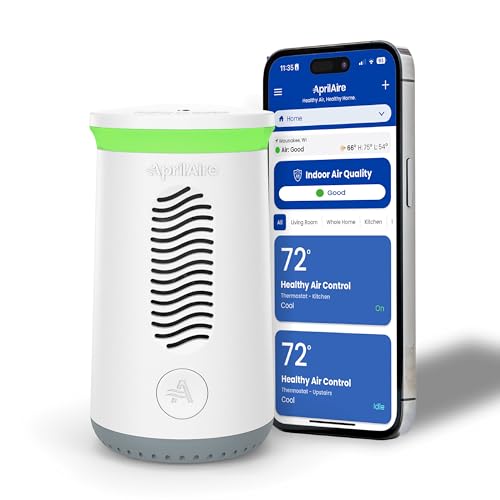
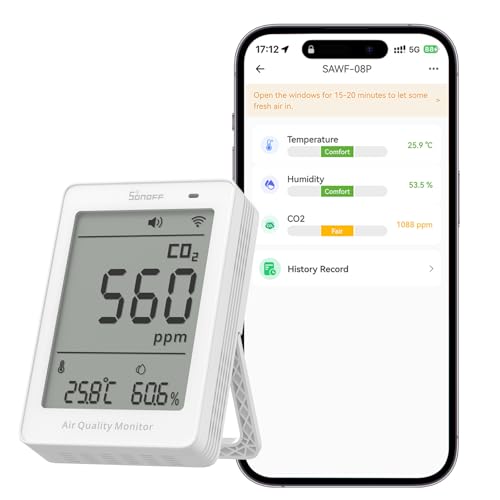
When the office feels sleepy after lunch and the bedroom window is somehow both closed and drafty, a small sensor can stop the guessing. HomeKit air quality monitors turn invisible indoor conditions into readings you can act on. After comparing 3 models, the Aprilaire Air Quality Monitor is the top pick because it tracks CO2, PM2.5 and VOCs, plus radon, with app control. The Sonoff Air Quality Monitor is the alternative pick because it adds app control with Matter support.
Pros
- 5-in-1 monitor tracks CO2, VOCs, PM2.5, humidity and temperature
- Wi-Fi app control with instant notifications
- Color status display for at-a-glance readings
- 3 light options: default, always on and always off
- Can integrate with select AprilAire systems
Cons
- Requires the AprilAire Healthy Air App to function
- Healthy Air Mode needs a separate compatible thermostat
- AprilAire filtration or ventilation solutions sold separately
Pros
- Matter support for major smart home platforms
- NDIR CO2 sensor accuracy of ±(50ppm + 5%)
- Updates data every 5 seconds with continuous power
- Shows CO2, temperature, and humidity on one screen
- Stores and exports up to 12 months of data
Cons
- For indoor use only
- Works with 2.4GHz WiFi
- Measures CO2, temperature, and humidity only

Pros
- Tracks PM2.5, PM10, CO2, temperature and humidity
- Readings refresh every second
- Works with Apple HomeKit and Qingping+ app
- 2.4GHz Wi-Fi supports remote data viewing
- USB-C rechargeable battery lasts up to 7 hours
Cons
- Not waterproof or dustproof
- Not for long-term use above 90% humidity
- Battery mode may auto shut off after a few minutes
How We Chose HomeKit Air Quality Monitors for Indoor Readings
An air quality monitor is most useful when it explains the room you are actually in, not just one isolated number. For this category, the strongest picks combine useful readings, clear alerts and smart-home features that make the numbers easier to act on.
- What it measures: The most useful monitors cover both comfort and air-quality readings. The Aprilaire Air Quality Monitor stands out because it tracks CO2, PM2.5 and VOCs, plus radon, giving it a broader view than a monitor focused only on temperature or humidity. Across the main list, the readings include temperature, humidity, CO2, PM2.5, PM10, VOCs and radon, so each pick has more than a single-purpose role.
- Stated accuracy: Accuracy claims matter most when they include a number. One pick uses an NDIR CO2 sensor with stated accuracy of plus or minus 50 ppm plus 5 percent across a 400 to 5000 ppm range. Another pick states that its readings refresh every second, while the Matter-compatible model updates data every 5 seconds when continuously powered.
- Display and readability: A useful display should make the current room status readable without opening an app every time. Among the main picks, 2 include an on-device screen for live room readings, while 1 uses a simple color status scheme for at-a-glance feedback. One model combines a multi-color LED indicator with a sound notice, giving you more than 1 way to notice a change in CO2, temperature or humidity.
- Data history and app or smart-home support: App support matters because air quality problems often show up as trends, not single moments. The qingping Air Quality Monitor works with Apple HomeKit and the Qingping+ app, and it measures CO2, PM10 and PM2.5 for automation or remote checks. The main list includes 2 picks with Apple Home or Matter smart-home support, and 1 pick offers 12 months of historical data with export.
- Power source and battery life: Continuous monitoring is easier when the monitor can stay powered, especially for CO2 trends. One pick is designed around continuous power and updates every 5 seconds, which suits rooms where you want steady alerts. Another includes a 2000 mAh rechargeable lithium battery with up to 7 hours of battery life, but it is still recommended to keep it plugged in for normal use.
- Number of sensors or rooms: These are single-room monitors, so placement matters more than coverage claims. Among the main picks, 1 model is described as a 5-in-1 monitor, while another shows 3 core readings on one screen. If you care about more than 1 room, plan on more than 1 monitor rather than expecting a single sensor to describe the whole home.
We excluded dehumidifiers because they remove moisture instead of measuring a room’s air conditions. We also excluded essential oil diffusers because they have too little output to humidify a room, and medical thermometers or meat thermometers because they do a different job.
The Competition
These are other air quality monitors we looked at but did not put on our main list.
If carbon monoxide is high on your concern list, Amazon Air Quality Monitor includes CO along with PM2.5, VOC, temperature and humidity readings. It also has app control, but it does not match this keyword’s need as closely as the main list because the main picks are more directly centered on HomeKit or smart-home air monitoring.
For shoppers focused on humidity, GoveeLife Air Quality Monitor states PM2.5 measurement and plus or minus 3 percent humidity accuracy. That is a useful stated number, but it is narrower than our top pick’s broader mix of CO2, PM2.5 and VOC tracking, and it does not align as closely with the HomeKit-focused use case.
More particle categories can be appealing, and Lwyinp Air Quality Monitor measures CO2, HCHO, PM1.0 and PM10. It also includes app control, yet the main list gives a clearer path for people comparing smart-home support, display behavior and indoor trend tracking from a HomeKit angle.
And if CO2 is the whole reason you are shopping, SAF Air Quality Monitor keeps the focus on that 1 reading with app control. The tradeoff is that our alternative pick adds a broader smart-home framework, while our top pick covers several air-quality readings rather than centering on a single metric.
FAQs
What readings matter most for a HomeKit air quality setup?
CO2, PM2.5 and humidity are the readings most people will notice in daily use because they connect to ventilation, particles and comfort. Across our picks, monitored readings include CO2, PM2.5, PM10, VOCs, temperature and humidity, with 1 pick also called out for radon.
Do I need a display if the monitor works with an app?
A display is useful if you want the current room status without opening a phone. Among our picks, 2 include an on-device screen, while 1 uses a color status system that is meant for quick at-a-glance checks.
How should humidity readings be interpreted?
According to the EPA, indoor humidity should be kept below 60 percent relative humidity, ideally between 30 and 50 percent. That makes humidity tracking useful even when your main concern is particles or CO2, because moisture problems can affect comfort and mold risk.
Is battery power important for an air quality monitor?
Battery power helps for moving a monitor between rooms, but continuous power is better for steady trend tracking. In our picks, one rechargeable model is rated for up to 7 hours of battery life, while another updates every 5 seconds when continuously powered.
Sources
- Use and Care of Home Humidifiers, U.S. Environmental Protection Agency. EPA guidance on humidifier types, minerals, cleaning and safe humidity levels.
- A Guide to Mold, Moisture and Your Home, U.S. Environmental Protection Agency. EPA guide to controlling indoor moisture and mold.



Write Your Review
No reviews yet. Be the first to share your experience!