

Free Delivery. Exclusive Deals. All Prime.
Prime members save on shipping and get first access to deals, plus Prime Video included. 30 days free.
The porch feels like a freezer, the bedroom feels like soup, and the thermostat insists everything is fine. Home indoor outdoor thermometers solve that everyday argument by showing current conditions where you actually live. After comparing 6 models, the DreamSky Indoor Outdoor Thermometer stands out for support for 3 sensors, a built-in clock, and a 5-level backlight. The AcuRite Indoor Outdoor Thermometer is the alternative pick for a color display with more than 15 data points.

Pros
- Large color display with big numbers
- Supports 3 outdoor sensors; 1 included
- High and low temperature alerts
- WWVB atomic clock with auto DST
- 5 backlight brightness levels
Cons
- Backup batteries are not included
- Battery-only mode lights for 10 seconds
- Extra outdoor sensors are not included
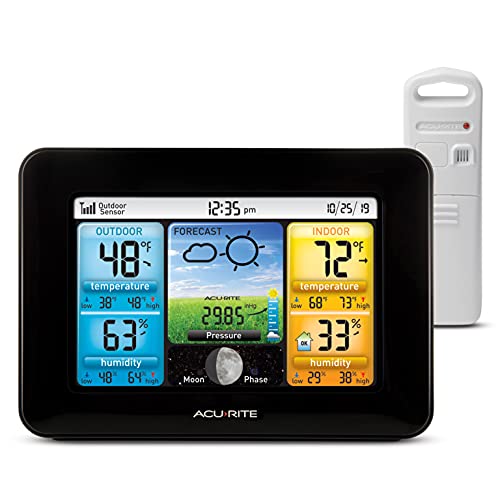
AcuRite Wireless Home Weather Station with Color Display, Indoor Outdoor Thermometer and Temperature Sensor (02077M)
Pros
- Tracks indoor and outdoor temperature and humidity
- Shows barometric pressure trends and moon phase
- 12-hour forecast based on current local conditions
- Color LCD display with adjustable dimmer
- Displays over 15 data points, including highs and lows
Cons
- Outdoor sensor needs 2 AA batteries, not included
- Requires hanging the outdoor sensor on a post or branch
- Monitors air conditions but does not humidify or purify

Pros
- Swiss-made Sensirion sensor
- Temperature accuracy is +/-0.5°F
- Humidity accuracy is +/-2%
- Wireless range up to 330 ft
- Updates data every 30 seconds
Cons
- Only one outdoor sensor is included
- Always-on backlight requires USB power
- Warranty does not include batteries

Pros
- 8 inch round dial with large numbers
- Measures -60°F to 120°F
- Weather resistant and shatterproof construction
- No batteries required
- One year limited warranty
Cons
- Temperature readings only, no humidity data
- For best accuracy, keep out of direct sunlight
- Analog dial lacks smart features
Pros
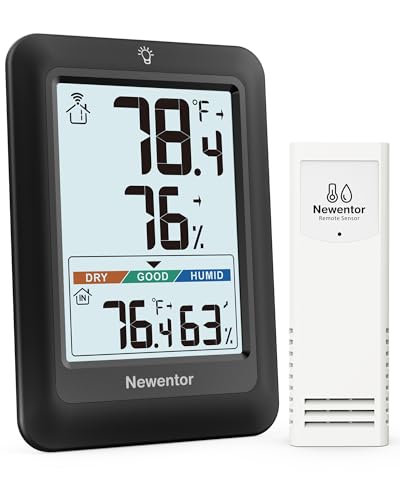
- Large bold display for quick room readings
- Comfort indicator shows Dry, Comfort, or Wet
- Tracks 24H, 48H, and all-time max/min
- 330 ft wireless range and supports up to 3 locations
- Compact 0.8 x 5 x 3.5 inch black design
Cons
- Only 1 sensor included
- Battery operated, but battery details are not listed
- No accuracy specification provided

Pros
- 500 ft wireless remote range
- Measures temperature and humidity indoors and outdoors
- Records all time and 24 hour max and min readings
- Trend arrows show warmer or colder changes
- Supports up to 3 sensors for different locations
Cons
- Includes 1 sensor; additional sensors are ordered separately
- Outdoor temperature range starts at -4°F
- Display unit is 3.1 x 2.6 x 1 inches
What We Looked For in Home Thermometers
A useful home thermometer should do more than settle a quick argument about whether to open a window. For indoor air comfort, the important questions are what it measures, how clearly it displays changes, and whether it can watch more than 1 space.
- What it measures: Most of our picks focus on temperature and humidity, which are the 2 readings most people need for comfort, storage, and mold prevention. According to the U.S. Environmental Protection Agency, indoor relative humidity is ideally between 30 and 50 percent and should stay below 60 percent. None of the main picks claim PM2.5, CO2, VOC, or radon monitoring, so readers who need those readings should look for a dedicated air quality monitor instead.
- Stated accuracy: Stated accuracy matters because a small difference can change whether a room seems dry, damp, or safe for storage. Among our picks, one model lists temperature accuracy at plus or minus 0.5 degrees Fahrenheit and humidity accuracy at plus or minus 2 percent. Another simple dial model lists a factory-calibrated temperature range from minus 60 degrees Fahrenheit to 120 degrees Fahrenheit, which is broader than many home needs but still does not add humidity accuracy.
- Display and readability: Readability is not cosmetic if the display sits across a kitchen, nursery, or garage. The DreamSky Indoor Outdoor Thermometer uses large numbers, a 5-level adjustable backlight, and includes a built-in clock. Its display size is listed at 5 by 7.9 by 1.2 inches, so it is meant to show more information than a small single-reading gauge.
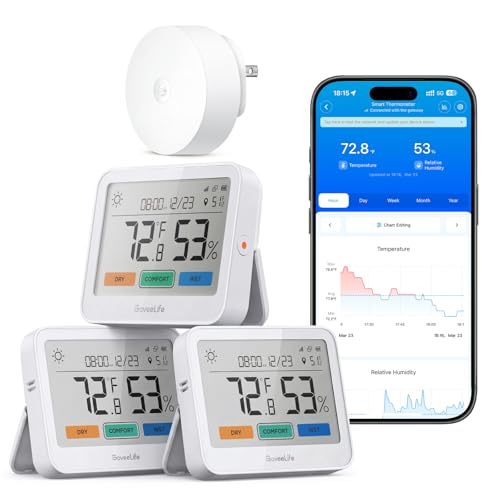
- Data history and app or smart-home support: For trends, we favored models that keep high and low records or show pressure history instead of only the current number. Across the group, some picks list 24-hour, 48-hour, or all-time maximum and minimum records, while another includes a barometric history chart. No main pick lists app control or smart-home platform support, so the comparison here is about local history on the display rather than phone alerts.
- Power source and battery life: Power affects both display brightness and where the unit can live. Some picks are battery-operated, one includes 4 AAA batteries, and another uses adapter power with battery backup. For the powered display models, battery-only use may limit the backlight, including one model that lights for 10 seconds on battery power alone.
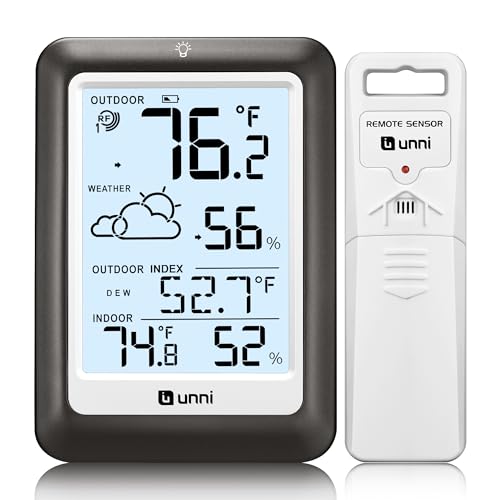
- Number of sensors or rooms: Multiroom support is helpful if you want to compare a bedroom, basement, and outdoor spot without buying separate displays. The TempPro Indoor Outdoor Thermometer measures temperature and humidity and can display readings from up to 3 sensors. The U Unni Indoor Outdoor Thermometer also supports up to 3 sensors and lists wireless transmission up to 330 feet.
We excluded dehumidifiers because they remove moisture instead of measuring it, and essential oil diffusers because their output is too small to humidify a room. We also excluded medical thermometers and meat thermometers because they are built for a different job.
Other Thermometers Worth Considering
These are other thermometers we looked at but did not put on our main list.
If you want another temperature and humidity setup, U Unni Thermometer Hygrometer stays close to the main category with support for 3 sensors. It may make sense if its size and feature mix fit your room better, but our top pick adds a built-in clock and a 5-level backlight for at-a-glance use.
For shoppers comparing simpler displays, OBET Indoor Outdoor Thermometer is another alternative to check against the main list. The tradeoff is that the available summary does not give the same concrete 3-sensor detail called out for several of our main picks, so it is harder to judge multiroom coverage from the basic listing alone.
Humidity control is the reason to look at TempPro Thermometer Hygrometer, since it adds a built-in humidistat along with temperature and humidity readings. That added control focus is useful for some rooms, but our main list keeps the emphasis on viewing indoor and outdoor readings across up to 3 sensor locations.
Prefer a more traditional indoor and outdoor thermometer from a familiar weather-instrument brand? La Crosse Technology Indoor Outdoor Thermometer is worth comparing on size and feature mix, but the summarized information gives fewer concrete numbers than our main picks. When a main pick lists details such as 330 feet or 500 feet of wireless range, it is easier to match the thermometer to a house layout.
FAQs
What should a home indoor and outdoor thermometer measure?
At minimum, temperature is the core reading, and humidity is the next most useful one for indoor comfort. The EPA says indoor relative humidity is ideally between 30 and 50 percent, which is why a humidity reading can be as important as the temperature number.
Where should the outdoor sensor go?
For the most useful reading, keep the outdoor sensor out of direct sun because direct sunlight can make temperatures read high. Among our picks, wireless range claims run from 330 feet to 500 feet, but walls and placement can affect real-world signal strength.
Do I need more than 1 sensor?
More than 1 sensor helps if your basement, nursery, garage, or porch behaves differently from the main living area. Several of our picks support up to 3 sensors, which is enough to compare 3 locations from one display.
Are smart-home features necessary for this category?
Not for basic home comfort checks. The main picks focus on local displays, high and low records, trend arrows, or pressure history rather than app or smart-home control, so they are better suited to quick glanceable readings than automation.
Sources
- Use and Care of Home Humidifiers, U.S. Environmental Protection Agency. EPA guidance on humidifier types, minerals, cleaning and safe humidity levels.
- A Guide to Mold, Moisture and Your Home, U.S. Environmental Protection Agency. EPA guide to controlling indoor moisture and mold.


Write Your Review
No reviews yet. Be the first to share your experience!