

Free Delivery. Exclusive Deals. All Prime.
Prime members save on shipping and get first access to deals, plus Prime Video included. 30 days free.
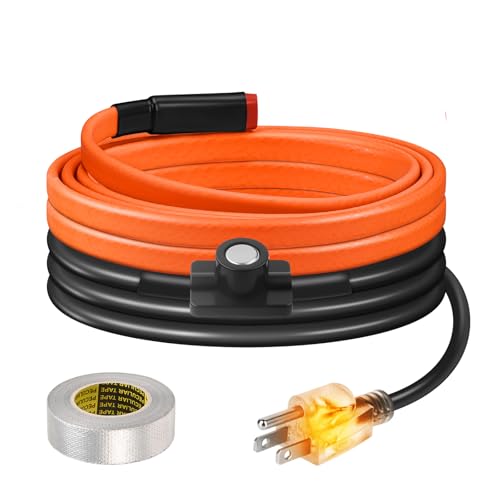
A dripping faucet left running overnight because the pipe under the kitchen sink froze solid is a familiar winter scramble for a lot of homeowners. Heat tapes for PEX pipe wrap directly around exposed lines and switch on automatically when temperatures drop, keeping water moving before a pipe ever cracks. After comparing 6 models, the Vevor Pipe Heat Tape is our top pick: it runs 12 feet, self-regulates its heat output, and plugs straight into a wall outlet with no splicing. For longer runs, the Yurnomy Pipe Heat Tape stretches to 18 feet of self-regulating cable.

Pros
- Self-regulating design automatically adjusts power based on temperature
- Built-in thermostat with ±1° accuracy activates at 43°F
- 12-foot length with flexible installation options (spiral, crossing, straight)
- IP68 waterproof rating for harsh winter conditions
- Works on PEX, PVC hoses, metal pipes, and outdoor fixtures
Cons
- 12-foot length may be insufficient for longer pipe runs
- Thermostat and entire cable must be in full contact with pipe for optimal performance
- Requires testing before installation to verify operation

Pros
- Self-regulating technology adjusts heat automatically based on temperature
- Works on pipes as cold as -40°F for extreme winter protection
- Compatible with PVC, PEX and metal pipes with multiple installation methods
- UV-resistant outer jacket resists sunlight, moisture and outdoor exposure
- Safe to overlap during installation without manual adjustment needed
Cons
- 18-foot length may not cover all pipe runs in larger homes
- Requires electricity to operate, adding to winter utility costs
- Installation on spiral or overlapping layouts needs careful planning

Pros
- 30 ft cable with 5W per foot at 120V
- Self regulating heat output based on surrounding temperature
- Rated to help protect pipes down to -40°F
- UV resistant TPE jacket for outdoor exposure
- Works with PVC, PEX and metal pipes
Cons
- Requires a 120V power source
- Listed for seasonal winter use
- Only the blue 30 ft option is specified

Pros
- 100ft bulk roll can be cut to needed lengths
- Self-regulating cable adjusts heat with temperature
- Works on metal, PEX, PVC and plastic pipes up to 2 inches
- Rated for freeze protection down to -40°F
- Includes 120V grounded plug with light indicator
Cons
- Requires connecting plug, splitter and end seal cap
- Only one accessory set is included
- Bulk roll may be better suited to pros or skilled DIYers

Pros
- Works on multiple pipe types: copper, steel, PVC, ABS, PEX and more
- Integrated thermostat automatically activates below 37F, deactivates at 50F
- Patented Glowcap feature indicates entire cable is functioning
- Commercial-grade outer jacket designed for longer durability
- Includes 36 inches of unheated cord for flexible installation
Cons
- Not suitable for outdoor use or installation inside pipes
- Thermostat must be exposed to ambient temperatures to function
- Requires ice pack testing before installation to verify operation

Pros
- Built-in thermostat automatically regulates heat up to 158°F
- Constant 4W/Ft output ensures even heat distribution along cable
- Straight-line design simplifies installation in basements and crawl spaces
- Compatible with copper, PVC, and stainless steel pipes
- 9.8 ft length covers most standard pipe runs
Cons
- Cannot be used on empty pipes or PEX pipes
- Surface gets warm during operation - avoid direct contact
- Should not be covered with insulation while operating
What We Looked for in Pipe Heat Tape for PEX Pipe Protection
Protecting PEX pipe from freezing is not a one-size-fits-all job, since a cable that is too short will not cover the run and one with the wrong certification can turn into a fire risk. Here is what moved a cable up or down our list.
- Cable length for the pipe run: Among our picks, lengths run from 9.8 feet up to 100 feet, which matters because a single exposed joint needs a very different cable than a crawl space full of branch lines. The YeloDeer Pipe Heat Tape ships as a bulk roll up to 100 feet that you cut to size, and it is rated for pipe up to 2 inches in diameter, so one roll can cover several shorter runs instead of buying separate pre-cut cables.
- Self-regulating cable or built-in thermostat: Self-regulating cable adjusts its own output as the temperature around it changes, while a thermostat-only design switches fully on or off at set points, for example 37°F on and 50°F off on one of our picks. The Rehoseup Pipe Heat Tape runs 30 feet of self-regulating cable at 5 watts per foot, so it keeps dialing heat up or down instead o f cycling completely off in a warm spell.
- Compatibility with metal or plastic (PEX, PVC) pipe: Most of our picks list PEX, PVC and metal pipe as compatible pipe material, while one 9.8 foot cable in our comparison is rated only for copper, PVC and stainless steel and specifically warns against PEX pipe. Check your pipe material before buying, since using a cable not rated for PEX can run against the maker’s own safety instructions.
- UL or CSA certification and GFCI protection: According to the U.S. Consumer Product Safety Commission, faulty electric heat tapes cause about 1,500 fires, 10 deaths and 100 injuries a year. The agency recommends grounded 3-prong plugs on outlets with GFCI protection and replacing any uncertified tape older than 3 years.
- Installation steps: Installation ranges from a straight no-overlap lay-down to spiral wraps that can cross over themselves, which changes how much cable you need for the same pipe length. The Vevor Pipe Heat Tape comes pre-assembled with a factory plug, so the 12 foot cable just lays along the pipe and plugs into an outlet, with no splicing or end caps to wire yourself.
- Weather resistance: Two of our picks use a UV-resistant TPE outer jacket rated to operate down to -40°F, which matters for cables left on outdoor hose bibs or RV lines all winter. If a cable will stay outside for months, check that the jacket is rated for sunlight exposure, not just cold, since UV breakdown is a separate failure mode from freeze protection.
We left out spray foam and caulk, since sealing a fixed gap is a different job from warming an active pipe, bidet seats, which we cover in separate guides, and space heaters, covered in our dedicated heater guides. With those filtered out, here are a few more pipe heat tapes worth a look if none of our main picks fit your run.
Other Pipe Heat Tapes Worth Considering
These are other pipe heat tapes we looked at but did not put on our main list.
If your trouble spot is a single exposed valve rather than a long run, Wabupd Pipe Heat Tape pipe heat tape covers just 3 feet with a built-in thermostat, a quarter of our top pick’s 12-foot length but enough for one joint or elbow.
Need to wrap a whole crawl space instead of one fitting? Maxkosko Pipe Heat Tape pipe heat tape runs 50 feet of self-regulating cable with a factory plug and carries CSA listing, more than 4 times the length of our top pick’s 12 feet for runs that stretch across a basement.
Somewhere between those two extremes sits Cupohus Pipe Heat Tape pipe heat tape, at 25 feet of self-regulating cable backed by a 3-year warranty, a length that splits the difference between a short patch job and a full-length roll.
FAQs
How long a pipe heat tape do I need?
It depends on the run you are protecting. Among our picks, lengths range from 9.8 feet for a single joint up to 100 feet of cut-to-length cable for longer or multiple runs, so measure the exposed pipe first and add a few feet for turns.
Is self-regulating cable better than a fixed thermostat?
Self-regulating cable continuously adjusts its own heat output as the surrounding temperature shifts, while a thermostat-controlled cable switches fully on at one temperature, such as 37°F, and off at another, such as 50°F. Self-regulating designs tend to use less energy in milder cold snaps because they do not stay at full output the whole time they are on.
Can I use a pipe heat tape on PEX pipe?
Most pipe heat tape is rated for PEX along with PVC and metal pipe, but not all of it is: at least one cable in wide circulation is rated only for copper, PVC and stainless steel and explicitly warns against PEX. Always check the pipe material list on the packaging before buying.
Do I need a GFCI outlet for pipe heat tape?
Yes. The U.S. Consumer Product Safety Commission recommends plugging heat tape into a grounded outlet with GFCI protection and replacing any uncertified cable older than 3 years, since faulty heat tape has been linked to about 1,500 fires a year.
Sources
- CPSC Re-Issues Heat Tape Guidelines In Wake Of Zoo Fire, U.S. Consumer Product Safety Commission. CPSC safety guidelines for electric pipe heat tapes.
- Consumer Guide to Air Sealing the Home, U.S. Department of Energy. DOE guide to finding and sealing air leaks at home.





Write Your Review
No reviews yet. Be the first to share your experience!