

Try Amazon Prime free for 30 days
Fast free delivery on heavy items, plus Prime Video, Prime Music and member-only deal prices.
When a garage feels like a walk-in freezer and your wrench is colder than the bolt, forced air kerosene heaters make sense because they push high-BTU heat across open work areas fast. After comparing 6 models, the Vevor 215,000 BTU Kerosene Forced Air Heater stands out for 215,000 BTU output, an adjustable thermostat and a 50.3-pound body. The Vevor 175,000 BTU Kerosene Forced Air Heater is the alternative pick with 175,000 BTU and thermostat control.

Pros
- Delivers 215,000 BTUs for large spaces up to 44,496.6 cuft
- Thermostat adjustable from 40°F to 110°F with temperature display
- Built-in overheat protection shuts off at 176°F
- 13.2 gal tank can run up to 7.5 hours per fill
- Dual fuel filters help reduce smoke and odor
Cons
- Weighs 50.27 pounds, heavier than many portable heaters
- Designed for workspaces like barns and job sites, not typical home rooms
- Burns kerosene or diesel, so fuel supply and ventilation are needed

Pros
- 175,000 BTU output for large work areas
- Heats indoor areas up to 36,021 cu ft
- 40°F to 110°F adjustable thermostat
- 13.2 gal tank runs up to 9.5 hours
- Overheat shutoff at 176°F
Cons
- Consumes 1.3 gal of fuel per hour under normal conditions
- 49.16 lb weight is less convenient to move
- Use only one fuel type at a time

Pros
- 50,000 BTUs heats up to 1,200 sq ft
- 175 CFM forced air output
- 5 gallon tank runs up to 14 hours
- Uses kerosene, fuel oil, JP8, or jet fuel
- Flame-out shut-off and overheat protection
Cons
- 29.5 lb weight may be bulky to carry
- No thermostat listed in the product data
- Fuel heater requires proper ventilation and fuel storage

Pros
- 220,000 BTU heat output
- Heats areas up to 5,500 sq. ft.
- 40°F to 110°F adjustable thermostat
- Runs on kerosene, diesel, or fuel oil
- Overheat, low-fuel, flameout, and tip-over shutoffs
Cons
- 54.3 lb weight may be hard to move often
- Large 46.8 x 19.6 x 26.3 inch body
- Fuel heater type needs proper ventilation
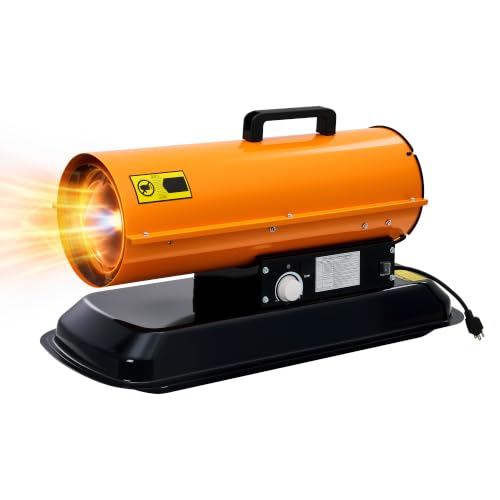
Pros
- 80,000 BTU output heats up to 2,000 sq ft
- Works with kerosene, diesel, and fuel oil
- 40°F to 110°F adjustable thermostat
- Overheat, flameout, low-fuel, and tip-over shutoffs
Cons
- 31.2 lb weight may be less convenient to move
- Up to 2,000 sq ft coverage, not for larger spaces
- 5-gallon tank requires fuel handling

Pros
- 85,000 BTU forced air output
- Heats areas up to 2,200 sq. ft.
- Thermostat range from 40°F to 110°F
- Overheat shutoff at 176°F
- Wheels and 32.2 lb body for jobsite mobility
Cons
- 1-K kerosene recommended, do not mix fuels
- Diesel use requires extra fresh-air ventilation
- 3.3 ft cord may limit placement
How We Chose Kerosene Heaters for Garage, Workshop and Backup Heat
A torpedo-style kerosene heater can warm a large work area quickly, but the same output that makes it useful also raises the stakes for clearance, ventilation and fuel handling. The right pick depends on matching BTU output to the space, then checking the safety features that help when a heater is running near tools, lumber or stored fuel.
- Heat output and coverage: Output among our picks runs from 50,000 BTU to 220,000 BTU, which is a wide spread for garages, barns and jobsite spaces. The Vevor 215,000 BTU Kerosene Forced Air Heater is our top pick because its 215,000 BTU rating gives it the strongest balance of high output, thermostat control and a listed 50.3-pound weight. Lower-output picks can be easier to place in smaller work areas, but they do not move as much heat into a large, drafty space.
- Indoor rating and oxygen depletion: We looked for heaters that clearly state where they are meant to be used, because enclosed spaces change the safety picture. The U.S. Consumer Product Safety Commission says unvented gas heaters should have an oxygen depletion sensor that shuts the heater off if oxygen drops too low. These kerosene heaters should still be treated as combustion appliances, so an indoor-use claim does not replace the need for proper ventilation and a carbon monoxide detector.
- Ventilation and carbon monoxide precautions: The CDC says to check with the local fire department that kerosene heaters are legal in your area, and it also says proper ventilation is needed if one must be used. It recommends a battery-operated carbon monoxide detector, which is especially important during a power outage when fans, doors and normal airflow may change. The U.S. Fire Administration says portable heater fires were only 3 percent of home heating fires in one span, but they accounted for 41 percent of fatal home heating fires, so clearance and supervision matter.
- Fuel type, tank size and run time: The main picks include models that run on 1-K kerosene, diesel or fuel oil, but the CDC says to use only the type of fuel the heater is designed to use. Tank capacities in the main list range from 5 gallons to 13.7 gallons, and stated run times range from 7.5 hours to 14 hours. A larger tank reduces refueling interruptions, while a smaller tank can make more sense when the heater is moved often.
- Ignition and safety shut-offs: Automatic cycling matters because a heater that can hold a set temperature needs less adjustment during long work sessions. The Specraft 80,000 BTU Kerosene Forced Air Heater combines 80,000 BTU output, coverage up to 2,000 square feet, an adjustable thermostat, tip-over protection and overheat protection. The CPSC says an automatic cut-off is required to turn off electric or kerosene heaters if they tip over, so we gave extra attention to shut-off language rather than output alone.
- Size and portability: Weight affects where the heater actually gets used, especially if it moves between a garage, barn and jobsite. The Specraft 220,000 BTU Kerosene Forced Air Heater has the highest output in the group at 220,000 BTU and a listed 54.3-pound weight, which puts it above our top pick by 4 pounds. Handles and wheels are useful, but the stated weight tells you whether one person is likely to move it comfortably.
We excluded central furnaces and whole-house systems because they need professional installation, and they solve a different heating problem. We also left out water heaters and heated blankets because they are not space heaters, and outdoor-only patio heaters because they are not rated for enclosed spaces.
Other Kerosene Heaters Worth Considering
These are other kerosene heaters we looked at but did not put on our main list.
If you want less output than our top pick but still need serious heat, the Mr. Heater 140,000 BTU Kerosene Forced Air Heater is an alternative with 140,000 BTU, an adjustable thermostat and a 10-hour timer. Its 44.1-pound weight is lighter than our top pick by 6.2 pounds, but it gives up 75,000 BTU.
For a smaller step down, the Vevor 125,000 BTU Kerosene Forced Air Heater is another alternative with 125,000 BTU and a 43-pound body. That makes it 7.3 pounds lighter than our top pick, though the output difference is 90,000 BTU, which matters in a cold barn or a high-ceiling workshop.
Prefer a heater sized more like a typical two-car garage rather than a large jobsite? The Craftsman 80,000 BTU Kerosene Forced Air Heater is rated for up to 2,000 square feet and includes an adjustable thermostat. At 26.7 pounds, it is much easier to move than our top pick, but its 80,000 BTU output is 135,000 BTU lower.
And if coverage is the reason you are shopping, the Reddy Heater RFA135CV is an alternative rated for up to 3,200 square feet with 135,000 BTU and an adjustable thermostat. Its 57.9-pound weight is 7.6 pounds heavier than our top pick, while its output is 80,000 BTU lower.
FAQs
How much BTU do I need for a garage or workshop?
Our picks range from 50,000 BTU to 220,000 BTU, so the right output depends on the size, ceiling height and draftiness of the space. A heater rated for 1,200 square feet is a different tool than one rated for 5,500 square feet.
Can I use a kerosene heater during a power outage?
Some forced-air kerosene heaters still need electricity for the fan and ignition, so check the power requirement before counting on one for backup heat. The CDC says proper ventilation is needed when using a kerosene heater, and it recommends a battery-operated carbon monoxide detector.
What clearance should I leave around a kerosene heater?
The CPSC and the U.S. Fire Administration both say to keep anything that can burn at least 3 feet from space heaters. That includes bedding, drapes, furniture and other flammable materials, and the CPSC also says to place heaters on a level, hard, nonflammable surface.
Should I choose kerosene or diesel fuel?
Several of our picks allow more than 1 fuel type, but the CDC says to use only the type of fuel the heater is designed to use. If a heater lists 1-K kerosene as recommended, that is the safer starting point unless the manual allows another fuel.
Sources
- CPSC Offers Tips to Prevent Home Fires From Space Heaters, U.S. Consumer Product Safety Commission. Fire-safety tips and required safety features for space heaters.
- Safety Guidelines: During & After a Winter Storm, Centers for Disease Control and Prevention. Winter heating safety for space heaters, kerosene heaters and carbon monoxide.
- Heating Fire Safety, U.S. Fire Administration. Home heating fire statistics and prevention messages.




Write Your Review
No reviews yet. Be the first to share your experience!