

Free Delivery. Exclusive Deals. All Prime.
Prime members save on shipping and get first access to deals, plus Prime Video included. 30 days free.
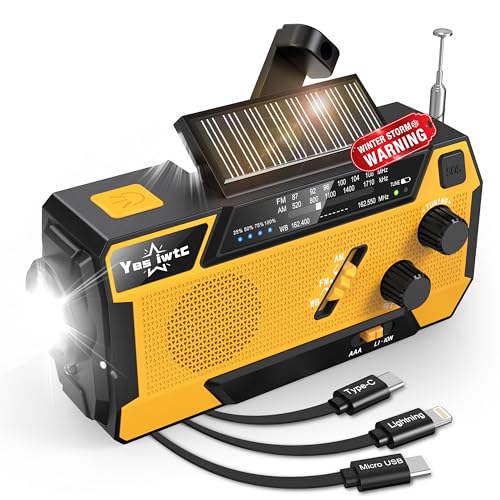
The lights blink out, the furnace goes quiet, and suddenly everyone wants to know where the batteries are. Emergency radios for power outage prep solve that by keeping weather information, light and backup power in one place. After comparing 6 models, the yesiwtc Emergency Radio stands out with a 2,000 mAh battery, NOAA weather alerts and solar charging. The Prunus Emergency Radio is the simpler alternative, with NOAA weather alerts in a compact battery radio.
Pros
- 7400mWh, 2000mAh built-in emergency battery
- Built-in Lightning, USB-C, and Micro USB cables
- 4 power sources: USB-C, crank, solar, and AAA batteries
- NOAA and AM/FM reception with extended antenna
- 3-mode flashlight plus 6 LED reading lights
Cons
- No battery runtime is listed
- No water resistance rating is listed
- AAA batteries add another item to keep on hand

Pros
- Covers 7 NOAA weather bands
- AM 520 to 1710 kHz and FM 87 to 108 MHz
- Compact 4.7 x 2.8 x 1.2 inch size
- Runs on 2 AA batteries
- Has speaker and headphone playback modes
Cons
- No automatic NOAA alert notifications
- AA battery power requires keeping spares on hand
- Only 3 manual controls, with no digital screen

Pros
- 22200mWh battery with 6000 mAh capacity
- Dual USB output for charging multiple smartphones
- Receives AM, FM, and 7 NOAA weather bands
- Type-C, solar, and hand crank charging options
- 3-mode flashlight plus SOS siren
Cons
- Green color only listed
- Solar panel and hand crank are for emergency use
- Weighs about 1.16 pounds

Pros
- NOAA, AM, FM and SW bands in one radio
- 5000 mAh built-in rechargeable battery
- 5 charging options, including solar and hand crank
- 3W flashlight and 2.5W reading lamp
- Loud SOS alarm with flashing red light
Cons
- Battery runtime is not listed
- Uses manual tuning controls
- AAA backup requires 3 AAA batteries
Pros
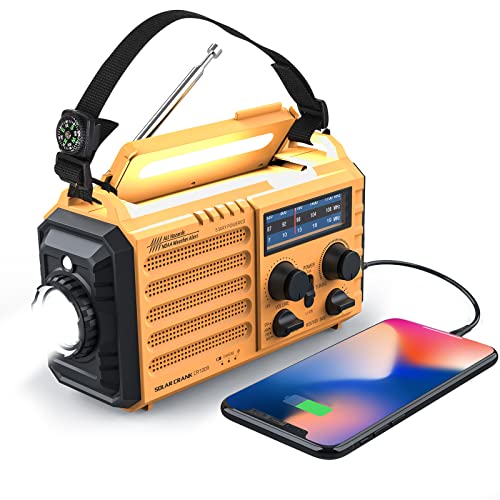
- 5000mAh battery with hand crank, solar, and AC power options
- AM, FM, SW, and 7 preset NOAA weather channels
- 3W flashlight and 2.5W reading lamp for outages
- USB device charging for a brief call or text
- Includes SOS alarm, compass, carabiner, and Micro USB charger
Cons
- Must be powered on and manually tuned to receive alerts
- Phone charging is described only for brief calls or texts
- IPX3 water resistance is limited protection

Pros
- Receives both AM and FM signals
- Can plug into wall or run on 4 AA batteries
- Large analog dial for simple tuning
- Earphone jack for private listening
- 8.2 x 2.2 x 4.6 inch portable size
Cons
- 4 AA batteries are not included
- Analog tuning lacks digital presets
- Listed under Internet Radios, but features only AM/FM
How We Chose Emergency Radios for Winter Outages
A winter outage asks more from a radio than casual background listening. It needs more than one way to stay powered, clear access to official weather information and controls that make sense when the house is cold and dark.
- Power sources and run time: For outage prep, one charging method is not enough. Among our picks, built-in battery capacity ranges from 2,000 mAh to 6,000 mAh, and several also add crank, solar and USB charging. The yesiwtc Emergency Radio pairs a 2,000 mAh battery with solar charging and a hand crank, which gives you multiple ways to keep the radio and light usable when wall power is down.
- NOAA weather alerts: The priority is access to official weather information, not just music or talk radio. According to the National Weather Service, NOAA Weather Radio All Hazards broadcasts warnings, watches, forecasts and other hazard information 24 hours a day. The Raynic Emergency Radio includes NOAA weather alerts with a 5,000 mAh battery, solar charging and a hand crank, which fits the needs of longer storm watches.
- Build and water resistance: Outage gear may sit in a closet for long stretches, then get moved around during a storm. One of our picks lists IPX3 water resistance, which matters if the radio is used near a leaking entryway or carried outside briefly. The RunningSnail Emergency Radio uses a 6,000 mAh battery and combines NOAA weather alerts with solar charging and a hand crank, giving it the highest stated battery capacity among the featured models.
- Size and weight: A radio for an emergency kit should be easy to store but not so tiny that the controls become awkward. Among our picks with listed dimensions, sizes range from 4.7 by 2.8 by 1.2 inches to 7.5 by 3.5 by 4.7 inches. Listed weights range from 0.24 pound to 1.2 pounds, so the smallest models are easier to tuck into a bag while larger ones make room for bigger lamps and batteries.
- Ease of use in the cold: Cold hands make small buttons and layered menus frustrating. We favored analog knobs, simple band selectors and designs with a few direct controls. One compact pick uses only 3 controls, while another includes a large tuning knob, which is easier to manage than scrolling through a screen during an outage.
We excluded disposable hand warmers and boot inserts because they are single use, ham radio licensing because it is outside the scope of household outage gear, and sleds pulled behind vehicles carrying people because that is unsafe. The focus here is a radio that can sit in a storm kit and still help when the power is out.
Other Emergency Radios Worth Considering
These are other emergency radios we looked at but did not put on our main list.
If you would rather compare another size and feature mix, the Panasonic Emergency Radio belongs on the broader shopping list. Its listing points to a different layout than our main picks, but without a stated battery capacity to compare against the 2,000 mAh battery in our top pick, it is harder to judge for longer outages.
For shoppers focused on reserve power, the iRonsnow Emergency Radio lists a 20,000 mAh battery, NOAA weather alerts, solar charging and a hand crank. That battery number is 10 times the capacity of our top pick, but the main list balances battery size with listed dimensions, weight and ease of use details.
Prefer a more traditional weather radio angle? The Midland Emergency Radio includes NOAA weather alerts, which is the core feature for storm information. The reason it stayed outside the main list is that the comparison details provided a different size and feature mix, while our picks gave clearer numbers for capacity, dimensions or weight.
And if the Baijiali Emergency Radio catches your eye, treat it as another alternative with a different size and feature mix. Because the comparison notes do not give a battery capacity number, it cannot be weighed as directly against our alternative pick or the 6,000 mAh model in the main list.
FAQs
Do I need NOAA weather radio for a power outage?
Yes, NOAA weather radio is one of the most important features for storm prep. The National Weather Service says the network broadcasts official warnings, watches and forecasts 24 hours a day.
Is crank charging enough during a winter outage?
Crank charging is useful as a backup, but it should not be your only plan. Our picks include models with 2,000 mAh to 6,000 mAh built-in batteries, and some also add USB and solar charging.
What size emergency radio is easiest to store?
The smallest listed model in our picks measures 4.7 by 2.8 by 1.2 inches and weighs 0.24 pound without batteries. Larger models reach 7.5 by 3.5 by 4.7 inches, which can make room for features like a reading lamp or bigger battery.
What else should be in the same outage kit?
A radio is only one part of a winter outage plan. The Centers for Disease Control and Prevention advises using electric space heaters with automatic shut-off switches, keeping space heaters at least 3 feet from drapes, furniture or bedding, and installing a battery-operated carbon monoxide detector.
Sources
- NOAA Weather Radio All Hazards, National Weather Service. NWS page on the NOAA Weather Radio network.
- Safety Guidelines: During & After a Winter Storm, Centers for Disease Control and Prevention. Winter heating safety for space heaters, kerosene heaters and carbon monoxide.




Write Your Review
No reviews yet. Be the first to share your experience!