

Free Delivery. Exclusive Deals. All Prime.
Prime members save on shipping and get first access to deals, plus Prime Video included. 30 days free.
Wet boots by the door have a way of making the whole entry smell like a locker room with worse ventilation. Boot dryers solve that by moving gentle heat or warm air into footwear so moisture does not sit overnight. After comparing 6 models, the PEET Boot Dryer is the top pick for its 36 watts, 120V plug and rubber build. The Everlasting Comfort Boot Dryer is the alternative pick for shoppers who want a rubber build with more drying stations.

Pros
- Silent drying with no fan noise
- 36W design uses less power than a low-wattage bulb
- Dries most footwear overnight with gentle airflow
- Compatible with PEET glove, mitten, helmet, and boot attachments
- Made in USA with a 25-year warranty when registered in 10 days
Cons
- Tall boots over 11 inches need extensions sold separately
- Attachments for gloves, mittens, and helmets are sold separately
- 120V US standard plug may not fit all locations
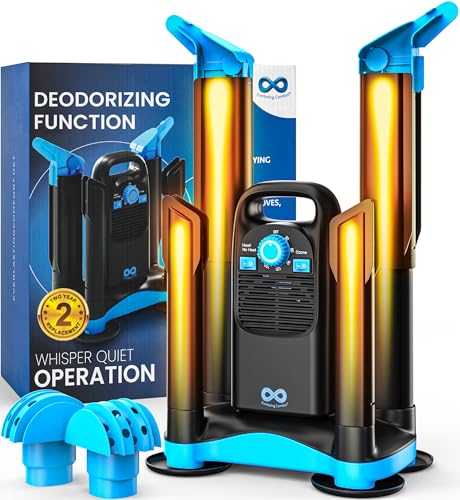
Pros
- Dries 2 pairs of boots, shoes, or gloves at once
- Ozone switch helps deodorize damp footwear and gear
- Adjustable timer up to 180 minutes
- Gentle warm air for rubber, neoprene, synthetics, and more
- Foldable forced-air design in a compact format
Cons
- Timer is limited to 180 minutes
- At 23.7 inches tall, it may need vertical storage space
- Only listed in black

Pros
- 200W forced warm air dries damp gear in about 1 to 2 hours
- Telescopic bendable ports reach toe boxes and tall shafts
- 0 to 120 minute timer with automatic shut-off
- Moderate 104 to 140°F heat for several common materials
- ETL certified with a 2-year free warranty
Cons
- Drying time varies by item and dampness
- Boot shaft fit is listed up to 21 cm
- Dual ports dry one pair or two small items at a time

Pros
- 0 dB fanless operation for silent drying
- 36W convection heat uses less power than a standard light bulb
- Dries damp footwear in about 8 hours, wet footwear in about 12
- ETL certified with overheat and overcurrent protection
Cons
- No fan or motor, so drying is slower than forced air designs
- Dries only one pair of shoes, boots, or sneakers at a time
- Warm-up takes about 30 minutes before gentle heat is noticeable

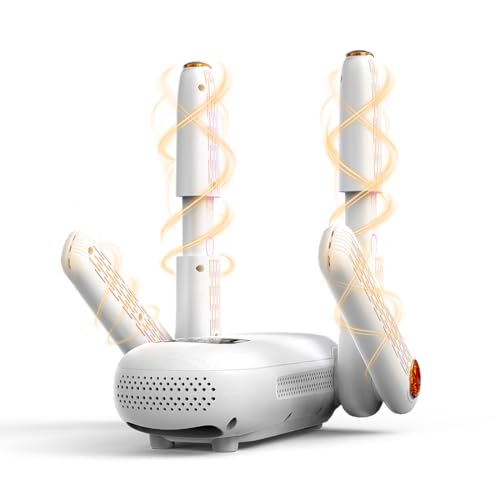
Pros
- PTC heat generator with temperature control
- 360 degree heat with vertical and horizontal air holes
- Compact 7.2 x 2 x 2.1 inch size
- Lightweight 0.61 lb design
- Cable rated to withstand 20KG pulling strength
Cons
- Only listed in white
- No wattage information provided
- No timer feature listed
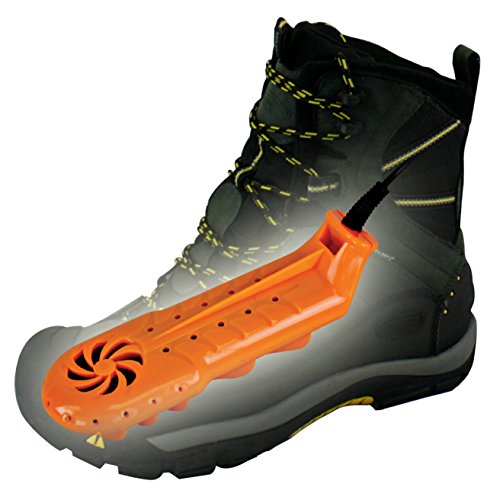
Pros
- Hybrid forced air and convection drying system
- Heats to 99 degrees for drying footwear
- AC/DC adaptor for home or car use
- Compact design fits in most footwear
- Made to avoid damage to fragile materials
Cons
- Not for use with gloves or socks
- Only listed in orange and black
- Dimensions are not provided in usable measurements
What matters in a boot dryer for wet work gear
A boot dryer has to do more than warm the outside of a boot. The useful differences are how heat moves, how much gear fits at once, whether the dryer can shut itself off, and whether it is quiet enough to run near living space.
- Drying or heating method and speed: Convection models are usually quieter and slower, while forced-air models move warm air more aggressively. The PEET Boot Dryer uses 36 watts on a 120V plug, so it is built around low-power, steady drying rather than high-output heat. Its rubber build also matters for a product that may sit in an entry, garage or mudroom near wet soles.
- How many pairs or how large an area it fits: Among our picks, capacity runs from small in-shoe units for 1 pair to standing dryers that can handle 2 pairs. One alternative pick is set up for 2 pairs at a time, which is useful when work boots and gloves come in together. A single-pair dryer can still make sense if only 1 person needs dry footwear each morning.
- Heat settings and timer: Timers help when you want drying to stop after a set session instead of running all night. The Forlim Boot Dryer uses 200 watts and has a timer that runs up to 120 minutes. Its thermostat control and ETL listing make it the most direct fit in our list for readers who want a defined drying cycle with an automatic shutoff.
- Noise: Fanless dryers can run with no motor noise, while forced-air dryers trade some sound for faster air movement. Two of our picks use 36 watts, which points to gentle, low-power drying rather than blower-style output. If the dryer will live near bedrooms or a home office, that difference matters more than it does in a garage.
- Size and storage: The most compact pick is designed to fit inside footwear and travel with AC and DC power. Standing models take more floor space, but they keep wet gear upright and away from a vent or wall. Among the listed models, boot shaft handling ranges up to 21 cm on one forced-air pick, while another standing model is sized at 22 inches tall.
- Safety listing: A dryer that runs around wet gear should have clear safety language and sensible heat control. The Lavieair Boot Dryer uses 36 watts, has an ETL listing and carries a 1-year warranty. The Centers for Disease Control and Prevention advises using electric space heaters with automatic shut-off switches and non-glowing elements, and the same caution is worth applying to any heat-producing appliance near clothing or gear.
We excluded disposable hand warmers and boot inserts because single-use items do not solve the daily drying problem. Ham radio licensing is outside the scope of a home gear guide, and sleds pulled behind vehicles carrying people are unsafe. The list focuses on plug-in dryers meant for footwear, gloves and similar wet gear.
Other boot dryers worth considering
These are other boot dryers we looked at but did not put on our main list.
If raw wattage is your main concern, Vcnfpro Boot Dryer lists 500 watts, far above the 36 watts of our top pick. That higher output may appeal to people who prioritize speed, but it is a different approach from the lower-power convection models in the main list.
For shoppers who want a lighter-duty build, Snowpea Boot Dryer uses a plastic build instead of the rubber build called out for our top pick and alternative pick. That material difference is the main reason it sits outside the main list, especially for homes where wet work boots may be used every day.
A different power setup is the main reason to notice Xcman Boot Dryer, which lists 12V and a UL listing. Compared with our top pick’s 120V setup, that points to a different size and feature mix rather than a simple one-for-one replacement.
And if high heat output is the whole reason you are shopping, Popchose Boot Dryer lists 800 watts and a rubber build. That is far higher than the 36 watts of our top pick, so it belongs in the conversation for fast drying, but it is not the same quiet, low-power style.
FAQs
How fast should a home boot dryer work?
Drying time depends on whether the dryer uses convection or forced air. In our picks, one forced-air model lists about 1 to 2 hours for damp gear, while convection models are better suited to overnight drying.
Is a quieter boot dryer better for work boots?
A quieter dryer is better if it will run near bedrooms, desks or shared living space. Fanless models avoid motor noise, while forced-air models use a blower to move warm air faster.
How much capacity do most people need?
Most single users can get by with a 1-pair dryer, especially if the same boots are used every day. Families, skiers or workers drying gloves and footwear together may benefit from a 2-pair layout.
What safety features matter for wet winter gear?
Look for a clear safety listing, heat control and an automatic shutoff when available. The CDC says electric space heaters should have automatic shut-off switches and non-glowing elements, and heat-producing gear should not be covered.
Sources
- Safety Guidelines: During & After a Winter Storm, Centers for Disease Control and Prevention. Winter heating safety for space heaters, kerosene heaters and carbon monoxide.
- NOAA Weather Radio All Hazards, National Weather Service. NWS page on the NOAA Weather Radio network.



Write Your Review
No reviews yet. Be the first to share your experience!