

Free Delivery. Exclusive Deals. All Prime.
Prime members save on shipping and get first access to deals, plus Prime Video included. 30 days free.
Wet waders left crumpled in a mudroom corner never dry on their own, and by morning they smell like a swamp and feel colder than the lake you fished. Boot dryers for waders solve this by pushing warm air through the full length of the boot instead of letting it sit damp overnight. After comparing 6 models, the PEET Boot Dryer stands out, running on 36 watts at 120V to gently dry neoprene wader material, and backed by a 25-year warranty. For a quieter overnight option, the JobSite Boot Dryer uses a fanless rubber-safe design backed by a 2-year warranty.

Pros
- Includes 2 sets of 12-inch DryPort Extensions
- 42.5-inch height with extensions for chest waders
- Dries and deodorizes in 3 to 8 hours
- No fans for silent overnight drying
- Converts to a standard 2-shoe dryer
Cons
- Glove and helmet attachments are sold separately
- 25-year warranty requires registration within 10 days
- 120V US standard plug may not suit all locations

JobSite Wader Boot Dryer - Silent Boots Dryer for Chest Waders & Waist Waders - Fanless Convection Dry - Helps Reduce Odor
Pros
- Fanless convection drying runs silently
- 36 watts uses less electricity than most light bulbs
- Warm-up in 30 minutes, damp dry time is 8 hours
- Includes 2 pairs of extender attachments
- Backed by a 2-year warranty
Cons
- Wet items can take 12 hours to dry
- No fan or motor for forced airflow
- Made for tall waders and boots, not general room drying
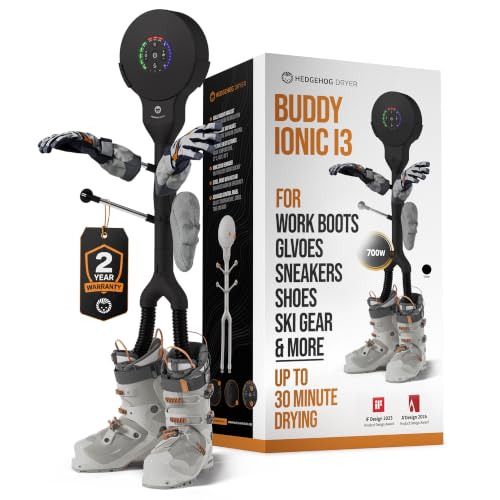
Pros
- Dries shoes and boots in 15-30 minutes
- Adjustable timer from 15 minutes to 10 hours
- No-heat option for leather footwear
- Gentle 113°F setting for ski boots and other materials
- Wall-mountable design with included brackets
Cons
- Soaked pairs may take up to 60 minutes
- Air vents must stay uncovered for best performance
- Initial freshness cycle takes about 2 hours

Pros
- 200W forced warm air dries damp gear in about 1 to 2 hours
- Telescopic bendable ports reach toe boxes and tall shafts
- 0 to 120 minute timer with automatic shut-off
- Moderate 104 to 140°F heat for several common materials
- ETL certified with a 2-year free warranty
Cons
- Drying time varies by item and dampness
- Boot shaft fit is listed up to 21 cm
- Dual ports dry one pair or two small items at a time
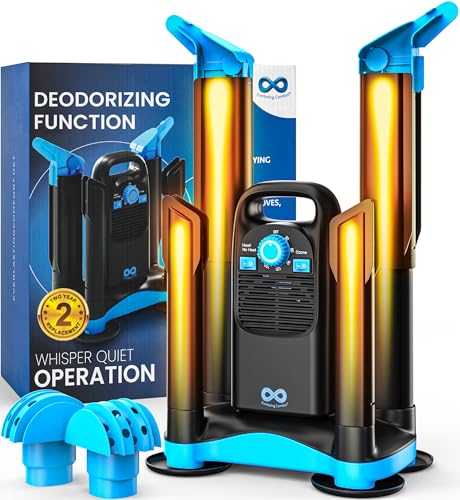
Pros
- Dries 2 pairs of boots, shoes, or gloves at once
- Ozone switch helps deodorize damp footwear and gear
- Adjustable timer up to 180 minutes
- Gentle warm air for rubber, neoprene, synthetics, and more
- Foldable forced-air design in a compact format
Cons
- Timer is limited to 180 minutes
- At 23.7 inches tall, it may need vertical storage space
- Only listed in black

Pros
- Heats to 99 degrees to help dry footwear
- Hybrid forced air and convection drying system
- Compact design packs in shoes or carry-on luggage
- Fits in most types of footwear
- Lightweight at 0.77 pounds
Cons
- Not for use with gloves or socks
- One size may not suit every footwear shape
- Limited to footwear drying and warming
How to Pick a Boot Dryer That Works for Tall Waders
Waders are taller, bulkier and more expensive to replace than a pair of sneakers, so the drying method, size and controls matter more here than with a standard shoe dryer.
- Drying method and speed: Waders need gentle, steady heat rather than a quick blast, since high heat can crack rubber or neoprene seams. The PEET Boot Dryer uses a fanless convection design that draws just 36 watts at 120V. According to the product listing, it dries a damp pair in about 3 to 8 hours, which works well left running overnight. Other picks in our list use forced-air fans that cut drying time to roughly 1 to 2 hours.
- How many pairs or how large an area it fits: A dryer that only handles one shoe at a time is not much help if you also need gloves or a second pair dry by morning. The Everlasting Comfort Boot Dryer dries two full pairs of boots, shoes or gloves at once, running on a rubber-safe heat setting with a timer that can run up to 180 minutes. Among the rest of our list, capacity ranges from single-pair units to models with removable extensions that stretch total height to 42.5 inches for tall chest waders.
- Heat settings and timer: A single fixed temperature will not suit every wader, boot or glove, so adjustable controls matter. The Forlim Boot Dryer runs on 200 watts with a thermostat that holds temperatures between 104 and 140 degrees Fahrenheit. Its mechanical timer dial shuts off anywhere from 0 to 120 minutes, so a bedtime batch does not overheat while you sleep. Among the other picks, timers stretch from a 15-minute minimum to a 10-hour maximum for all-day drying.
- Noise: A dryer running in a shared mudroom or bedroom closet all night needs to stay quiet. Among our picks, some rely on fanless convection heat with no motor at all, while forced-air models hum audibly for the 1 to 2 hours it takes to finish a cycle. If noise is a concern, a fanless design left plugged in overnight is the easier fit.
- Size and storage: Mudrooms and gear closets have limited floor space, so compact or wall-mountable units help. Height across our picks ranges from a compact tabletop unit to a tower that extends to 42.5 inches with wader extensions attached, and at least one model folds down to a travel size that weighs under 4 pounds. Wall-mountable options also free up floor space during the off-season.
- Safety listing: Any heater running unattended overnight should carry recognized certification and sensible placement. According to the Centers for Disease Control and Prevention, electric space heaters should include an automatic shut-off switch and sit at least 3 feet from drapes, bedding or furniture. Warranty coverage across our picks ranges from 2 to 25 years, which is a reasonable proxy for how confident each maker is in long-term safety and build quality.
This list leaves out disposable hand warmers and boot inserts, since they are single-use rather than reusable dryers, and it skips sleds pulled behind vehicles carrying people, which raise their own safety concerns and have nothing to do with drying gear at home. Ham radio licensing topics also fall outside what this guide covers. With those excluded, here is how a few other boot dryers stack up against our main list.
Other Boot Dryers Worth Considering
These are other boot dryers we looked at but did not put on our main list.
If you would rather compare a different footprint against our top pick’s 36-watt convection setup, the Dr.Prepare Boot Dryer offers a distinct size and feature mix worth a look on its own listing page.
Prefer an all-rubber shell to neoprene? The Kaaeiccr Boot Dryer swaps that lining for rubber, a simple material trade next to the 36-watt neoprene-safe build of our top pick above.
That contrast in materials carries over to power too. The Joytential Boot Dryer draws 200 watts with thermostat control, more than five times the 36 watts our top pick uses, trading some energy efficiency for a faster heat-up.
And if raw wattage is what you are after, the Popchose Boot Dryer goes further still, pulling 800 watts through a rubber body, over twenty times the draw of our 36-watt top pick.
FAQs
How long does it take to dry a pair of waders overnight?
Dry times across our picks range from about 3 hours for a lightly damp pair to as long as 12 hours for a fully soaked one, depending on the method. Fanless convection designs tend toward the slower end of that range, while forced-air fans can finish in as little as 1 to 2 hours.
Are boot dryers safe to leave running overnight?
According to the Centers for Disease Control and Prevention, any electric heater left running should have an automatic shut-off switch and sit at least 3 feet from bedding, drapes or furniture. It is also worth installing a battery-operated carbon monoxide detector nearby, especially in an enclosed mudroom or garage.
Will a boot dryer damage neoprene or rubber waders?
Not if the heat stays low. Across our picks, safe operating temperatures run from about 99 to 140 degrees Fahrenheit, which is gentle enough for neoprene, rubber and synthetic wader material without warping seams over repeated use.
Can I track winter storms that might keep my waders wet for days?
Yes. NOAA Weather Radio All Hazards broadcasts continuous forecasts and warnings from more than 1000 transmitters covering all 50 states, so you can plan drying time around incoming weather before it hits.
Sources
- Safety Guidelines: During & After a Winter Storm, Centers for Disease Control and Prevention. Winter heating safety for space heaters, kerosene heaters and carbon monoxide.
- NOAA Weather Radio All Hazards, National Weather Service. NWS page on the NOAA Weather Radio network.




Write Your Review
No reviews yet. Be the first to share your experience!